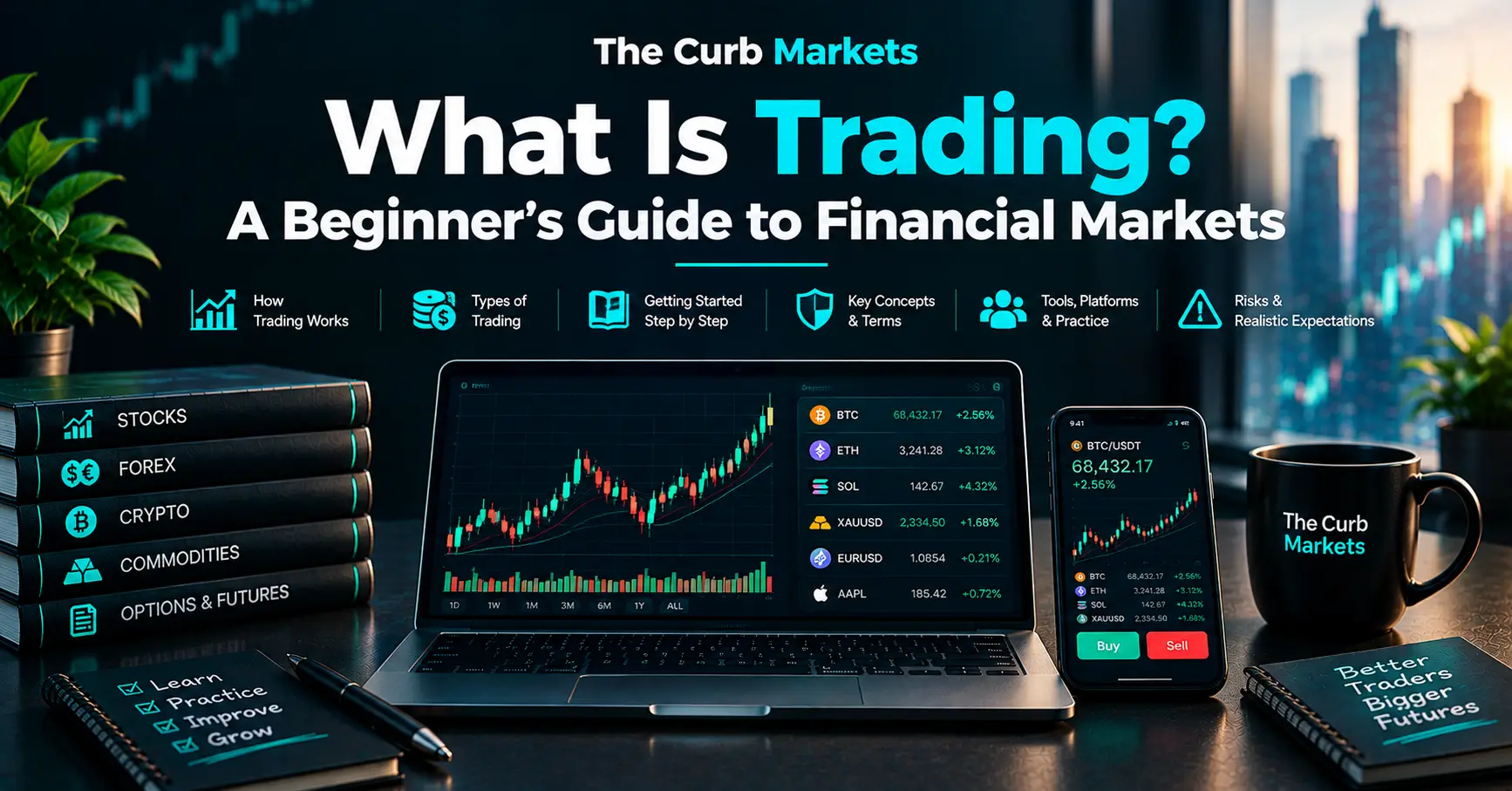
“Trading” gets used as a catch all term for a dozen different activities, and that is exactly why it confuses so many beginners. Someone might use it to describe buying a few shares of a company, running automated strategies on cryptocurrency, or placing short term bets on currency pairs overnight. All of these fall under the same word, yet they can look almost nothing alike day to day.
This guide answers the question directly: what is trading, how do financial markets actually work, and what does a genuine beginner need to know before opening an account or risking a single dollar. We will walk through the different types of trading at a high level, explain core mechanics like order types and paper trading, cover how to actually start and how to learn the skill properly, and be honest about the real risks involved along the way. By the end, you should have a clear, grounded picture of what trading is, without the hype that so much of this space is wrapped in.
What Is Trading?
Trading is the act of buying and selling financial assets, such as stocks, currencies, commodities, or cryptocurrencies, with the goal of profiting from changes in their price. A trader buys an asset expecting its price to rise, or sells an asset they believe will fall, aiming to capture the difference.
That is the core idea in a single sentence, but understanding how it actually works in practice requires a bit more context.
How Financial Markets Work
A financial market is simply a place, physical or digital, where buyers and sellers meet to trade assets. Every trade requires two sides: someone willing to buy at a given price, and someone willing to sell at that same price. Prices move constantly because buyers and sellers are continuously adjusting what they are willing to pay or accept, based on new information, sentiment, and supply and demand.
An exchange is the platform or marketplace where this buying and selling actually happens, such as the New York Stock Exchange for stocks or a cryptocurrency exchange for digital assets. Most individual traders do not access an exchange directly. Instead, they use a broker, a licensed firm that connects individual traders to the exchange and executes orders on their behalf.
Two terms come up constantly once you start looking at a live market: bid and ask. The bid is the highest price a buyer is currently willing to pay for an asset. The ask is the lowest price a seller is currently willing to accept. The difference between them is called the spread, and it represents a natural cost of trading, since a buyer typically pays the ask and a seller typically receives the bid.
Types of Trading: A Quick Overview
Trading can be categorized in two main ways: by the market being traded, and by the style or time horizon a trader uses. This section is intentionally brief. It exists to orient you, not to teach each type in depth. For a full breakdown of each category, including strategies specific to each one, see our dedicated Types of Trading guide.
By market, the most common categories are stocks, ownership shares in individual companies, forex, the trading of currency pairs against each other, crypto, digital assets like Bitcoin and Ethereum, commodities, physical goods like gold, oil, or agricultural products, options, contracts that give the right to buy or sell an asset at a set price, and futures, contracts obligating a trade at a set price on a future date.
By style, the most common categories are day trading, opening and closing positions within a single trading day, swing trading, holding positions for several days to a few weeks to capture a larger price move, and position trading, holding for months or longer based on a broader thesis about where an asset is headed.
Most beginners find it easier to first pick a market they are genuinely interested in, then explore which style fits their available time and temperament, rather than trying to absorb every combination at once.
What Is Paper Trading?
Paper trading means practicing trading using simulated money on real, live market data, without any actual capital at risk. Most brokers offer a demo account specifically for this purpose, letting you place trades, track results, and get a feel for a platform exactly as if you were trading live, minus the real financial consequence.
Why Beginners Use Paper Trading
Paper trading gives a new trader a way to learn the mechanics, placing orders, reading a chart, managing a position, without risking real money while still making mistakes. It is a genuinely useful first step for understanding how a platform works and for testing a trading plan under real market conditions before committing actual capital.
The Limitations of Paper Trading
It is worth being direct about this rather than presenting paper trading as equivalent to the real thing, because it is not. Paper trading cannot replicate the emotional pressure that comes from having real capital at risk. Watching a paper position lose money produces a very different psychological response than watching a real position lose money that could otherwise pay a bill.
Because of this gap, paper trading results are frequently better than a trader’s eventual live results. Decisions made without real financial consequence tend to be calmer and more rule following than decisions made once genuine loss is on the line. Treat strong paper trading performance as a useful signal that a strategy is at least mechanically sound, not as proof that the same results will carry over once real money enters the picture.
Price Types in Trading: Market, Limit, and Stop Orders
Before placing any trade, every trader needs to choose an order type, essentially, instructions telling a broker exactly how to execute a buy or sell. These three order types are foundational, and nearly every other trading concept builds on understanding them correctly.
Market Orders
A market order executes immediately at the best available current price. It prioritizes speed of execution over price precision, which makes it useful when getting into or out of a position quickly matters more than the exact price paid. The tradeoff is that in a fast moving or lower liquidity market, the price actually received can differ somewhat from the price seen just before placing the order.
Limit Orders
A limit order executes only at a specified price or better, never worse. A buy limit order will only fill at the specified price or lower, and a sell limit order will only fill at the specified price or higher. This gives a trader control over the exact price paid or received, with the tradeoff that the order may not fill at all if the market never reaches that price.
Stop Orders
A stop order triggers only once the market reaches a specified price, at which point it typically becomes a market order and executes at the next available price. Stop orders are most commonly used to limit losses on an existing position, automatically closing it if the market moves against the trade past a certain point, though they can also be used to enter a position once price breaks a certain level.
How Many Trading Days Are in a Year?
This is a question with two honest answers, and both matter depending on why you are asking.
Approximately 252 trading days a year is a long standing industry convention, used consistently in financial formulas such as annualized volatility calculations and the Sharpe ratio. It is a useful, stable number for modeling and comparison purposes precisely because it does not change year to year in most formulas.
The literal count for any specific calendar year, however, does change, and typically falls somewhere between 250 and 253 depending on how weekends and market holidays happen to land. As of this writing, the official NYSE calendar puts the 2026 total at 251 trading days for US cash equities and equity options, based on 10 scheduled market holidays. This specific figure should be independently verified and updated for whichever year you are reading this in, since it shifts annually and this article will not update itself automatically.
It is also worth noting that this trading day count applies specifically to US stock exchanges like the NYSE and Nasdaq, which operate on a fixed weekday schedule with holiday closures. Forex trades five days a week, nearly 24 hours a day, following markets as they open and close around the globe. Crypto markets, by contrast, trade continuously, 24 hours a day, 7 days a week, 365 days a year, with no exchange holidays or closures at all.
How to Start Trading: Step by Step
Getting started involves a fairly consistent sequence of steps, regardless of which market you eventually choose to focus on.
- Learn the basics. Understand core concepts, what is trading, how orders work, what risk actually means in this context, before opening any account or risking capital.
- Choose a market. Pick a starting point, such as stocks, forex, or crypto, based on genuine interest and available capital, rather than trying to trade everything at once.
- Open a brokerage account. Choose a regulated, reputable broker appropriate for your chosen market, and complete the account verification process.
- Practice with paper trading. Use a demo account, as covered in the Paper Trading section above, to get comfortable with the platform and test a basic plan before using real capital.
- Develop a simple trading plan. Define, in writing, what you will trade, how you will decide to enter and exit, and how much you are willing to risk per trade, before you need to make that decision live.
- Start small with real capital. Begin with an amount you are genuinely comfortable losing, treating the first stretch of live trading as a continuation of the learning process rather than a serious income attempt.
- Keep a trading journal. Record every trade, the reasoning behind it, and the outcome, since this record becomes the fastest and most honest feedback loop available for actually improving.
How to Learn Trading
Learning trading well is less about finding one perfect resource and more about combining a few different approaches consistently over time.
Free Learning Resources
A substantial amount of genuinely useful trading education is available for free: broker educational hubs, reputable financial publications, long form articles like this one, and community discussion on the mechanics and terminology covered throughout this guide. For a true beginner, free resources are usually more than enough to build a solid foundation before ever considering a paid option.
Courses and Structured Education
A genuinely useful paid course offers structure, a clear progression from basics to more advanced material, and some form of feedback or review on your own decisions, rather than simply access to information that is otherwise freely available elsewhere.
Watch for warning signs in course marketing specifically. Guaranteed returns are not something any honest course can promise, since markets involve genuine uncertainty. High pressure, limited time sales tactics, “enroll in the next hour or miss the price,” have far more in common with general sales pressure than with legitimate financial education.
Learning by Doing
Paper trading and keeping a trading journal, as covered above, together form the fastest feedback loop available for actually improving as a trader. Reading about a concept is useful, but applying it, tracking the result, and reviewing what happened tends to build real skill far faster than passive study alone.
Common Mistakes When Learning to Trade
A few mistakes show up repeatedly among beginners. Skipping the basics and jumping straight into advanced strategies or specific setups, without first understanding order types and how markets actually work, tends to produce confusion rather than progress. Rushing to real capital before spending meaningful time in a demo account often means learning expensive lessons that could have been learned for free. Trying to learn every market and every strategy at once, rather than building depth in one area first, tends to leave a beginner with shallow knowledge across the board rather than genuine competence anywhere.
Trading vs. Investing: What’s the Difference?
Trading and investing both involve buying and selling financial assets, but they differ meaningfully in horizon and approach. Trading is generally shorter horizon and more active, involving frequent decisions and a focus on shorter term price movement. Investing is generally longer horizon and less active, often built around holding assets for years based on a belief in their long term value or growth.
The line between the two is not always sharp. A position trader holding for several months looks, in practice, closer to an investor than a day trader does, even though both technically fall under the broader “trading” umbrella. Neither approach is inherently superior. They simply serve different goals, time commitments, and risk tolerances.
Basic Trading Terminology Every Beginner Should Know
A short glossary of terms that come up constantly, worth knowing before diving deeper into any specific market.
Bid and ask. The bid is the highest price a buyer is currently willing to pay. The ask is the lowest price a seller is currently willing to accept.
Spread. The difference between the bid and ask price, representing a natural cost built into most trades.
Volume. The total number of shares, contracts, or units traded over a given period, used as a measure of how active a market currently is.
Liquidity. How easily an asset can be bought or sold without significantly moving its price. Highly liquid markets tend to have tighter spreads and smoother execution.
Volatility. A measure of how much and how quickly an asset’s price moves over a given period. Higher volatility generally means larger potential price swings in either direction.
Bull market. A period characterized by rising prices and generally positive sentiment across a market.
Bear market. A period characterized by falling prices and generally negative sentiment across a market.
Broker. A licensed firm or platform that connects individual traders to an exchange and executes orders on their behalf.
Exchange. The marketplace, physical or digital, where the actual buying and selling of an asset takes place.
Risks of Trading
Trading carries genuine financial risk, and it is worth being direct about what that actually means rather than glossing over it.
Capital loss risk applies to every trade, and in some cases the loss can be total, particularly with certain options strategies or highly leveraged positions. Leverage, where applicable, allows a trader to control a larger position than their actual capital would otherwise support, and while this can amplify gains, it equally amplifies losses, sometimes beyond the amount originally deposited depending on the specific product and broker terms.
There is also the psychological gap covered earlier in the Paper Trading section: real capital at risk produces real emotional pressure that a demo account simply cannot replicate, and this gap catches a lot of otherwise well prepared beginners off guard during their first stretch of live trading.
This article is educational content, not financial advice. Trading involves real risk of loss, and nothing in this guide should be taken as a recommendation to buy, sell, or hold any specific asset. Anyone considering trading should evaluate their own financial situation and risk tolerance, and consider speaking with a qualified financial professional before committing real capital.
Frequently Asked Questions
Is trading hard to learn for beginners?
The basics, what trading is, how orders work, how markets function, are genuinely learnable by anyone willing to put in consistent time. Becoming consistently skilled takes considerably longer and typically requires real practice, not just reading, so expect a real learning curve rather than instant competence.
How much money do I need to start trading?
This varies enormously by market and broker, and many brokers now allow accounts to be opened with very small amounts, sometimes even fractional shares in the case of stocks. What matters more than the starting amount is only using money you can genuinely afford to lose while you are still learning.
Can I learn trading on my own without a course?
Yes. A significant amount of solid, freely available education exists, covering everything from basic terminology to order types to risk management. A course is not a requirement to learn the fundamentals, though a genuinely good one can add structure and feedback for some learners.
Is paper trading a good way to prepare for real trading?
It is a genuinely useful starting step for learning platform mechanics and testing a basic plan, but it has real limitations, most notably that it cannot replicate the emotional pressure of real capital at risk, as covered earlier in this guide. Treat it as one part of preparation, not the final test.
How long does it take to learn to trade?
This varies significantly based on time invested and the market chosen, but many beginners report a meaningful improvement in understanding after several months of consistent, deliberate practice. Genuine, repeatable skill across varying market conditions typically takes considerably longer than that.
What is the difference between a broker and an exchange?
An exchange is the actual marketplace where buying and selling occurs. A broker is the licensed firm that gives individual traders access to that exchange, executing orders on their behalf and typically providing the platform most beginners actually interact with day to day.
Do I need to understand every order type before I start trading?
At minimum, understanding market, limit, and stop orders, as covered in this guide, is genuinely foundational, since nearly every other trading concept builds on these three. More advanced order types exist, but they can generally be learned later as they become relevant.
Is trading the same as gambling?
Trading and gambling both involve risk and uncertain outcomes, but they differ in an important way: trading, done well, involves analysis, a defined plan, and risk management aimed at producing a favorable outcome over time, whereas gambling outcomes are typically governed by fixed odds that do not respond to skill or analysis in the same way. That said, trading without a plan or without proper risk management can behave a great deal like gambling in practice.
Conclusion
Trading is learnable, but it rewards starting with fundamentals over chasing shortcuts. Understanding what trading actually is, how orders work, what paper trading can and cannot teach you, and how to build a simple plan will serve you far better in the long run than jumping straight into live trades on a market you do not yet understand.
Treat your first several months as a genuine learning period rather than a serious income attempt. Practice with paper trading, keep a journal, start small once you do move to real capital, and build your knowledge one solid layer at a time rather than trying to absorb everything about trading at once. That patient approach is a far more reliable path than any shortcut you are likely to come across.