Disclaimer: This article is for educational purposes only and does not constitute financial, investment, or tax advice. Options trading carries significant risk, including the potential loss of your entire investment, and is not suitable for every investor. Consult a licensed financial advisor before making any trading decisions.
Options let a trader profit from a stock’s movement, up, down, or sideways, without ever having to buy the stock itself, and with a fraction of the capital that owning the shares outright would require. That flexibility is exactly why options trading attracts so many beginners, and exactly why it trips up so many of them.
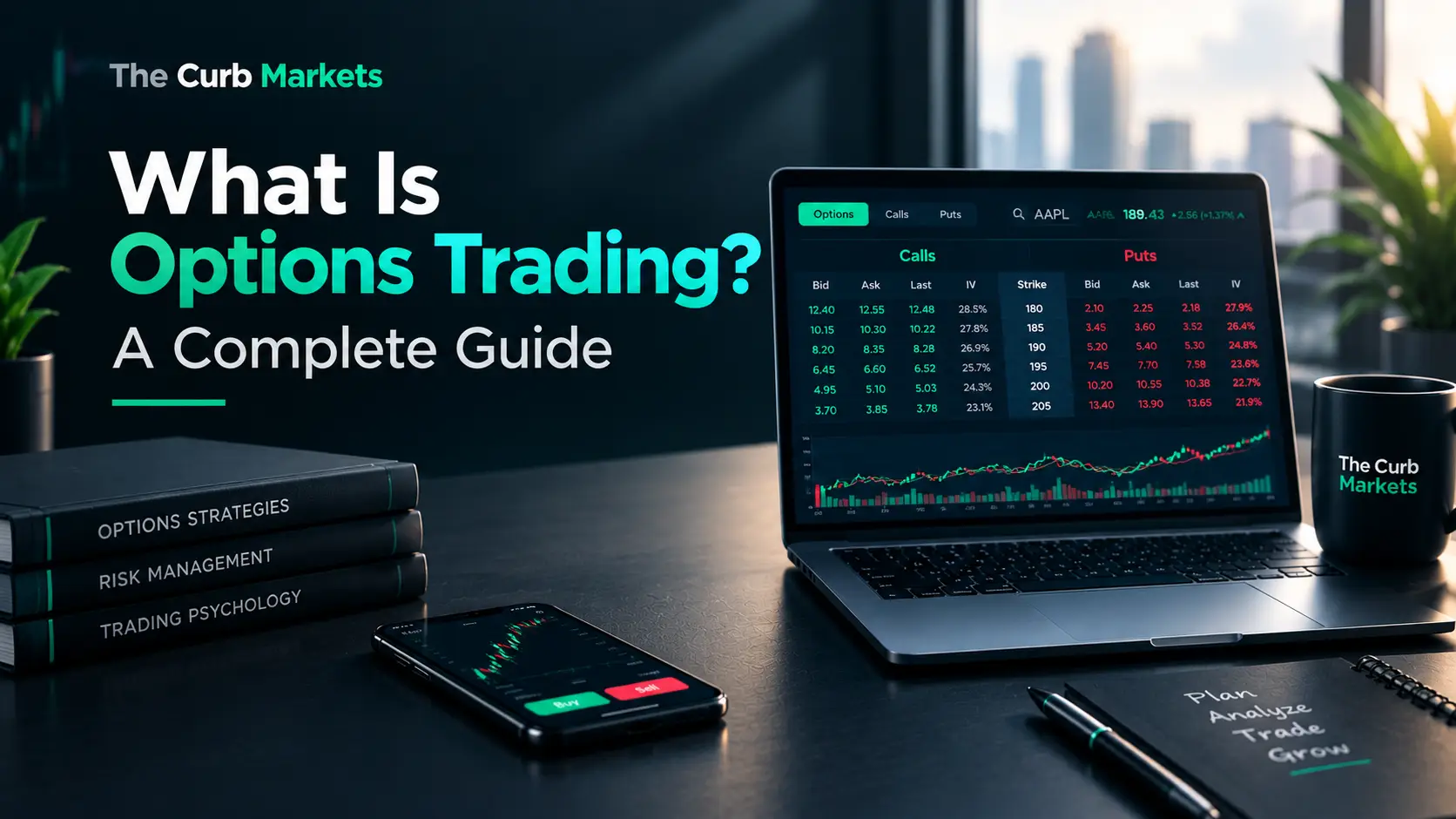
Options trading is the buying and selling of contracts that give the holder the right, but not the obligation, to buy or sell an underlying asset, typically a stock, ETF, or index, at a specified price on or before a specified date. That single distinction, right instead of obligation, is what separates an option from simply owning a stock, and it’s the foundation everything else in this guide builds on.
This guide walks through what options trading actually is, how the mechanics work, the strategies traders use most often, the Greeks that quietly drive an option’s price, where options can be traded, the tools involved, the real risks, and a realistic step-by-step path to getting started — carefully, and without more capital at risk than you can afford to lose.
What Is Options Trading?
An option is a contract between two parties. The buyer pays a price, called the premium, for the right to buy or sell a specific asset at a specific price before a specific date. The seller (or “writer”) of that contract collects the premium and takes on the obligation to fulfill the trade if the buyer chooses to exercise their right.
That’s the whole concept in one paragraph. Everything else in options trading is a variation, combination, or refinement of that basic structure.
Calls vs. Puts
There are only two basic types of options contracts, and understanding both is the entry point to everything else.
A call option gives its buyer the right to buy the underlying asset at a set price. Traders buy calls when they expect the price of the underlying asset to rise — a call becomes more valuable as the stock climbs above the agreed price.
A put option gives its buyer the right to sell the underlying asset at a set price. Traders buy puts when they expect the price to fall, a put becomes more valuable as the stock drops below the agreed price.
Every option is either a call or a put, and every trader in that contract is either a buyer or a seller, which means there are four basic positions in options trading: buying a call, selling a call, buying a put, and selling a put. Each carries a different risk and reward profile, which we’ll cover shortly.
Why Traders Use Options
Options aren’t used for just one purpose, three distinct motivations show up repeatedly:
- Speculation: betting on the direction (or magnitude, or timing) of a price move, often with less capital than buying the stock outright would require.
- Income generation: collecting premium by selling options against stock a trader already owns, or against cash set aside to buy a stock.
- Hedging: using options to protect an existing stock position from a potential downside move, similar in spirit to buying insurance.
These aren’t mutually exclusive, and many experienced traders use options for more than one of these purposes depending on the position and their broader portfolio.
How Options Trading Works
The mechanics of an options contract can look intimidating at first glance, largely because of the vocabulary. Once the core terms are defined, the logic is fairly straightforward.
Strike Price and Expiration Date
The strike price is the fixed price at which the option holder can buy (for a call) or sell (for a put) the underlying asset. It’s set when the contract is created and doesn’t change for the life of that contract.
The expiration date is the last date the option can be exercised. After that date, the contract ceases to exist, it either gets exercised, gets assigned, or simply expires worthless. Options can expire anywhere from the same day they’re opened (so-called zero-days-to-expiration, or “0DTE,” contracts) to months or even years out, depending on the contract.
Together, the strike price and expiration date define exactly what a trader is betting on: not just direction, but a specific price level by a specific point in time — which is a meaningfully harder bet to win than simply guessing whether a stock goes up or down eventually.
The Premium
The premium is the price the option buyer pays the seller for the contract, it’s quoted per share, but standard equity option contracts represent 100 shares, so a premium of $2.00 typically means $200 for one contract.
An option’s premium is made up of two components:
- Intrinsic value: the amount by which the option is already profitable based on the current price of the underlying asset relative to the strike price. Out-of-the-money options (explained below) have zero intrinsic value.
- Time value: the additional amount buyers are willing to pay for the possibility that the option becomes more profitable before expiration. Time value shrinks as expiration approaches, a phenomenon covered in more detail in the Greeks section below.
Several factors influence how expensive a premium is: how far the strike price is from the current price, how much time remains until expiration, and how volatile the underlying asset is expected to be. More time and more expected volatility both generally mean a higher premium.
In the Money, At the Money, Out of the Money
These three terms describe an option’s strike price relative to the underlying asset’s current price, and they come up constantly in options trading discussions.
- In the money (ITM): the option already has intrinsic value. For a call, this means the stock price is above the strike price; for a put, it means the stock price is below the strike price.
- At the money (ATM): the strike price is at or very close to the current stock price.
- Out of the money (OTM): the option currently has no intrinsic value. For a call, the stock price is below the strike; for a put, it’s above the strike. OTM options are generally cheaper, but require a bigger move to become profitable.
Exercise vs. Assignment
Exercise is what happens when an option buyer chooses to use their right, buying the underlying asset at the strike price (for a call) or selling it at the strike price (for a put).
Assignment is what happens to the option seller when a buyer exercises their contract, the seller is now obligated to fulfill their side of the deal, buying or selling the underlying asset at the strike price, whether or not that’s currently favorable for them.
Most retail options traders never actually exercise or get assigned, the majority of contracts are bought and sold for their changing premium value and closed out before expiration. But understanding what exercise and assignment mean matters, because it’s the underlying mechanism that gives an option its value in the first place, and every option holder should understand what happens if a contract runs to expiration.
Payoff at a glance: a call buyer profits as the stock rises above the strike price plus the premium paid; a put buyer profits as the stock falls below the strike price minus the premium paid. In both cases, the most a buyer can lose is the premium they paid, a boundary that doesn’t exist in the same way for option sellers, which is a critical distinction covered in the risks section.
Options Trading vs. Stock Trading vs. Futures Trading
Options sit in an interesting middle ground between owning stock directly and trading futures contracts, sharing some traits with each, but distinct from both.
| Options Trading | Stock Trading | Futures Trading | |
|---|---|---|---|
| Ownership | Right, not obligation | Direct ownership of shares | Obligation to buy/sell at settlement |
| Capital needed | Lower — typically just the premium | Full share price | Margin-based, often highly leveraged |
| Time decay risk | Yes — value erodes as expiration nears | No | No |
| Complexity | High | Low | High |
| Maximum loss (buyer) | Limited to premium paid | Can lose full investment (stock to $0) | Can exceed initial margin deposited |
| Expiration | Yes — contracts expire | No — shares can be held indefinitely | Yes — contracts expire or settle |
Options tend to make the most sense relative to plain stock ownership when a trader wants defined, limited risk on a directional bet (as a buyer), wants to generate income against stock they already hold, or wants to hedge an existing position without selling it outright. Straightforward stock ownership tends to make more sense for investors who want simplicity, don’t want to manage an expiration date, and are comfortable with the more linear risk of simply owning the shares. Futures generally involve more leverage and more complexity than either, and typically suit more advanced, well-capitalized traders.
Common Options Trading Strategies
Options strategies range from simple, single-contract positions to multi-leg combinations designed for very specific market outlooks. The five below are among the most commonly used and are a reasonable place for a beginner to start building familiarity, even before attempting any of them with real money.
Covered Call
A covered call involves owning at least 100 shares of a stock and selling a call option against those shares. The trader collects the premium upfront as income, in exchange for capping their upside if the stock rises above the strike price.
Example: A trader owns 100 shares of a stock trading at $50 and sells a call with a $55 strike for a $1.50 premium ($150 total). If the stock stays below $55, they keep the premium as income. If it rises above $55, their shares are likely called away — sold at $55 — meaning they still profit from the stock’s rise up to that point plus the premium, but miss out on any gain above $55.
This strategy is generally used by investors who already hold a stock, are comfortable selling it at a set price, and want to generate some income while they wait.
Protective Put
A protective put involves owning shares of a stock and buying a put option on that same stock, functioning much like an insurance policy against a decline in price.
Example: A trader owns 100 shares at $50 and buys a put with a $45 strike for a $1.00 premium ($100 total). If the stock falls sharply, the put gains value, offsetting losses on the shares below $45. If the stock rises instead, the trader loses only the premium paid, while their shares continue to gain value.
This strategy suits investors who want to stay invested in a stock they believe in long-term, but want to limit their downside during a period of uncertainty.
Long Straddle
A long straddle involves buying both a call and a put at the same strike price and expiration date, profiting from a large price move in either direction.
Example: A trader expects a company’s earnings report to cause a big move but isn’t sure which direction. They buy a call and a put at the $100 strike, each for $3.00 ($600 total for both). If the stock moves sharply above or below $100 by enough to cover the combined premium, the position profits; if the stock stays close to $100, both options lose value and the trader loses most or all of the premium paid.
This strategy suits traders anticipating high volatility around a specific event, rather than a directional bet on which way the price will move.
Iron Condor
An iron condor is a four-leg strategy combining a call spread and a put spread, designed to profit when a stock stays within a defined price range through expiration.
Example: With a stock trading at $100, a trader might sell a $105 call and buy a $110 call (a call spread), while also selling a $95 put and buying a $90 put (a put spread), collecting net premium from all four legs combined. If the stock stays between $95 and $105 through expiration, the trader keeps the premium collected. If the stock moves sharply beyond either the $90 or $110 boundary, losses are capped by the long options, but can still be meaningful.
This is a more advanced, multi-leg strategy generally suited to traders who expect low volatility and want to define their maximum risk and reward before entering the trade.
Credit Spread
A credit spread involves simultaneously selling one option and buying another option of the same type (both calls or both puts) at a different strike, with the same expiration date, collecting net premium upfront.
Example: A trader who expects a stock to stay below $100 might sell a $100 call and buy a $105 call, collecting the net difference in premium. If the stock stays below $100 through expiration, both options expire worthless and the trader keeps the full credit received. If the stock rises above $105, the loss is capped at the difference between the two strikes, minus the premium collected.
Credit spreads are popular because they define maximum risk upfront (unlike selling a single “naked” option, discussed in the risks section) while still allowing a trader to collect premium as income.
Understanding the Options Greeks
The “Greeks” are a set of values that describe how an option’s price is expected to change in response to different factors. They can look mathematically intimidating, but the underlying concepts are approachable, and every options trader should have at least a working, conceptual grasp of them before trading live.
Delta
Delta measures how much an option’s price is expected to move for every $1 move in the underlying stock. A call option with a delta of 0.50 would be expected to gain roughly $0.50 in value if the stock rises $1. Delta is also commonly used as a rough proxy for the probability that an option will expire in the money, a delta of 0.30 suggests roughly a 30% chance, though this is an approximation, not a guarantee.
Theta
Theta measures how much value an option loses each day purely due to the passage of time, all else being equal, commonly called “time decay.” Theta works against option buyers, whose contracts lose value as expiration approaches, and works in favor of option sellers, who benefit from that same decay. Theta accelerates as expiration gets closer, which is a big part of why short-dated options can lose value quickly even when the underlying stock barely moves.
Gamma
Gamma measures how much an option’s delta is expected to change for every $1 move in the underlying stock. In practical terms, gamma tells you how quickly your directional exposure (delta) is changing, options that are at the money and close to expiration tend to have the highest gamma, meaning their sensitivity to price moves can shift rapidly.
Vega
Vega measures how sensitive an option’s price is to changes in the underlying asset’s implied volatility, the market’s expectation of how much the price will move going forward. Rising implied volatility generally increases an option’s premium (all else equal), which benefits option buyers and works against option sellers; falling volatility does the opposite.
Together, these four Greeks explain the majority of what moves an option’s price day to day, and experienced traders use them together, not in isolation, to understand a position’s full risk profile.
Where You Can Trade Options
Options aren’t limited to individual company stocks, several distinct categories of underlying assets have their own options markets, each with different characteristics.
Stock Options
The most common and familiar category, options written on individual company stocks. Liquidity varies enormously depending on the company; options on large, widely traded companies tend to have tight bid-ask spreads and deep markets, while options on smaller or less-followed companies can be thin and expensive to trade in and out of.
Index Options
Index options are written on a broad market index rather than a single company, offering exposure to the overall direction of a market segment without picking individual stocks. These are frequently used by traders looking to hedge a diversified portfolio or express a view on the broader market, and many are cash-settled rather than resulting in delivery of an underlying asset.
ETF Options
ETF (exchange-traded fund) options are written on shares of an ETF, which itself holds a basket of underlying assets, offering a middle ground between the single-stock focus of stock options and the broad exposure of index options. Options on the most widely traded ETFs tend to be highly liquid, making them a common starting point for beginners.
A brief note on liquidity: across all three categories, liquidity directly affects trading cost. Highly liquid options (large companies, major indexes, popular ETFs) generally have tighter bid-ask spreads, while thinly traded options can be expensive to enter and exit even if the underlying price move goes exactly as predicted. Sticking to liquid underlying assets is one of the simplest ways beginners can reduce unnecessary cost.
Tools and Platforms for Options Trading
Options trading requires more from a platform than basic stock trading does, largely because of the added dimensions, strike, expiration, and the Greeks, that a trader needs visibility into before placing a trade.
Options chains display all available strike prices and expiration dates for a given underlying asset, along with real-time (or delayed, depending on the platform) pricing, volume, and open interest for each contract. A clear, well-organized options chain is essential for comparing contracts before choosing one.
Real-time Greeks: delta, theta, gamma, and vega figures displayed directly on the platform, help traders understand a position’s sensitivity to price, time, and volatility without manually calculating them. Not every platform offers this by default, and it’s worth checking for before committing to one.
Paper trading mode: lets a trader practice placing options trades with simulated money in real market conditions, an especially important feature for options given how much more there is to get wrong compared to a simple stock trade (choosing the wrong strike, misjudging time decay, or misunderstanding a multi-leg strategy, for example).
Beyond these options-specific features, the same general considerations from evaluating any trading platform still apply: execution speed, fee structure (including per-contract fees, which are common for options and can add up with multi-leg strategies), and platform reliability during volatile periods.
This guide intentionally avoids recommending specific brokers, since features, fees, and options-approval requirements change over time. Compare current offerings directly, and pay particular attention to per-contract fees and Greeks availability, since both vary significantly between platforms.
Risks of Options Trading
Options trading carries risks that are meaningfully different, and in some cases more severe, than the risks of simply owning stock, and this section deserves careful attention before anyone considers trading with real capital.
Time Decay Working Against Buyers
As covered in the Greeks section, theta erodes an option’s value every day, all else being equal. This means an option buyer isn’t just betting on direction, they’re racing against the clock. A stock can move in the direction a trader predicted and the option can still lose money, if that move happens too slowly relative to how much time is left before expiration.
Total Premium Loss for Buyers
When you buy an option, call or put, the maximum you can lose is the premium you paid. That’s a defined, capped risk, which is one of the genuine appeals of buying options. But it’s important to understand that “capped” doesn’t mean “small” options can and frequently do expire completely worthless, meaning a 100% loss of the capital put into that specific trade. This isn’t a rare edge case; a large share of out-of-the-money options expire worthless as a matter of course.
Unlimited or Large Loss Risk for Uncovered Sellers
This is arguably the single most important risk distinction in options trading, and one beginners must understand clearly before selling any option. When you sell a call option without owning the underlying stock (known as selling a “naked” or “uncovered” call), your potential loss is theoretically unlimited, because there’s no cap on how high a stock’s price can rise. Selling a naked put carries substantial, though technically capped, downside risk — a stock can only fall to zero, but that’s still a large potential loss relative to the premium collected. Covered strategies, like the covered call and credit spread strategies described earlier, exist specifically to define and limit this risk, but any options strategy involving selling uncovered options should be approached with extreme caution, and generally isn’t appropriate for beginners.
Complexity Risk
Options introduce several additional variables that simple stock trading doesn’t, strike selection, expiration timing, implied volatility, and the interacting effects of the Greeks. Multi-leg strategies compound this further, since a trader has to correctly manage several moving parts simultaneously rather than one straightforward buy-or-sell decision. This complexity is a real risk factor on its own: it’s substantially easier to make a costly mistake in options trading, misjudging an expiration date, misunderstanding assignment risk, or misreading a multi-leg position’s true exposure — than in simple stock ownership.
Options trading is not inherently a bad idea, and it’s not gambling by definition, but it is a more complex, faster-moving, and in some configurations far riskier activity than owning stock outright, and it deserves to be approached with real caution, thorough education, and a clear understanding of maximum potential loss before any position is opened.
If you find yourself trading larger or more frequently than your plan calls for, or feel your trading is becoming difficult to control, it’s worth speaking with a licensed financial counselor, this is a legitimate and fairly common issue among active traders, not a personal failing.
Options Trading and Taxes
Tax treatment of options trading is genuinely complex and varies not just by country, but often by the specific strategy used, so this section is intentionally a brief overview rather than a complete guide.
In the United States, options are generally taxed based on how the position is closed, whether the option expires, is exercised, is assigned, or is sold before expiration, and whether the resulting gain or loss is treated as short-term or long-term can depend on holding periods and, in some cases, the specific type of option involved (certain index options, for example, can receive different tax treatment than equity options under U.S. tax rules). Multi-leg strategies can add further complexity, since each leg may be treated somewhat differently depending on the outcome.
Outside the U.S., tax treatment of derivatives like options varies widely — some countries tax options gains as regular capital gains, some apply different rules to derivatives specifically, and some have reporting requirements distinct from standard stock trading. Because this area is both complex and country-specific, this article won’t attempt to summarize it in full. Consult a qualified tax professional familiar with derivatives taxation in your own country before trading options, and keep detailed records of every position, including multi-leg trades, from the start, since reconstructing complex options activity at tax time is considerably harder than logging it as you go.
How to Get Started with Options Trading
For anyone who has weighed the risks above and still wants to learn options trading properly, here is a realistic, responsible starting path.
- Learn the fundamentals thoroughly before opening any position. Make sure you genuinely understand calls, puts, strike prices, expiration, premium, and at least the conceptual basics of the Greeks covered above. Options punish gaps in understanding more quickly than stock trading does.
- Get approved for options trading with a broker. Most brokers require a separate approval process for options accounts, often with different tiers of approval depending on strategy complexity (for example, covered calls typically require lower approval than uncovered option selling). Be honest about your experience level during this process, it exists to protect you, not just the broker.
- Paper trade extensively before using real money. Practice placing trades, including multi-leg strategies, in a simulator that reflects real market pricing. Pay close attention to how time decay affects your paper positions day to day, since that’s one of the harder concepts to internalize without watching it happen.
- Start with simple, defined-risk strategies. Buying a single call or put, or starting with a covered call on stock you already own, involves far less complexity than multi-leg strategies like iron condors. Build genuine, tested understanding before layering in more complex positions.
- Manage position size deliberately. Because options can move a large percentage in a short time, it’s easy to risk more of your account on a single position than you intend to. Decide, before entering any trade, exactly what percentage of your capital that specific position represents and stick to it.
- Understand your maximum loss before every trade, not after. For any position you’re considering, work out, in dollars, not just percentages, the absolute worst-case outcome before you place it. If you can’t clearly answer that question, you’re not ready to enter that specific trade yet.
- Track and review every trade. Log strikes, expirations, entry and exit prices, and your reasoning for the trade. Reviewing this over time is how disciplined options traders identify what’s actually working, rather than relying on memory or feel.
Pros and Cons of Options Trading
| Pros | Cons |
|---|---|
| Defined, capped risk when buying options (limited to premium paid) | Time decay works against buyers regardless of whether their direction is eventually correct |
| Lower upfront capital required than buying shares outright | Selling uncovered options can carry very large or theoretically unlimited loss potential |
| Flexibility to profit from upward, downward, or sideways markets depending on strategy | Meaningfully steeper learning curve than stock trading |
| Useful for hedging existing stock positions against downside risk | Options frequently expire worthless, especially out-of-the-money contracts |
| Can generate income against stock already owned (e.g., covered calls) | Multi-leg strategies add complexity that increases the chance of costly mistakes |
| Wide range of strategies for different market outlooks and risk tolerances | Additional fees (often per-contract) can add up, especially with frequent or multi-leg trading |
Options trading offers genuine strategic flexibility that stock ownership alone doesn’t — but that flexibility comes paired with real complexity and, in certain configurations, real risk of outsized loss. Neither side of this table should be read in isolation.
Frequently Asked Questions
Is options trading risky?
Yes, meaningfully so, though the degree of risk depends heavily on the specific strategy used. Buying a single call or put carries defined, capped risk (limited to the premium paid), while selling uncovered options can carry very large or theoretically unlimited risk. Multi-leg strategies fall somewhere in between depending on their structure. Options trading as a category should be considered higher-risk and higher-complexity than straightforward stock ownership.
Can you lose more than you invest in options trading?
If you’re buying options, no, your maximum loss is limited to the premium you paid. If you’re selling options without owning the underlying asset (uncovered or “naked” selling), yes — losses can significantly exceed your initial investment, and in the case of selling uncovered calls, losses are theoretically unlimited. This distinction is one of the most important concepts in options trading.
How much money do you need to start trading options?
This varies by broker and strategy. Buying a single option contract can sometimes cost well under $100 in premium for cheaper, shorter-dated, or far out-of-the-money contracts, though prices vary enormously based on the underlying asset and contract terms. Some strategies, particularly those involving selling uncovered options, may require brokers to hold significantly more capital or margin in reserve. Check specific requirements with your broker before assuming a number.
What’s the difference between options and stocks?
Owning a stock means direct ownership of a share of a company, with no expiration date and no built-in time decay. An option is a contract giving the right, not the obligation, to buy or sell that stock at a set price by a set date, and its value is influenced by time and volatility in ways that stock ownership simply isn’t.
Is options trading good for beginners?
Options trading is generally considered more complex and higher-risk than stock trading, and most experienced educators recommend beginners build a solid foundation in basic investing and simple options concepts — starting with strategies like buying a single call or put, or a covered call on stock already owned, before attempting more complex or higher-risk strategies. It’s not inherently “off-limits” to beginners, but it does reward patience and thorough education more than most other entry points into trading.
What happens if an option expires worthless?
If an option is out of the money at expiration, it simply expires with no value, and the buyer loses the entire premium they paid for it. No further action is typically required from the buyer — the position closes on its own. The seller of that option, in this scenario, keeps the full premium they originally collected.
What does it mean to be “assigned” on an option?
Assignment happens to an option seller when the buyer of that option exercises their right. A seller who is assigned on a call is obligated to sell the underlying shares at the strike price; a seller assigned on a put is obligated to buy the shares at the strike price, regardless of whether that’s currently favorable for them.
Can you trade options without owning the underlying stock?
Yes. Many options positions, buying a call or put, or many multi-leg spread strategies — don’t require owning the underlying stock at all. Some strategies, like a standard covered call, specifically require owning the underlying shares, while selling certain other options without owning the underlying asset (uncovered selling) is possible but carries substantially higher risk, as covered above.
Do options trade on the same exchanges as stocks?
Options trade on dedicated options exchanges, separate from (though often affiliated with) stock exchanges, and are cleared through the Options Clearing Corporation (OCC) in the United States, which acts as the central counterparty guaranteeing contract performance for listed options. Major U.S. options exchanges include Cboe and several others operating under similar regulatory oversight.
What’s the difference between a call and a put in simple terms?
A call gives the buyer the right to buy a stock at a set price, and generally increases in value as the stock price rises. A put gives the buyer the right to sell a stock at a set price, and generally increases in value as the stock price falls. Buying a call is a bet the price goes up; buying a put is a bet the price goes down.
Conclusion
Options trading is the buying and selling of contracts that grant the right, but never the obligation, to buy or sell an underlying asset at a set price by a set date. From simple calls and puts to more advanced strategies like iron condors and credit spreads, options offer a level of flexibility, profiting from upward, downward, or even sideways markets — that straightforward stock ownership doesn’t.
That flexibility comes with real complexity. Concepts like time decay, implied volatility, and the risk asymmetry between buying and selling options aren’t optional details — they’re central to using options responsibly. Anyone considering options trading should build genuine understanding first, paper trade extensively, start with simple, defined-risk strategies, and never risk more capital than they can afford to lose.
If you’d like to go deeper, explore our related guide on options trading strategies explained for a closer look at building and managing specific positions.