Disclaimer: This article is for educational purposes only and does not constitute financial, investment, or tax advice. Forex trading involves substantial risk of loss, particularly due to leverage, and is not suitable for every investor. Consult a licensed financial advisor before making any trading decisions.
Forex is, by a wide margin, the largest financial market in the world. According to the Bank for International Settlements’ 2025 Triennial Central Bank Survey, global foreign exchange trading reached $9.6 trillion per day in April 2025, more volume in a single day than many national stock markets see in months.
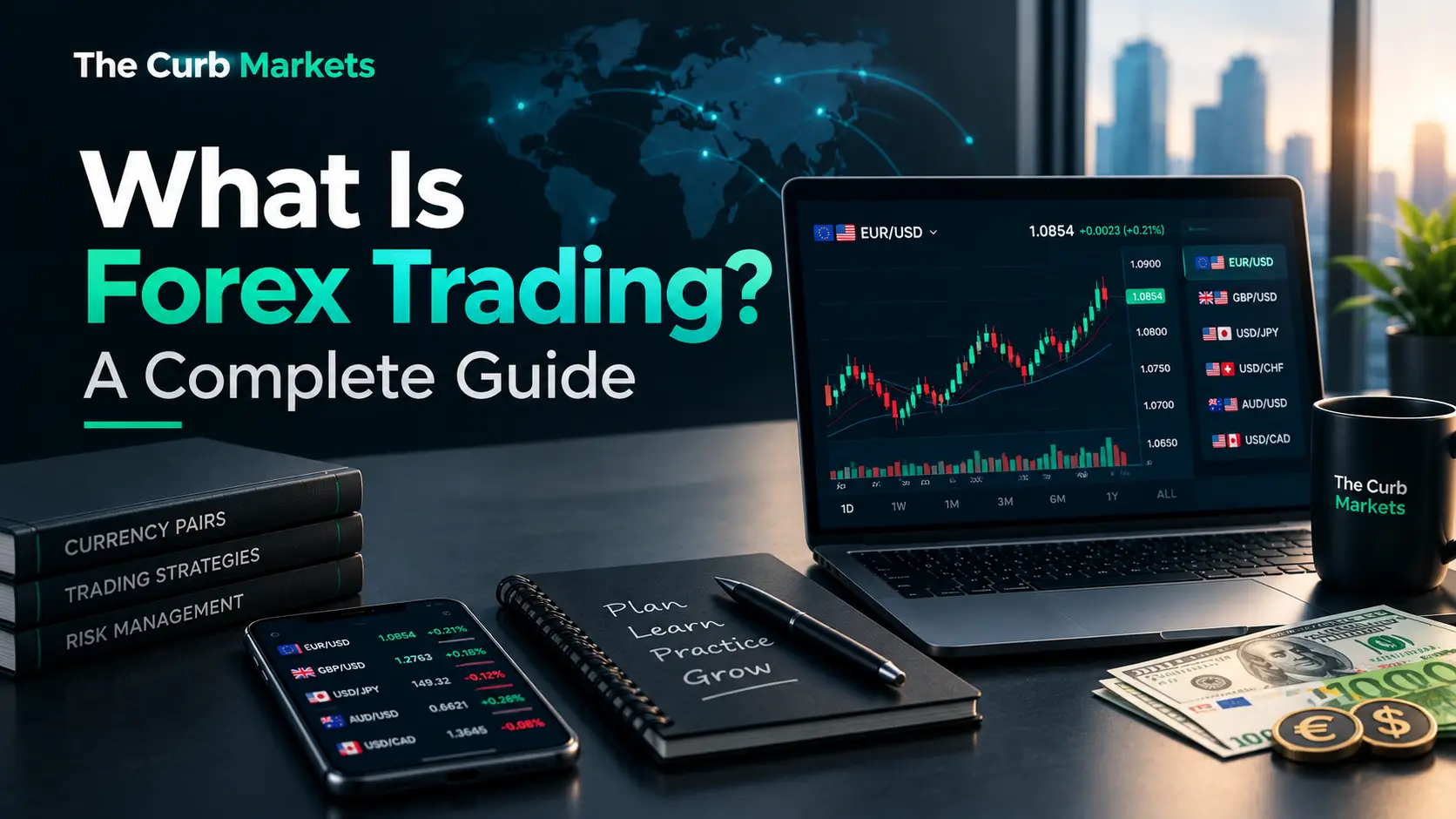
Forex trading (also called FX trading or currency trading) is the buying of one currency while simultaneously selling another, with the goal of profiting from changes in their relative exchange rate. It’s a market with no central exchange, no fixed hours during the trading week, and a level of accessibility that draws in beginners faster than almost any other financial market, for better and for worse.
This guide covers what forex trading actually is, how the mechanics of pips, lots, and leverage work, the strategies traders use, how forex compares to stock and day trading, the real risks involved, and a realistic path to getting started without risking more than you can afford to lose.
What Is Forex Trading?
At its core, forex trading means exchanging one currency for another in the hope that the one you bought will strengthen relative to the one you sold, or that the one you sold will weaken relative to the one you bought, if you’re taking a short position. Profit and loss come entirely from the movement in that exchange rate between the time you open and close the trade.
How the Forex Market Works
Unlike stock markets, which operate through centralized exchanges like the NYSE or Nasdaq, the forex market is decentralized and trades over-the-counter (OTC). There’s no single physical location or exchange where all forex trades happen, instead, currencies are traded directly between participants (banks, financial institutions, brokers, and individual traders) through an interconnected global network.
This structure is also what allows forex to trade 24 hours a day, five days a week, following the sun through major financial centers — opening in Sydney and Tokyo, moving through London, and closing out in New York before the cycle begins again. There’s no single “closing bell” the way there is for stocks; trading pauses only over the weekend.
Currency Pairs Explained
Because forex trading always involves exchanging one currency for another, every trade is quoted as a currency pair, two currencies shown together, with an exchange rate between them.
Take EUR/USD as an example, one of the most heavily traded pairs in the world. The first currency listed, EUR, is called the base currency. The second, USD, is called the quote currency. The exchange rate tells you how much of the quote currency it takes to buy one unit of the base currency, if EUR/USD is trading at 1.0850, it takes $1.0850 to buy €1.00.
When you buy EUR/USD, you’re simultaneously buying euros and selling US dollars, betting that the euro will strengthen relative to the dollar. When you sell EUR/USD, you’re doing the reverse. Every forex trade, no matter how complex the strategy behind it, boils down to this same basic mechanic.
How Forex Trading Works
Beyond the basic concept of currency pairs, a handful of core terms and mechanics show up constantly in forex trading, and understanding them is essential before placing a single trade.
Pips, Lots, and Leverage
A pip (short for “percentage in point”) is the standard unit used to measure movement in a currency pair’s exchange rate. For most pairs, a pip is the fourth decimal place — if EUR/USD moves from 1.0850 to 1.0851, that’s a one-pip move. (Pairs involving the Japanese yen are a notable exception, where a pip is typically the second decimal place instead.)
A lot is the standardized trade size in forex. A standard lot represents 100,000 units of the base currency, though brokers commonly offer smaller sizes too, a mini lot (10,000 units) and a micro lot (1,000 units), which allow traders to control position size and risk more precisely, especially with smaller accounts.
Leverage allows a trader to control a much larger position than their actual account balance would otherwise permit, by borrowing capital from the broker. Forex leverage is often significantly higher than what’s available in stock trading — ratios like 50:1 or even higher are common in various jurisdictions, though maximum permitted leverage varies considerably by regulator and by country, and has been tightened by many regulators in recent years. Always verify the current leverage limits that apply to your account directly with your broker and your local regulator, since these figures vary and change over time.
Leverage is what makes forex trading accessible with relatively small amounts of starting capital, but it’s also, as covered in the risks section below, the single biggest reason forex accounts can lose money quickly.
The Bid-Ask Spread
Every currency pair quote shows two prices: the bid (the price at which you can sell) and the ask (the price at which you can buy). The difference between them is the bid-ask spread, and it represents one of the primary ways forex brokers earn money on trades, particularly with brokers that don’t charge separate commissions.
Tighter spreads mean lower costs for traders, and spreads tend to be tightest on the most liquid, most heavily traded pairs. Spreads can also widen significantly during periods of low liquidity or high volatility, around major news releases, for example, which is an important, often underestimated cost for active traders to factor in.
Major, Minor, and Exotic Pairs
Currency pairs are generally grouped into three categories, and the category matters for both liquidity and typical trading cost.
- Major pairs: pairs that include the US dollar alongside another heavily traded currency, such as EUR/USD, USD/JPY, or GBP/USD. These are the most liquid pairs in the world, typically with the tightest spreads.
- Minor pairs: (also called cross pairs) pairs that don’t include the US dollar but still involve widely traded currencies, such as EUR/GBP or AUD/JPY. Generally still liquid, though usually with somewhat wider spreads than majors.
- Exotic pairs: pairs that combine a major currency with the currency of a smaller or emerging economy, such as USD/TRY or EUR/ZAR. These tend to have significantly wider spreads and lower liquidity, along with higher volatility, making them considerably riskier and more expensive to trade for beginners.
Most beginner-friendly forex trading strategies stick to major pairs, precisely because of the liquidity and cost advantages they offer over minors and exotics.
Forex Trading vs. Stock Trading vs. Day Trading
Forex trading shares some structural similarities with stock trading and day trading, but the differences matter for anyone deciding where to focus their time and capital.
| Forex Trading | Stock Trading | Day Trading (Stocks) | |
|---|---|---|---|
| Market hours | 24 hours, 5 days a week | Exchange hours only | Exchange hours only |
| Typical leverage | Often very high, varies by broker and regulator | Lower, more tightly regulated | Moderate; margin rules apply |
| Main price driver | Interest rates, central bank policy, economic data | Company earnings, business news | Intraday volatility, news, volume |
| Market structure | Decentralized, over-the-counter | Centralized exchanges | Centralized exchanges |
| Typical minimum capital | Can be low, varies by broker | Cost of shares purchased | Varies; margin rules can apply depending on market |
Forex trading tends to suit traders who want round-the-clock market access, are comfortable with macroeconomic analysis (interest rates, central bank decisions, geopolitical events), and want exposure to a market that doesn’t depend on any single company’s performance. Stock trading tends to suit those more interested in company-specific fundamentals and who prefer trading within defined exchange hours. Day trading, in either market, adds a layer of time intensity and short-term focus that isn’t required by longer-timeframe forex or stock strategies — though forex itself can absolutely be day-traded, as covered next.
Common Forex Trading Strategies
Forex trading strategies span a wide range of timeframes and styles, and beginners are generally better served understanding the full landscape before picking one to focus on.
Scalping
Scalping is a high-frequency style where traders aim to profit from very small price movements, often just a few pips, by executing a large number of trades throughout a session. Positions are typically held for seconds to a few minutes.
This strategy demands intense focus, fast execution, and low trading costs (since spread costs are paid on every single trade), and it generally suits traders who can dedicate full, uninterrupted attention to the market during active sessions.
Day Trading
Forex day trading involves opening and closing positions within the same day, without holding anything overnight. Traders using this approach typically rely on technical analysis and shorter-term price action, watching for setups during the most active trading sessions (such as the London-New York overlap, when liquidity and volatility both tend to be highest).
Day trading suits traders who want to avoid overnight exposure to news or rate decisions but who can still dedicate meaningful, active attention to the market during the day.
Swing Trading
Swing trading involves holding positions for several days to a few weeks, aiming to capture a larger directional move than a single day’s price action would typically offer. Swing traders often combine technical analysis with a broader view of fundamental factors, like an upcoming central bank decision.
This approach suits traders who can’t watch the market constantly but still want to stay actively engaged, checking in periodically rather than continuously.
Carry Trade
A carry trade involves borrowing (effectively, going short) a currency with a low interest rate and using it to buy a currency with a higher interest rate, aiming to profit from the interest rate differential between the two, in addition to any favorable exchange rate movement. This is a longer-term strategy, often held for weeks or months.
Carry trades can perform well during periods of stable or rising rate differentials, but they carry real risk: sudden shifts in central bank policy, or a spike in market volatility, can quickly erase gains from the interest differential and cause significant losses on the currency exposure itself. This strategy generally suits more experienced traders who understand macroeconomic dynamics and interest rate policy well.
Fundamental vs. Technical Analysis in Forex
Forex traders generally rely on two broad approaches to making trading decisions, and most experienced traders end up blending both to some degree.
Fundamental Analysis
Fundamental analysis in forex focuses on the broader economic and political forces that drive currency values over time. This includes interest rate decisions from central banks (which are often the single biggest driver of currency strength), economic data releases (inflation figures, employment reports, GDP growth), and geopolitical events that can shift investor sentiment toward or away from a given currency.
A trader using fundamental analysis might watch a central bank’s policy meeting closely, reasoning that a signal toward higher interest rates tends to strengthen a currency by making assets denominated in it more attractive to yield-seeking capital, while a signal toward lower rates tends to have the opposite effect.
Technical Analysis
Technical analysis focuses on price charts themselves, using historical price action, patterns, and indicators to try to anticipate future price movement, largely independent of the underlying economic reasons behind it. Common tools include trendlines, support and resistance levels, moving averages, and momentum indicators.
A trader using technical analysis might identify a currency pair repeatedly bouncing off a specific support level and plan a trade around that pattern continuing or eventually breaking down.
Most experienced forex traders use both approaches together — fundamental analysis to understand the broader direction and context a currency might be moving in, and technical analysis to help time specific entries and exits within that broader view.
Tools and Platforms for Forex Trading
Choosing a forex broker and platform is one of the most consequential decisions a new trader makes, since it directly affects trading costs, execution quality, and critically, the safety of deposited funds.
Spreads and fees vary meaningfully between brokers and even between account types at the same broker. Comparing typical spreads on the pairs you intend to trade, and understanding any additional commissions, is an important first step.
Execution speed matters especially during volatile periods, when delayed order execution can mean a materially worse fill price than expected.
Regulation is arguably the single most important factor. A regulated broker, overseen by a recognized financial authority in a relevant jurisdiction, offers meaningfully more protection for client funds and more accountability than an unregulated one. Requirements and oversight bodies vary by country (examples include the NFA and CFTC in the United States, the FCA in the United Kingdom, and equivalent bodies elsewhere), so it’s worth confirming a broker’s specific regulatory status directly, since this is an area where claims aren’t always what they appear.
Demo (practice) accounts let a trader test a platform and a strategy with simulated funds under real market conditions, before any real capital is at risk. Given how much there is to learn in forex trading, spending meaningful time on a demo account before going live is one of the most valuable steps a beginner can take.
This guide intentionally avoids recommending specific brokers, since regulatory status, spreads, and features can change, always verify a broker’s current regulatory standing and terms directly before opening an account.
Risks of Forex Trading
Forex trading offers real opportunity, but it also carries risks that every beginner needs to understand clearly and honestly before risking real capital.
Leverage Risk
As covered earlier, leverage in forex trading is often considerably higher than what’s available in stock trading, and it amplifies both gains and losses proportionally. A relatively small adverse move in a highly leveraged position can result in a loss that represents a large percentage of the trader’s actual account equity — this is, by a wide margin, the most common way new forex traders lose money quickly. Using conservative position sizing and understanding exactly how much capital is genuinely at risk on any given trade is essential.
Volatility Around News Events
Currency prices can move sharply and suddenly around major news events — central bank interest rate decisions, employment reports, inflation data, and unexpected geopolitical developments. Spreads often widen substantially during these windows, and price can gap or move faster than a trader’s order can be filled at the expected price, a phenomenon known as slippage. Traders who don’t specifically plan for this volatility, including around scheduled economic releases, are often caught off guard by it.
Counterparty and Broker Risk
Because forex trading happens over-the-counter rather than through a centralized exchange, a trader’s funds and trade execution both depend directly on the broker they’ve chosen. This is precisely why broker regulation matters so much, a properly regulated broker is subject to oversight, capital requirements, and client fund protection rules that an unregulated one is not. Trading through an unregulated or poorly regulated broker introduces a risk that has nothing to do with market analysis or trading skill, and it’s entirely avoidable by doing due diligence upfront.
None of this means forex trading can’t be done responsibly. It means leverage should be used conservatively, volatility around scheduled events should be planned for rather than ignored, and broker selection deserves the same scrutiny as any other major financial decision.
If you find that trading is causing significant financial or emotional stress, it’s worth speaking with a licensed financial counselor, this is a legitimate and fairly common issue, not a personal failing.
How to Get Started with Forex Trading
For anyone who understands the risks above and wants to learn forex trading properly, here’s a realistic, responsible path to follow.
- Learn the fundamentals thoroughly. Understand currency pairs, pips, lots, leverage, and the bid-ask spread before placing a single trade, these concepts form the foundation for everything else, and gaps in understanding here tend to get expensive quickly.
- Choose a regulated broker. Verify a broker’s regulatory status directly with the relevant authority in your jurisdiction before depositing any funds. This step protects you regardless of how good your trading strategy eventually becomes.
- Practice extensively on a demo account. Trade with simulated funds under real market conditions for an extended period, long enough to experience a range of market conditions, not just a few lucky days. Use this time to test a strategy and build genuine familiarity with your platform.
- Start with a small position size on a live account. When you do move to real money, trade small. Position sizing is one of the most important risk management tools available to a beginner, and starting small limits the cost of the mistakes you’ll inevitably make early on.
- Build a written trading plan. Define, in advance, which pairs you’ll trade, how much you’re willing to risk per trade, where your stop-loss and take-profit levels will sit, and under what conditions you’ll stop trading for the day. Making these decisions in advance, rather than in the moment, is one of the clearest markers of a disciplined trader.
- Use stop-loss and take-profit orders consistently. A stop-loss automatically closes a losing position at a predetermined level, capping downside on any single trade. A take-profit does the same for a winning position, locking in gains at a target level rather than leaving the outcome to chance. Both tools exist specifically to remove emotion from exit decisions.
- Review your trades and adjust deliberately. Keep a record of every trade, including your reasoning, and review it regularly. Genuine improvement in forex trading comes from honest, ongoing review — not from memory or gut feeling about how things are going.
Pros and Cons of Forex Trading
| Pros | Cons |
|---|---|
| Extremely liquid market, especially in major pairs | High leverage can amplify losses just as fast as gains |
| Trades 24 hours a day, 5 days a week — flexible around other commitments | Volatility around news events can move prices quickly and unpredictably |
| Low typical starting capital compared to some other markets | Decentralized structure makes broker selection and regulation especially important |
| Wide range of strategies across different timeframes and styles | Steep learning curve, particularly around macroeconomic analysis |
| No need to pick “winning” individual companies, unlike stock picking | Spreads and costs can widen significantly during volatile or illiquid periods |
Forex trading’s accessibility and around-the-clock market hours are genuinely appealing, but that same accessibility, combined with high available leverage, is exactly why new traders need to approach it with real caution and a clear, honest understanding of the risks involved.
Frequently Asked Questions
Is forex trading profitable for beginners?
Profitability varies enormously by individual, and there’s no reliable universal statistic specific to forex the way there is for some other trading categories. What’s well established is that leverage-driven losses are common among inexperienced traders, and building genuine skill — through education, extensive demo practice, and disciplined risk management — takes real time. Beginners should approach any claims of easy or guaranteed forex profits with significant skepticism.
How much money do you need to start forex trading?
This varies significantly by broker, since minimum deposit requirements and available lot sizes differ. Some brokers allow accounts to be opened with relatively small amounts, particularly when using micro lots, but starting capital should always be an amount you can genuinely afford to lose, and larger, properly funded accounts generally allow for more sustainable risk management than very small ones.
Is forex trading legal?
Yes, forex trading is legal in most countries, though it’s regulated differently depending on jurisdiction, and some countries impose restrictions on retail forex trading or on the leverage that brokers can offer. Always confirm the specific rules and any registration requirements that apply in your own country before trading.
What’s the difference between forex trading and stock trading?
Forex trading involves exchanging currency pairs on a decentralized, 24-hour market driven largely by macroeconomic factors like interest rates and central bank policy. Stock trading involves buying and selling shares of individual companies on centralized exchanges during fixed market hours, driven more by company-specific performance and news.
Can you day trade forex without $25,000?
Yes. The $25,000 minimum equity requirement that many people associate with day trading applies specifically to pattern day trading rules for equities in certain markets (historically tied to U.S. stock trading regulations), not to forex. Forex trading operates under different rules and typically doesn’t carry that same equity threshold, though specific requirements still vary by broker and jurisdiction, so it’s worth confirming directly with your broker.
What is leverage in forex trading?
Leverage lets a trader control a larger position size than their actual account balance would otherwise allow, by borrowing capital from the broker. It amplifies both potential gains and potential losses proportionally, which makes it one of the most important concepts to understand, and manage carefully, before trading forex.
What is a pip in forex trading?
A pip is the standard unit used to measure a change in a currency pair’s exchange rate, typically the fourth decimal place for most pairs (the second decimal place for pairs involving the Japanese yen). It’s the basic building block used to describe price movement and calculate profit or loss in forex trading.
How do I choose a forex broker?
Prioritize confirmed regulatory status with a recognized financial authority in a relevant jurisdiction, competitive and transparent spreads on the pairs you intend to trade, reliable trade execution, and the availability of a demo account for practice before committing real funds. Regulation, in particular, should never be assumed, always verify it directly.
Conclusion
Forex trading is the buying and selling of currency pairs on the world’s largest, most liquid financial market, a decentralized market that trades nearly 24 hours a day and offers exposure to macroeconomic forces like interest rates and central bank policy in a way no other asset class quite does. From scalping to carry trades, the range of strategies available means forex can suit very different trading styles and time commitments.
That same accessibility comes with real responsibility. High leverage, sharp volatility around news events, and the importance of choosing a properly regulated broker are not footnotes, they’re central to trading forex safely. Anyone serious about forex trading should build genuine understanding first, practice extensively on a demo account, and never risk more than they can afford to lose.
If you’d like to go deeper, explore our related guide on the best currency pairs for beginners to see how these concepts apply to real trading decisions.
Stay informed with real-time financial market updates by following Marcus on X (formerly Twitter).