Disclaimer: This article is for educational purposes only and does not constitute financial advice. Trading involves risk, including the potential loss of your invested capital. Always do your own research and consider speaking with a licensed financial advisor before trading.
Trading isn’t one single activity, it’s an umbrella term that covers dozens of different approaches, spread across different markets and different timeframes. A crypto scalper holding a position for ninety seconds and a position trader holding blue-chip stocks for three years are both “traders,” but almost nothing about their day-to-day process looks the same.
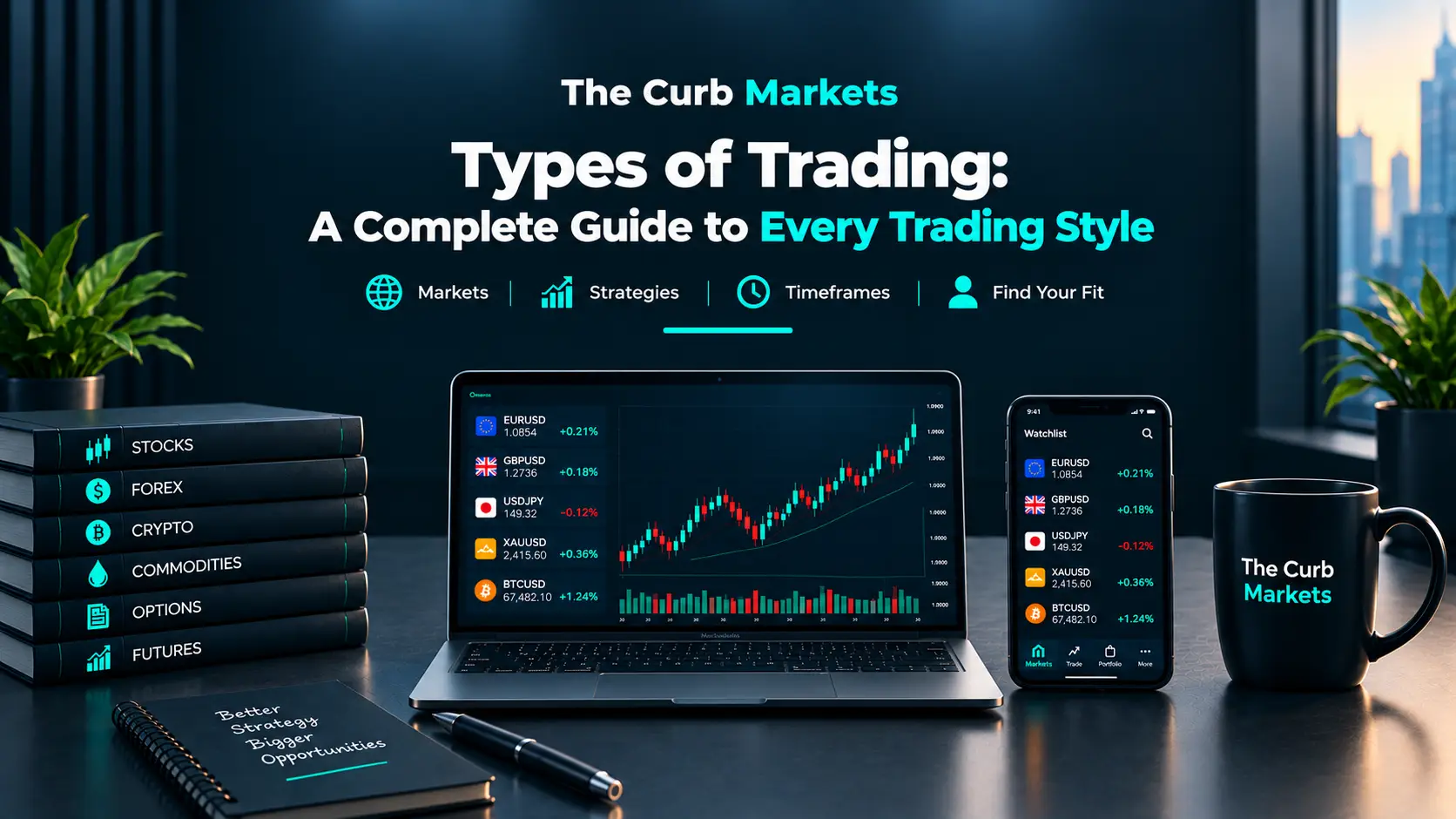
That’s exactly why so many beginners get stuck before they even place their first trade: they ask “what type of trading should I do?” without realizing the question actually has two layers. There’s the question of which market you trade, stocks, forex, crypto, commodities, options, futures, and there’s the question of which style you trade it in, day trading, swing trading, scalping, position trading, and more.
This guide covers both. By the end, you’ll understand the full landscape of types of trading, how they differ in risk, time commitment, and skill requirements, and how to figure out which combination might actually fit your life, not just which one looks exciting on social media.
What Is Trading? A Quick Definition
Trading is the act of buying and selling financial assets, stocks, currencies, commodities, cryptocurrencies, or derivatives, with the goal of profiting from price movement. It’s distinct from investing, which generally means holding an asset for years with the expectation that its underlying value will grow over time.
Trading, by contrast, is typically more active. Traders aren’t necessarily betting on a company’s long-term success; they’re betting on price movement over a shorter window, using tools like technical charts, news events, or market trends to time their entries and exits. Some styles of trading (like position trading) blur the line with investing, while others (like scalping) look nothing like it at all.
Types of Trading by Market
The first way to categorize types of trading is by what you’re trading. Each market has its own hours, liquidity characteristics, and risk profile.
Equity (Stock) Trading
Equity trading is buying and selling shares of publicly listed companies through exchanges like the NYSE, NASDAQ, London Stock Exchange, or your local national exchange. It’s one of the oldest and most widely understood forms of trading, and it’s usually where beginners start because company information is relatively transparent and heavily reported on. Equity markets typically operate during set exchange hours, which makes them a more structured entry point than 24-hour markets like forex or crypto.
Within equity trading, there’s also a distinction between large, established “blue-chip” companies — generally seen as more stable but slower-moving, and smaller-cap stocks, which can offer larger percentage moves but often come with wider spreads and lower liquidity. Some equity traders also participate in IPOs (initial public offerings), buying shares of a company as it first lists on an exchange, though this carries its own distinct risks around price volatility in the early days of trading.
Forex Trading
Forex (foreign exchange) trading involves buying one currency while simultaneously selling another, aiming to profit from changes in the exchange rate. Unlike stock exchanges, the forex market is decentralized and trades nearly 24 hours a day across overlapping global sessions. It’s known for high liquidity in major currency pairs and for often involving significant leverage, which magnifies both potential gains and potential losses.
Currency pairs are generally grouped into majors (pairs involving the US dollar and another large economy’s currency, like EUR/USD), minors (pairs between major currencies excluding the US dollar), and exotics (pairs involving one major currency and one from a smaller or emerging economy). Majors tend to have the tightest spreads and highest liquidity, while exotics can be more volatile and costlier to trade due to wider spreads.
Commodity Trading
Commodity trading involves physical goods like gold, oil, natural gas, or agricultural products such as wheat and coffee. Traders participate either through futures contracts or through commodity-linked instruments, often reacting to supply and demand shifts, geopolitical events, or seasonal factors. Commodities are frequently used both for speculation and for hedging by businesses that rely on the underlying goods.
Commodities are often split into “hard” commodities, natural resources that are mined or extracted, like gold, oil, and copper, and “soft” commodities, which are grown or farmed, like coffee, cotton, and soybeans. Hard commodities tend to be more influenced by industrial demand and geopolitical events, while soft commodities are often more sensitive to weather patterns and seasonal supply cycles.
Cryptocurrency Trading
Crypto trading involves buying and selling digital assets like Bitcoin or Ethereum on crypto exchanges. It shares some similarities with forex in that markets run 24/7, but cryptocurrency prices tend to be significantly more volatile, and the regulatory environment varies widely by country and continues to evolve. This makes crypto trading attractive to some for its profit potential, but it also carries risks that are less present in more established, regulated markets.
Beyond trading major coins like Bitcoin and Ethereum, some traders also trade altcoins (smaller, alternative cryptocurrencies) or participate in decentralized finance (DeFi) platforms. These areas tend to carry even higher volatility and additional risks, including lower liquidity and, in some cases, less regulatory oversight, so they generally require a higher degree of caution and research than trading established, large-cap cryptocurrencies.
Options Trading
Options are derivative contracts that give a trader the right, but not the obligation, to buy (a call) or sell (a put) an underlying asset at a set price before a set expiration date. Traders use options to speculate on price movement with less upfront capital than buying the asset outright, or to hedge existing positions. Options trading is generally considered more complex than straightforward stock trading, because pricing depends on multiple factors beyond just the underlying asset’s price — including time remaining until expiration and expected volatility.
For example, instead of buying 100 shares of a stock outright, a trader might buy a single call option contract representing those 100 shares for a fraction of the cost, controlling a similar amount of exposure with significantly less capital. The tradeoff is that if the stock doesn’t move as expected before expiration, the option can lose value quickly or expire worthless.
Futures Trading
Futures are standardized contracts that obligate the buyer to purchase (and the seller to deliver) an asset at a predetermined price on a specific future date. Unlike options, futures carry an obligation, not just a right. They’re widely used for both speculation and hedging, for example, an airline might use fuel futures to lock in prices and manage cost risk, while a trader might use stock index futures purely to speculate on market direction.
Futures are commonly traded on indices, commodities, currencies, and even interest rates, and they typically involve margin requirements that allow traders to control a large contract value with a relatively small upfront deposit. This makes futures capital-efficient, but it also means losses can accumulate quickly if the market moves against a position.
Types of Trading by Strategy (Style-Based)
The second, and often more practically important, way to categorize types of trading is by how long a position is held and how actively it’s managed. This applies across nearly every market above.
Day Trading (Intraday Trading)
Day trading means opening and closing a position within the same trading day, so no positions are held overnight. Day traders aim to profit from short-term price movements during market hours and rely heavily on technical analysis, real-time charts, and disciplined risk management. It requires quick decision-making and constant attention during the trading session, which is why it doesn’t suit everyone’s schedule or temperament.
Day trading typically requires a dedicated setup, reliable charting software, fast order execution, and often multiple monitors for tracking several positions or watchlists at once. In some markets, regulators also impose specific rules on frequent day trading in margin accounts (such as minimum equity requirements), so it’s worth checking the current rules that apply to your account type and country before starting.
Scalping
Scalping is an even faster version of day trading, with positions sometimes held for only seconds or minutes. Scalpers aim to capture very small price movements repeatedly throughout the day, relying on high trade frequency rather than large individual gains. It demands fast execution, low transaction costs, and intense focus, and it’s generally considered one of the more demanding trading styles from a stress and time perspective.
Because each individual trade targets such a small price movement, transaction costs like spreads and commissions matter enormously to scalpers, a strategy that looks profitable on paper can become unprofitable once realistic trading costs are factored in. This is why scalping is often associated with highly liquid markets and tight-spread instruments.
Swing Trading
Swing trading involves holding positions for several days to a few weeks, aiming to capture a “swing” in price driven by a short-to-medium-term trend. Swing traders typically use a mix of technical analysis and broader market context, and because positions aren’t managed minute-by-minute, this style requires less constant screen time than day trading or scalping, making it a common choice for people trading alongside a full-time job.
A typical swing trade might involve identifying a stock that has pulled back to a support level within a broader uptrend, entering a position, and holding until the price reaches a predetermined target or shows signs of reversing. Because positions are held overnight and over weekends, swing traders are exposed to gap risk, the possibility that a price moves sharply between one session’s close and the next session’s open.
Position Trading
Position trading means holding trades for months or even years, based on longer-term trends and often supported by fundamental analysis, company earnings, economic data, or macroeconomic shifts. It requires the least day-to-day monitoring of any active trading style, and in some ways it overlaps with long-term investing, though position traders are typically more willing to exit based on trend changes rather than holding indefinitely regardless of price action.
Because of the long holding periods involved, position traders generally place less weight on short-term volatility and more weight on the broader trajectory of a company, sector, or economy. This makes position trading less time-intensive on a daily basis, but it still requires patience and a willingness to sit through short-term price swings that might unsettle a shorter-term trader.
Momentum Trading
Momentum trading is based on a simple premise: assets that are moving strongly in one direction tend to keep moving in that direction, at least for a while. Momentum traders buy assets that are trending up and sell (or short) those trending down, using indicators like moving averages, relative strength index (RSI), and volume to time entries and exits. It can offer strong returns in trending markets but carries real risk when a trend suddenly reverses.
Momentum trading can be applied across multiple timeframes, some momentum traders operate on an intraday basis, while others hold momentum-driven positions for days or weeks. What ties the style together isn’t the holding period itself, but the underlying logic of following existing price strength rather than betting on a reversal.
Algorithmic (Quantitative) Trading
Algorithmic trading uses computer programs to execute trades automatically based on pre-set rules or mathematical models, often at speeds no human could match manually. It ranges from relatively simple rule-based systems used by retail traders to highly sophisticated, institutional-grade high-frequency trading. Algorithmic trading can reduce emotional decision-making, but it also requires technical skill to build and maintain, and poorly designed systems can lose money just as quickly as a human trader can.
Before deploying an algorithmic strategy with real capital, most traders backtest it against historical data to see how it would have performed in the past, though it’s worth noting that strong historical performance never guarantees future results, since market conditions change over time.
Technical Trading vs. Fundamental Trading
Beyond market and holding period, trading styles also differ by the type of analysis used to make decisions.
Technical Trading
Technical trading relies on price charts, patterns, and indicators, like moving averages, support and resistance levels, and candlestick patterns, to forecast where prices are likely to head next. The underlying premise is that historical price action tends to repeat in recognizable patterns, and that most relevant information is already reflected in the price itself.
Fundamental Trading
Fundamental trading focuses on the underlying health and value of the asset itself. For stocks, that means studying earnings reports, revenue growth, and industry conditions; for currencies, it means watching interest rates and central bank policy; for commodities, it means tracking supply and demand data. Fundamental traders are trying to determine whether an asset is undervalued or overvalued relative to its “true” worth.
In practice, most experienced traders blend both approaches rather than relying on one exclusively, using fundamentals to decide what to trade and technicals to decide when. Some traders also incorporate a third lens, sentiment analysis, which looks at overall market mood, through news flow, social media activity, or trading volume patterns, as a supplementary signal alongside price charts and company fundamentals.
Types of Traders: Who’s Actually in the Market
Beyond market and strategy, it’s worth understanding who you’re trading alongside, since different participants behave very differently and collectively shape how markets move.
Retail traders are individual, non-professional traders using personal capital, typically through an online broker. This is the category most beginners fall into, and retail trading has grown significantly as online platforms have made market access easier.
Institutional traders work for entities like hedge funds, mutual funds, pension funds, or investment banks, trading much larger amounts of capital, often with access to more sophisticated tools and research than individual retail traders.
Proprietary (“prop”) traders trade a firm’s own capital rather than client funds, aiming to generate profit directly for the firm. Some prop trading firms also offer funded-account programs where individual traders can access firm capital after passing an evaluation.
Market makers are firms or individuals that continuously quote both buy and sell prices for a security, providing liquidity to the market and profiting primarily from the spread between those prices, rather than from directional bets on price movement.
Understanding this landscape matters because retail traders are often trading against, or alongside, participants with more capital, faster execution, and more resources. That’s not a reason to avoid trading, but it’s a reason to stay realistic about the playing field.
Types of Share Trading: Delivery vs. Intraday
Within stock markets specifically, trading is often split into two categories based on whether ownership actually changes hands.
Delivery Trading
Delivery trading means buying shares with the intention of actually taking ownership, the shares are transferred into your account (or demat account, in markets that use that term) and can be held for any length of time, from days to years. This is the closest style to traditional investing, since there’s no requirement to sell by a specific time.
Intraday Trading
Intraday trading, as covered above, means buying and selling within the same session, no shares are actually “delivered” or held overnight. Because there’s no ownership transfer, intraday trades are typically squared off (closed) before the market closes, and brokers often apply different margin rules to intraday positions versus delivery trades.
Comparison Table: Which Type of Trading Fits You?
| Trading Type | Holding Period | Time Commitment | Risk Level |
|---|---|---|---|
| Scalping | Seconds–minutes | Very high | High |
| Day Trading | Minutes–hours | High | High |
| Swing Trading | Days–weeks | Medium | Medium |
| Position Trading | Months–years | Low | Lower (relatively) |
This is a simplified comparison — actual risk depends heavily on position sizing, leverage used, and the specific market being traded, not just the style itself.
How to Choose the Right Type of Trading for You
There’s no universally “best” type of trading, only the type that fits your circumstances. A few honest questions worth asking yourself:
How much time can you realistically dedicate during market hours? Day trading and scalping demand near-constant attention while positions are open. If you have a full-time job with limited flexibility, swing trading or position trading are structurally easier to manage.
How do you handle fast, high-pressure decisions? Some people thrive on rapid decision-making; others find it draining or prone to emotional mistakes. Be honest about which category you fall into, it matters more than most beginners expect.
How much capital do you have, and how much can you afford to lose? Some styles and markets (like day trading US stocks, or leveraged forex/crypto trading) come with higher capital requirements or higher effective risk per trade. Never trade with money you can’t afford to lose.
Do you prefer analyzing charts, or researching companies and economies? This can point you toward a technical style or a fundamental style, respectively, and by extension, toward faster or slower trading timeframes.
What trading platform and tools do you have access to? Different types of trading platforms are built for different styles, some prioritize fast order execution and advanced charting for active day traders and scalpers, while others are simpler and better suited to longer-term position trading or delivery-based investing. It’s worth matching your platform choice to the style you actually intend to practice, rather than picking based on marketing alone.
Are you trading alone, or learning from others? Some beginners benefit from structured courses, trading communities, or mentorship, while others prefer to learn independently through demo accounts and self-directed study. Neither approach is inherently better, but knowing your own learning style can shape which type of trading feels more approachable to start with.
Many traders also experiment across several styles early on before settling into the one that matches their personality and lifestyle, there’s no rule that says you have to pick one on day one. It’s also worth remembering that switching styles later, as your available time or risk tolerance changes, is completely normal and doesn’t mean you “failed” at the first one.
Risks Across Different Types of Trading
Every type of trading carries risk, though the specific risks differ by style and market.
Leverage risk is common across forex, futures, options, and some crypto trading. Leverage can amplify gains, but it amplifies losses just as fast, and in some cases, losses can exceed the amount originally invested.
Volatility risk affects faster styles most acutely. Scalpers and day traders are exposed to sudden price swings within very short windows, while position traders have more time to let short-term volatility play out.
Emotional decision-making is a risk factor across every style, but it tends to be more dangerous in fast-paced trading, where there’s less time to pause and reconsider before acting.
Capital loss is possible in any type of trading. No style, market, or strategy eliminates risk, and claims suggesting otherwise should be treated with skepticism.
Liquidity risk can affect any market, but it’s especially relevant in smaller-cap stocks, exotic currency pairs, or smaller cryptocurrencies, where it may be harder to exit a position quickly at a fair price during periods of low trading activity.
Overconfidence after early wins is a less-discussed but very real risk. A string of early successful trades, whether from skill or simply favorable market conditions, can lead traders to increase position sizes or abandon risk management rules prematurely, which is a common way early gains get erased later.
This article is educational in nature and isn’t a substitute for professional financial advice. If you’re new to trading, consider starting with a demo or paper trading account before committing real capital, regardless of which type of trading you’re drawn to.
Pros and Cons Summary
| Pros | Cons | |
|---|---|---|
| Fast styles (scalping, day trading) | Quick feedback, no overnight risk | High stress, demands constant attention |
| Slower styles (swing, position trading) | Less time-intensive, room for fundamentals | Slower feedback, exposure to overnight/weekend risk |
| Leveraged markets (forex, futures, options) | Lower capital needed to participate | Losses can be amplified significantly |
| Unleveraged equity trading | Simpler risk profile, easier to understand | Requires more capital for meaningful position sizes |
Frequently Asked Questions
How many types of trading are there?
There’s no single official count, since trading can be categorized by market (stocks, forex, commodities, crypto, options, futures) and separately by style (day trading, swing trading, position trading, scalping, momentum, algorithmic). Combined, there are dozens of possible approaches, but most traders focus on one or two core combinations rather than trying to master all of them.
What type of trading is best for beginners?
There’s no single best answer, but many beginners start with swing trading or position trading in equities, since these styles require less constant monitoring and give more time to learn without the pressure of rapid decision-making. That said, “best” ultimately depends on your available time, risk tolerance, and interests.
What’s the difference between trading and investing?
Trading generally involves shorter holding periods and more active management, aiming to profit from price movement. Investing typically means holding assets for years, based on a belief in their long-term underlying value. The line isn’t always sharp, position trading, for example, sits close to the boundary between the two.
What is the safest type of trading?
No type of trading is entirely “safe,” since all trading carries risk of loss. That said, unleveraged, longer-timeframe styles (like position trading in established stocks) are generally considered to carry a different, often lower-intensity risk profile than highly leveraged, fast-paced styles like day trading forex or crypto with high leverage.
Can I do more than one type of trading?
Yes. Many traders combine styles, for example, swing trading a core portfolio while day trading a smaller, separate account, though managing multiple styles at once adds complexity and is generally better suited to more experienced traders.
What is the difference between intraday and delivery trading?
Intraday trading involves buying and selling within the same day with no transfer of ownership, while delivery trading involves actually taking ownership of the shares, which can then be held for any length of time.
What are the main types of trading platforms?
Trading platforms generally range from beginner-friendly apps with simplified interfaces and educational tools, to advanced professional platforms offering in-depth charting, algorithmic trading support, and faster execution. The right type of trading platform depends on which trading style you’re practicing, an active day trader typically needs different tools than someone doing longer-term position trading.
Is day trading a type of trading or a strategy?
It’s both, depending on context. Day trading is a style of trading defined by holding period (same-day entry and exit), but it can be applied across multiple markets and combined with different strategies, for example, a day trader might use momentum-based or technical-analysis-based decision-making within that same-day timeframe.
Stay informed with real-time financial market updates by following Marcus on X (formerly Twitter).
Conclusion
There’s no single “correct” answer to the question of what types of trading exist or which one you should choose, the honest answer is that trading spans multiple markets and multiple timeframes, each with a different risk and time profile. Equity, forex, commodities, crypto, options, and futures represent the what; day trading, swing trading, position trading, scalping, momentum, and algorithmic trading represent the how.
The right combination isn’t the one that looks most exciting, it’s the one that fits your available time, risk tolerance, and temperament. Take the time to understand each type of trading before committing real capital, and consider starting with a demo account to test which style genuinely suits you before trading live.
Whichever direction you choose, treat your first few months as a learning period rather than a race to profitability. The traders who last tend to be the ones who take the time to understand the mechanics, risks, and demands of their chosen style before scaling up their capital, not the ones who jump in expecting instant results.