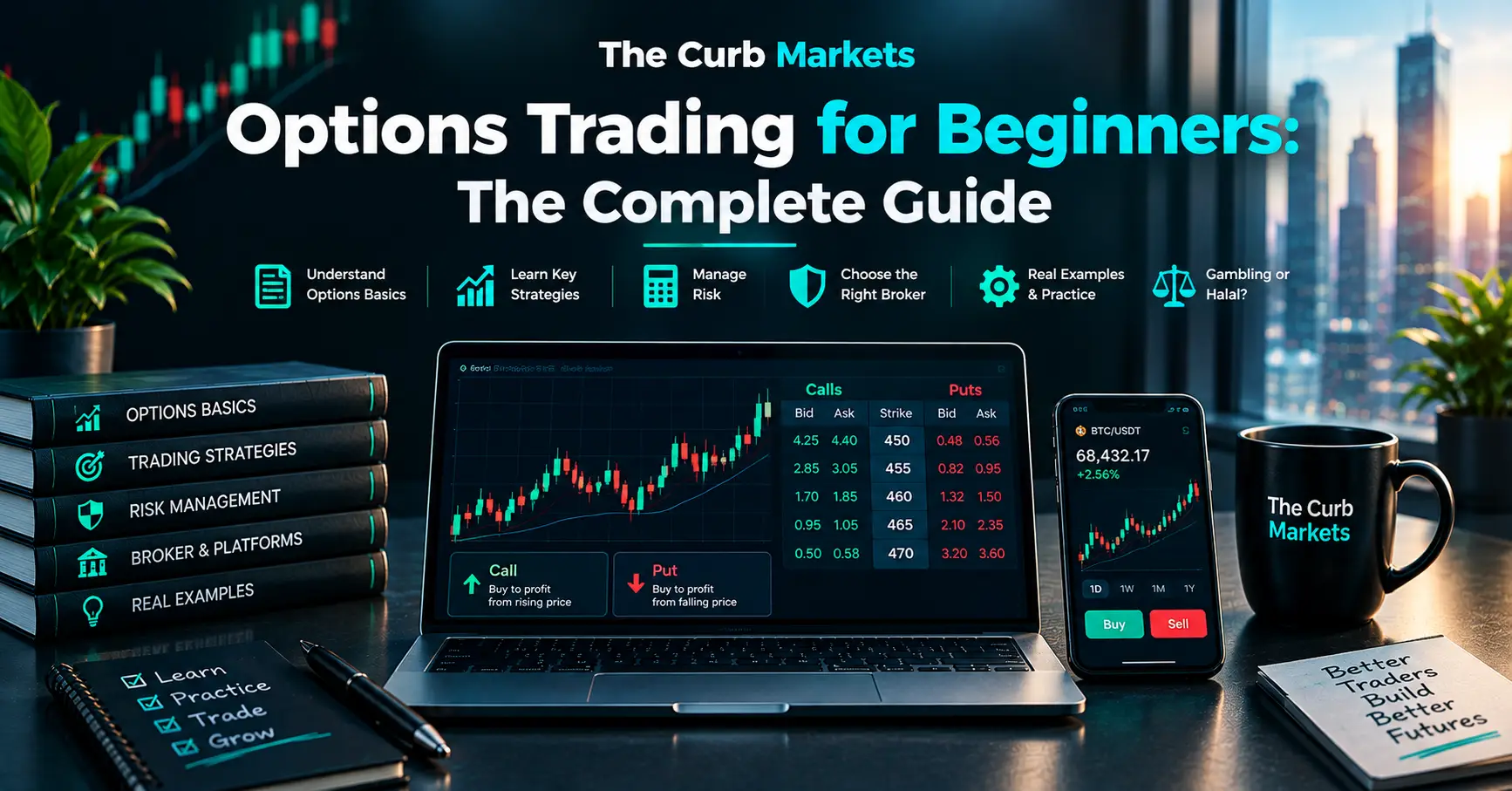
Options trading has a reputation for being one of the most intimidating corners of financial markets, full of Greek letters, strike prices, and warnings about unlimited risk. The reputation for complexity is partly deserved, but the actual fundamentals of trading options are more approachable than they first appear, and this guide is built to prove that with concrete numbers rather than abstract theory.
This is a complete walkthrough of options and trading them responsibly: what a contract actually is, how pricing and the Greeks work, the specific strategies beginners use most often (each with a worked numeric example), how to get approved and choose a broker, and the risk management habits that separate traders who last from traders who don’t. It also tackles two questions most guides avoid entirely: whether options trading is functionally a form of gambling, and what religious scholars, specifically within Islamic finance, say about its permissibility. Both get honest, evenhanded treatment rather than being glossed over. By the end, you’ll have a genuinely complete foundation, not just a glossary of terms.
What Is Options Trading?
Options trading what is it, in the simplest possible terms? It’s the buying and selling of contracts that give the holder the right, but not the obligation, to buy or sell an underlying asset, most commonly a stock, at a predetermined price before a set expiration date. That right is what you’re actually paying for when you buy an option, and it’s what separates options from simply buying the underlying stock itself.
What is option trading, practically speaking, comes down to two things: choosing a direction you expect an asset to move (or not move), and selecting a contract structure that profits from that expectation while defining your risk in a specific way. What is trading options used for varies widely, from speculating on price direction, to generating income on stock you already own, to hedging an existing position against a decline.
What Are Options Trading Contracts? (What Are Options in Trading)
What are options trading contracts, structurally? Each options contract typically represents 100 shares of the underlying stock, and it has three defining components: a strike price (the predetermined price at which the option can be exercised), an expiration date (the date by which the right must be used or it becomes worthless), and a premium (the price paid to purchase the contract).
What are options in trading used for beyond speculation is worth understanding early: they’re also widely used by long term investors and institutions specifically to manage risk on existing holdings, not exclusively to make directional bets. That dual purpose, speculation on one hand and risk management on the other, is central to later sections of this guide, particularly the discussion of whether options trading amounts to gambling.
Calls vs. Puts
A call option gives its holder the right to buy the underlying asset at the strike price before expiration. Traders buy calls when they expect the underlying asset’s price to rise, since a call becomes more valuable as the underlying price climbs above the strike.
A put option gives its holder the right to sell the underlying asset at the strike price before expiration. Traders buy puts when they expect the underlying asset’s price to fall, since a put becomes more valuable as the underlying price drops below the strike.
Both calls and puts can also be sold rather than bought, a distinction covered in more detail in the risk management section, since selling options carries a fundamentally different risk profile than buying them.
It helps to think of the four basic positions as a matrix rather than just two contract types. Buying a call is a bet on the underlying rising, with risk limited to the premium paid. Selling a call is a bet that the underlying stays below the strike, with risk that ranges from moderate (if the shares are already owned, forming a covered call) to substantial (if sold naked, without owning the shares). Buying a put is a bet on the underlying falling, again with risk limited to the premium paid. Selling a put is a bet that the underlying stays above the strike, with risk that depends on whether cash is set aside to cover a potential assignment (a cash secured put) or not (a naked put). Every strategy covered later in this guide is ultimately built from some combination of these four basic positions.
How Does Options Trading Work?
How does options trading work in practice comes down to understanding a handful of mechanical concepts that govern how a contract’s value changes over time and what happens as expiration approaches.
Strike Price and Expiration Date
The strike price is fixed at the time the contract is created and never changes for the life of that specific contract. It determines the price at which the underlying asset would be bought (for a call) or sold (for a put) if the option is exercised.
The expiration date is the final day the contract is valid. Options can expire in as little as a day (for very short dated contracts) or extend months to years into the future (for longer dated contracts sometimes called LEAPS). Generally, more time until expiration means a higher premium, since more time gives the underlying asset a greater opportunity to move favorably before the contract expires.
Premiums and Contract Size
The premium is the price a buyer pays and a seller receives for an options contract, quoted on a per share basis but multiplied by 100 since each standard contract represents 100 shares.
Here’s a worked example. Suppose a stock is trading at $50 per share, and a call option with a $52 strike price and one month until expiration has a premium of $1.50 per share. Buying one contract would cost $1.50 multiplied by 100 shares, or $150 total, plus any broker commission. If the stock rises to $55 before expiration, that call option would have at least $3 of intrinsic value per share (the $55 current price minus the $52 strike), or $300 for the contract, before accounting for any remaining time value. The buyer’s profit in that scenario would be roughly $150 (the $300 value minus the original $150 premium paid), not counting fees. If instead the stock stays below $52 through expiration, the call expires worthless, and the buyer’s entire $150 premium is lost. This example illustrates the core defined risk nature of buying options: the maximum loss for a buyer is always limited to the premium paid, while the potential gain, at least for a call buyer, is theoretically unlimited if the underlying keeps rising.
In the Money, At the Money, Out of the Money
In the money describes an option that currently has intrinsic value: a call is in the money when the underlying price is above the strike, and a put is in the money when the underlying price is below the strike.
At the money describes an option where the underlying price is equal to, or very close to, the strike price, meaning the contract currently has little to no intrinsic value.
Out of the money describes an option with no intrinsic value: a call is out of the money when the underlying price is below the strike, and a put is out of the money when the underlying price is above the strike. Out of the money options consist entirely of time value and tend to be cheaper, and riskier in percentage terms, than in the money contracts.
Exercise, Assignment, and Letting Options Expire
Exercise refers to an option holder actually using their right to buy (for a call) or sell (for a put) the underlying asset at the strike price. Most retail option buyers don’t exercise their contracts directly; instead, they typically close the position by selling the contract itself if it has value, capturing the profit or loss without ever taking ownership of the underlying shares.
Assignment is what happens to the seller of an option when the buyer on the other side chooses to exercise. If you’ve sold a call and it’s assigned, you’re obligated to sell 100 shares of the underlying at the strike price, regardless of the current market price, which can mean selling significantly below market value if the stock has risen sharply. Understanding assignment risk before selling any option is essential, and it’s covered in more depth in the risk management section ahead.
Letting an option expire simply means taking no action and allowing the contract to lapse at expiration. An out of the money option expires worthless, and the buyer’s loss is limited to the premium originally paid; an in the money option, if left unaddressed, is typically automatically exercised or assigned by the broker at expiration under standard exercise procedures, which is why monitoring positions as expiration approaches matters.
Options Trading vs. Stock Trading
Options and stock trading share the same underlying assets but differ substantially in capital requirements, risk structure, and complexity.
Buying options generally requires far less capital than buying the equivalent number of shares outright, since you’re only paying a premium rather than the full share price, a concept often referred to as capital efficiency. This lets a trader gain exposure to a larger notional position with a smaller upfront cost, though that same efficiency amplifies both potential gains and potential losses on a percentage basis.
For option buyers specifically, risk is defined and capped at the premium paid, a meaningful difference from owning shares outright, where a stock can theoretically decline toward zero and the loss is measured in the full capital invested. However, this defined risk advantage applies to buyers, not sellers. Sellers of uncovered (naked) options can face substantially larger, even theoretically unlimited, losses, covered in detail in later sections.
Complexity is the clearest trade off. Stock trading requires understanding a single number: the share price. Options trading requires understanding strike price, expiration, premium, and the Greeks (covered next), all interacting simultaneously, which is precisely why options carry a steeper learning curve than straightforward stock ownership.
Time is another dimension that has no real equivalent in stock trading. A share of stock, once purchased, doesn’t lose value simply because a week passes with no price movement. An option does, through theta, which means options traders are managing not just a directional view but a timing view as well, a distinction that trips up a large share of beginners who transfer stock trading habits directly onto options without adjusting for this added dimension.
Here’s a direct comparison:
| Factor | Stock Trading | Options Trading |
|---|---|---|
| Capital required | Full share price per share owned | Premium only, typically a fraction of the equivalent share value |
| Risk profile (buyer) | Loss limited to amount invested, can lose full value if stock goes to zero | Loss limited to premium paid, but can lose 100% of that premium relatively quickly |
| Risk profile (seller) | Not applicable in the same sense | Can range from defined risk (covered strategies) to theoretically unlimited risk (naked selling) |
| Complexity | Relatively straightforward: price movement only | Higher: strike, expiration, premium, and the Greeks all interact |
Understanding the Options Greeks
The Greeks are a set of calculated values that describe how an option’s price is expected to change in response to different factors. Understanding them, even at a basic level, is essential to trading options with any real precision rather than guessing.
Delta
Delta measures how much an option’s price is expected to change for a $1 move in the underlying asset. A call option with a delta of 0.50 would be expected to gain roughly $0.50 in value if the underlying rises by $1, all else being equal. Delta also serves as a rough approximation of the probability that an option will expire in the money, which is why many beginners use it as a quick reference when comparing contracts at different strikes.
Theta
Theta measures how much an option’s value is expected to decline each day purely from the passage of time, all else being equal, a phenomenon commonly called time decay. Theta accelerates as expiration approaches, which is why short dated options lose value particularly quickly in the final days and weeks before expiring, an effect every option buyer needs to account for and every option seller can potentially benefit from.
Vega
Vega measures how sensitive an option’s price is to changes in implied volatility, the market’s expectation of how much the underlying asset is likely to move going forward. When implied volatility rises, option premiums generally increase, all else being equal, and when implied volatility falls, premiums generally decrease, an effect sometimes referred to as IV crush when it happens sharply, often following a known event like an earnings announcement.
Gamma
Gamma measures the rate of change of delta itself, essentially describing how quickly an option’s delta will shift as the underlying price moves. Gamma tends to be highest for at the money options close to expiration, which means their price behavior can become especially sensitive and fast moving in the final stretch before expiring.
Here’s a summary comparison of all four:
| Greek | What It Measures | Why Beginners Should Care |
|---|---|---|
| Delta | Price sensitivity to a $1 move in the underlying | Helps estimate potential gains or losses from a given price move, and approximates probability of expiring in the money |
| Theta | Value lost per day from time passing | Explains why option buyers lose value even if the underlying doesn’t move, especially near expiration |
| Vega | Sensitivity to changes in implied volatility | Explains why premiums can swing sharply around events like earnings, independent of price direction |
| Gamma | Rate of change of delta itself | Explains why price behavior can become unstable and fast moving near expiration, particularly at the money |
How to Start Trading Options: Step by Step
Here’s the practical path from knowing nothing about options to placing an informed first trade.
Step 1: Learn the Basics
Before opening any account, make sure the concepts covered so far, calls, puts, strike price, premium, expiration, and the basic idea behind each Greek, feel genuinely familiar rather than half understood. Options punish vague understanding more than most other instruments, since several variables interact simultaneously.
Step 2: Get Approved for Options Trading
Most brokers require a specific approval process before allowing options trading, typically involving a questionnaire about your trading experience, financial situation, and risk tolerance. Brokers generally assign an options approval level, often ranging from a basic level permitting covered calls and cash secured puts, up through higher levels permitting spreads and, eventually, uncovered (naked) option selling. Higher approval levels typically require demonstrating more experience and often a larger account size.
Many sources cite $2,000 or more as a commonly referenced margin account minimum associated with options approval at many brokers, though this figure, along with specific approval level requirements, varies by broker and can change over time, so confirm current requirements directly with any broker you’re considering rather than relying on a cited figure that may be outdated.
Step 3: Choose a Broker With Strong Options Tools
Not every broker offers the same quality of options specific tools. Look for a clear, usable options chain (the table showing available strikes, expirations, and pricing), useful profit and loss visualization tools, transparent commission and per contract fee structures, and genuinely useful educational resources geared toward options specifically, not just general investing content.
Step 4: Paper Trade First
Paper trading, simulated trading using real market pricing without real money, lets you practice reading an options chain, understanding how premiums move with the underlying and with time, and executing trades without financial consequences. Given how many variables interact in options pricing, this step is arguably even more valuable for options than for straightforward stock trading.
Step 5: Start With One Defined Risk Strategy
Resist the urge to explore every strategy at once. Choose a single defined risk strategy (several beginner appropriate options are covered in detail in the next section) and commit to understanding it thoroughly, including exactly how it behaves in different market scenarios, before adding complexity.
Step 6: Place a Small Real Trade
Once you’ve paper traded a strategy you understand well, transition to a small real position, sized so that a full loss remains an affordable lesson rather than a significant setback. The goal at this stage is learning to execute and manage a live position under real conditions, not maximizing profit.
Step 7: Track Every Trade in a Journal
Record every trade: the strategy, strike, expiration, premium paid or received, your reasoning at entry, and the eventual outcome. Reviewing this journal regularly is one of the most effective ways to identify which strategies and market conditions genuinely suit your understanding and risk tolerance, rather than relying on memory alone.
Common Options Trading Strategies for Beginners
Several strategies are widely considered appropriate starting points for beginners specifically because they have defined, calculable risk.
Covered Call
A covered call involves owning at least 100 shares of an underlying stock and selling a call option against those shares, collecting the premium as income. If the stock stays below the strike price through expiration, the call expires worthless, the seller keeps the full premium, and still owns the shares. If the stock rises above the strike, the shares may be called away (assigned) at the strike price, capping further upside beyond that level.
Worked example: you own 100 shares of a stock trading at $40, and you sell a call with a $43 strike expiring in one month for a $1 premium, collecting $100. If the stock stays at or below $43 through expiration, you keep the $100 premium and your shares. If the stock rises to $47, your shares are likely assigned and sold at $43, meaning you miss out on the additional $4 per share of upside above the strike, though you keep the full $100 premium on top of the gain up to $43.
Cash Secured Put
A cash secured put involves setting aside enough cash to buy 100 shares at a given strike price, then selling a put option at that strike, collecting the premium. If the stock stays above the strike through expiration, the put expires worthless and the seller keeps the premium. If the stock falls below the strike, the seller is obligated to buy 100 shares at the strike price, effectively acquiring the stock at a discount to where it was trading when the position was opened, offset partially by the premium collected.
Worked example: a stock trades at $50, and you sell a cash secured put with a $47 strike for a $1.20 premium, collecting $120 while setting aside $4,700 (100 shares at $47) in case of assignment. If the stock stays above $47, you keep the $120. If the stock falls to $44 and you’re assigned, you buy 100 shares at $47 (a price above the current $44 market value), but your effective cost basis is reduced to $45.80 per share once the $120 premium collected is accounted for.
Protective Put
A protective put involves owning shares of a stock and buying a put option to hedge against a decline, functioning similarly to insurance on the position. If the stock falls significantly, the put gains value, offsetting some or most of the loss on the shares. If the stock rises or stays flat, the put may expire worthless, and the cost of that put reduces overall returns, similar to an insurance premium that goes unused.
Worked example: you own 100 shares at $60, and you buy a protective put with a $55 strike for a $2 premium, costing $200. If the stock drops to $45, your shares have lost $1,500 in value, but the put is now worth at least $1,000 (the $55 strike minus the $45 price), significantly offsetting the loss, since your downside beyond the $55 strike is now protected minus the cost of the put itself.
Debit Spread
A debit spread involves simultaneously buying one option and selling another option of the same type (both calls or both puts) at a different strike, with the same expiration, paying a net premium (a debit) to enter the position. This caps both the maximum potential loss (limited to the net premium paid) and the maximum potential gain (limited by the difference between the two strikes minus the premium paid), in exchange for a lower cost than buying a single option outright.
Worked example: a stock trades at $50, and you buy a call at the $50 strike for $3 while simultaneously selling a call at the $55 strike for $1, for a net cost of $2 (or $200 per spread). If the stock rises to $55 or higher by expiration, the spread reaches its maximum value of $5 (the difference between strikes), for a profit of $3 per share, or $300, on the original $200 risked. If the stock stays at or below $50, both options expire worthless and the maximum loss is the $200 originally paid.
Here’s a comparison of all four strategies:
| Strategy | Risk Level | Capital Needed | Best Market Condition |
|---|---|---|---|
| Covered Call | Moderate (downside risk on owned shares, capped upside) | High (must own 100 shares per contract) | Flat to mildly bullish |
| Cash Secured Put | Moderate (obligation to buy shares if assigned) | High (must reserve cash to cover potential purchase) | Neutral to bullish, willing to own the stock |
| Protective Put | Low added risk (cost of the put itself) | High (must own shares, plus premium for the put) | Any, specifically to hedge against a decline |
| Debit Spread | Defined and limited to premium paid | Low relative to owning shares outright | Directional view with a defined price target range |
Choosing an Options Broker
Selecting a broker for options trading involves evaluating several factors beyond the general criteria that apply to any brokerage account.
The approval process matters directly, since it determines which strategies you can access and how quickly you can move between approval levels as your experience grows. Fee transparency is essential, since options often carry both a base commission and a per contract fee, and these costs compound meaningfully for active traders using multi leg strategies like spreads. Options chain usability, how clearly a platform displays available strikes, expirations, and real time pricing, has a direct impact on how efficiently and accurately you can evaluate and place trades. Access to genuine paper trading functionality lets you practice specifically within that broker’s own interface before risking real capital. Finally, options specific educational resources, beyond generic investing content, indicate a broker genuinely built to support traders learning this particular skill.
This guide intentionally avoids naming a specific “best” broker, since offerings, fee structures, and approval requirements change over time and vary by region; research current, independent comparisons at the time you’re actually selecting one.
It’s also worth checking a broker’s specific policy around assignment notifications and exercise procedures, since these details vary by firm and can matter significantly if you’re actively selling options. Some brokers provide clearer, faster notifications when a position is assigned than others, and understanding your specific broker’s process before it happens, rather than learning it in the moment, avoids unnecessary confusion at a time when a quick, informed decision may already be required. A quick comparison of a few brokers’ assignment policies and notification methods, available in most brokers’ published account documentation, is a worthwhile step before settling on one.
Risk Management for Options Traders
Options amplify both opportunity and risk simultaneously, which makes deliberate risk management even more important than in straightforward stock trading.
Position sizing should be conservative, a small, fixed percentage of your total trading capital per position, specifically because options can lose their entire value more quickly than most stock positions, given the added effect of time decay working against buyers continuously.
Preferring defined risk strategies over naked option selling is a foundational principle for beginners specifically. Naked selling, writing an option without owning the underlying shares (for a naked call) or without setting aside the cash to buy them (for a naked put), can expose a seller to losses substantially larger than the premium collected, and in the case of naked calls, theoretically unlimited losses, since there’s no cap on how high a stock’s price could rise. Defined risk strategies, like the debit spread or covered strategies covered earlier, have a maximum loss that’s calculable and capped before you ever enter the position, which is a meaningfully safer foundation while you’re still building experience.
Understanding assignment risk before selling any option is essential, not optional. Any option sold carries the possibility of being assigned, obligating you to buy or sell 100 shares at the strike price, and beginners should fully understand the financial consequence of that obligation, including having sufficient capital or shares available to meet it, before ever selling a contract.
A related habit worth building early is tracking total portfolio exposure across all open options positions, not just position size on any single trade. Because each contract controls 100 shares, it’s easy to accumulate meaningful aggregate exposure to a single underlying, or to a handful of correlated underlyings, without realizing how concentrated that exposure has become, especially when multiple positions are opened gradually over time rather than all at once. Periodically reviewing total exposure, not just individual trade sizing, catches a category of risk that position sizing rules alone can miss, and it’s a habit worth building into the same weekly journal review process covered earlier in this guide.
Is Options Trading Gambling?
This is a genuinely reasonable question, and it deserves a factual answer rather than a defensive one, presenting both sides of a real, ongoing debate.
Options were originally developed, and continue to be used extensively by institutions and sophisticated investors, for genuine hedging and risk transfer purposes distinct from gambling. A protective put, for example, functions economically similarly to insurance: a known, limited cost paid to protect against a larger, uncertain potential loss. Covered calls are widely used specifically to generate incremental income on existing holdings, a use case with a defined, calculable risk and reward profile rather than a pure speculative bet. Used this way, options serve a legitimate economic function that most people wouldn’t characterize as gambling.
At the same time, it’s honest to acknowledge that certain retail options behavior can functionally resemble gambling. Trading short dated, far out of the money options purely on speculative direction, with position sizes disproportionate to an account’s total capital, and without any defined risk management plan, shares meaningful structural similarities with gambling: a defined, often small cost with a low probability, high payout outcome, driven substantially by short term price movement that’s difficult to predict reliably. The high leverage inherent in options, the ability to control a large notional exposure with a relatively small premium, can amplify this dynamic considerably when used speculatively without discipline.
The honest conclusion is that options trading itself isn’t inherently gambling, but it can be used in a way that functions like gambling, largely depending on the strategy, position sizing, time horizon, and the trader’s underlying intent and discipline. This guide doesn’t assert a single verdict on your behalf; the distinction genuinely depends on how the tool is used, not on the existence of the tool itself.
Does Trading Options “Blacken the Heart” in Islam? An Overview of Scholarly Views
This question comes up often enough in searches related to options trading that it deserves a direct, factual overview, presented here as general information rather than a personal religious ruling or fatwa.
The majority scholarly position among contemporary Islamic finance authorities, including bodies such as the OIC Islamic Fiqh Academy and AAOIFI (the Accounting and Auditing Organization for Islamic Financial Institutions), generally considers conventional options trading impermissible (haram). The reasoning cited typically centers on several factors: gharar, meaning excessive uncertainty or ambiguity in the contract’s outcome; maysir, meaning a gambling like structure where one party’s gain corresponds directly to another party’s loss based substantially on chance; and the absence of genuine ownership of a real underlying asset at the time the contract is formed, since an option represents a right tied to a future, uncertain outcome rather than an actual transfer of ownership.
A minority view among some scholars holds that certain uses of options, particularly in specific hedging or genuinely non speculative contexts, may have grounds for permissibility, arguing that the underlying economic function (risk transfer, similar to insurance) can, in specific structured circumstances, be distinguished from purely speculative gambling. This view is less widely held than the majority position but does exist within contemporary Islamic finance scholarship.
Commonly cited halal alternatives for investors seeking Shariah compliant approaches include arbun contracts, a traditional Islamic finance structure involving a non refundable deposit toward a future purchase that some scholars view as structurally distinct from conventional options, and direct Shariah compliant stock ownership, investing directly in shares of companies that meet specific Islamic finance screening criteria, without the use of derivative contracts at all.
This section is a general informational summary of publicly documented scholarly positions, not a fatwa, and it is not a substitute for personalized religious guidance. Readers seeking direction for their own specific situation should consult a qualified Islamic finance scholar rather than relying on this overview alone.
Common Beginner Mistakes to Avoid
Several recurring mistakes account for a disproportionate share of beginner losses in options trading, and most are avoidable with awareness.
Trading short dated options without understanding time decay. Theta accelerates sharply as expiration approaches, and beginners frequently underestimate how quickly a short dated option can lose value even if their directional view eventually proves correct, simply because the move didn’t happen fast enough.
Ignoring implied volatility. Buying options when implied volatility is elevated, often right before a known event like earnings, means paying a premium inflated by that volatility, and a sharp drop in implied volatility afterward (IV crush) can cause a loss even if the underlying moves in the anticipated direction.
Overleveraging. Because options allow control of a large notional position with a relatively small premium, it’s easy to take on far more risk relative to account size than a beginner intends, particularly when combining multiple positions without tracking total exposure.
Selling naked options without understanding unlimited risk. As covered in the risk management section, naked selling, particularly naked calls, can expose a seller to losses well beyond the premium collected, and beginners should fully understand this exposure before ever writing an uncovered contract.
Trading illiquid underlyings. Options on thinly traded stocks often have wide bid ask spreads and limited volume, making it harder to enter and exit positions at fair prices, and increasing the practical cost of trading beyond what the quoted premium alone suggests.
Confusing a correct directional view with a profitable trade. It’s entirely possible to correctly predict that a stock will rise and still lose money on a call option, if the move happens too slowly, too late, or is too small to overcome the combined effect of the premium paid and the time decay accumulated along the way. Beginners sometimes treat options as a straightforward, leveraged proxy for a stock opinion, without accounting for the additional timing and magnitude requirements a specific option contract actually demands.
Options Trading Taxes: What Beginners Should Know
Tax treatment of options trading varies significantly by country, and this section is a brief overview only, not tax advice specific to your situation.
In many jurisdictions, options trading generates taxable events with rules that can differ meaningfully from standard stock trading, including specific treatment for how premiums, exercises, assignments, and expirations are each categorized for tax purposes. These rules are detailed, vary substantially by country, and change over time, making generic guidance an unreliable basis for actually filing taxes. Beginners are strongly encouraged to consult a qualified tax professional familiar with options trading in their specific jurisdiction, and to maintain detailed records of every trade (which also directly supports the trading journal habit covered earlier) to make that process accurate and efficient.
Risks of Options Trading
Options trading carries genuine, significant risks that deserve full, direct treatment, not a brief afterthought.
Premium loss risk for buyers means that buying an option can result in losing the entire premium paid if the underlying doesn’t move favorably enough, or quickly enough, before expiration. This can happen even when the directional view eventually proves correct, if the move occurs after the option has already expired.
Unlimited loss risk for uncovered sellers applies specifically to naked option selling, where losses can substantially exceed the premium collected and, in the case of naked calls, are theoretically unbounded, since there’s no ceiling on how high an underlying asset’s price could rise.
Time decay working against buyers means that every option buyer is, in effect, fighting a continuously ticking clock, since theta erodes value daily regardless of whether the underlying price moves, adding a structural headwind that doesn’t exist with straightforward stock ownership.
Complexity risk reflects the genuine possibility of misunderstanding how a position behaves, given how many variables (strike, expiration, implied volatility, and the Greeks) interact simultaneously, increasing the chance of an outcome that surprises a trader who hasn’t fully internalized the mechanics involved.
This is educational content only and does not constitute financial advice. It is not a recommendation to trade any specific strategy, contract, or underlying asset. Options trading carries significant risk, including the potential loss of your entire investment, and for certain strategies, losses greater than your original investment. Consider consulting a licensed financial advisor before trading options, and only trade with capital you can genuinely afford to lose.
Frequently Asked Questions
Is this guide a good replacement for an options trading for dummies ebook?
Yes, this guide is specifically built to serve that purpose: a complete, standalone resource covering contract mechanics, the Greeks, worked numeric examples, beginner appropriate strategies, risk management, and honest answers to harder questions, without requiring a separate purchased ebook to fill in the gaps.
How much money do I need to start trading options?
This varies by broker and by strategy. Many sources cite $2,000 or more as a commonly referenced margin account minimum associated with options approval at many brokers, though this figure and specific approval requirements vary and can change, so confirm current numbers directly with any broker you’re considering. Strategies requiring share ownership, like covered calls, also require enough capital to hold 100 shares of the relevant stock.
Can you lose more than you invest trading options?
For option buyers, no: the maximum loss is limited to the premium paid. For option sellers, particularly those selling uncovered (naked) options, yes: losses can exceed the premium collected, and in the case of naked calls, are theoretically unlimited, which is why defined risk strategies are generally recommended for beginners.
What’s the easiest options strategy for beginners?
Covered calls and cash secured puts are commonly considered accessible starting points, since both have clearly defined risk and reward, and both are typically available at lower broker approval levels. Debit spreads are another beginner friendly option, since their maximum loss is capped and known before the trade is even placed.
Is options trading harder than stock trading?
Generally, yes. Stock trading requires understanding a single variable, price. Options trading requires understanding strike price, expiration, premium, implied volatility, and the Greeks, all interacting simultaneously, which creates a steeper learning curve even though the underlying assets are often the same.
Do I need a lot of experience before trading options?
Not necessarily extensive experience, but a solid understanding of the fundamentals covered in this guide, combined with thorough paper trading practice, matters more than years of general market experience. Most brokers also gate access to more advanced, higher risk strategies behind higher approval levels specifically to align strategy complexity with demonstrated experience.
What happens if I don’t close my option position before expiration?
If the option is out of the money at expiration, it typically expires worthless with no further action needed, and the buyer’s loss is limited to the premium paid. If it’s in the money, it’s generally automatically exercised or assigned under standard procedures, which can mean actually buying or selling 100 shares of the underlying, so monitoring positions as expiration approaches is important to avoid unexpected outcomes.
Should beginners avoid weekly options entirely?
Not necessarily, but weekly options, given their very short time to expiration, carry particularly fast theta decay and can require a directional move to happen quickly and significantly to be profitable. Beginners are often better served starting with options that have somewhat more time until expiration, giving a directional view more room to play out, before experimenting with the faster, more demanding dynamics of weekly contracts.
Conclusion
Options trading for beginners doesn’t have to mean drowning in jargon or gambling blindly on short dated speculative bets. With a genuine understanding of how contracts work, how the Greeks influence pricing, and which strategies offer defined, calculable risk, options become a learnable, structured tool rather than an intimidating black box.
The path that actually works is the one covered throughout this guide: understand the fundamentals thoroughly, paper trade before risking real capital, start with a single defined risk strategy rather than several at once, size positions conservatively, and track every trade honestly enough to actually learn from it. Whether options trading functions as a legitimate risk management tool or resembles gambling in practice depends far more on how it’s used than on the instrument itself, and the same is true of the religious and ethical questions some traders bring to this topic, which deserve genuine, informed consideration rather than a dismissive answer either way.
If this guide gave you a genuinely complete foundation, the next step is simply beginning deliberately: open a paper trading account, study the mechanics of one defined risk strategy until it’s second nature, and build from there at a pace that matches real understanding rather than urgency.