
A few years ago, most people had never heard of Bitcoin. Today, millions of people around the world open a trading app on their phone, look at a price chart, and wonder whether they should buy something called Ethereum, Solana, or a coin they found on social media. Some of them are curious. Some are excited by stories of huge gains. Some are simply tired of watching everyone else talk about it and want to understand what is going on.
If that sounds like you, this guide is a good place to begin. Cryptocurrency trading is a real skill with real risks, and it deserves a calm, honest explanation rather than hype. In the sections below, you will learn what cryptocurrency trading is, how it works behind the scenes, whether crypto counts as real money, how to start with a small amount, how to choose a trading platform or app, how to read a cryptocurrency trading chart, and how to protect yourself from the mistakes that cost beginners the most.
You will also find straight answers to questions people search for every day. Can you start with only 100 rupees? Can you really make $100 a day? What will Bitcoin be worth in 2030? Some of these answers are not what people want to hear, but they will save you time, money, and stress.
Read the guide from top to bottom if you are new, or jump to the section you need using the table of contents below.
- What Is Cryptocurrency Trading?
- How Does Cryptocurrency Trading Work?
- Is Crypto Real Money?
- Benefits of Cryptocurrency and Crypto Trading
- Crypto Trading Compared With Investing and Forex
- How to Start Trading Cryptocurrency Step by Step
- How to Buy Cryptocurrency and How Prices Convert to Rupees
- Choosing a Cryptocurrency Trading Platform and App
- Reading a Cryptocurrency Trading Chart and Live Data
- Popular Crypto Trading Strategies
- Risk Management for Crypto Traders
- Can You Make $100 a Day Trading Crypto?
- How Much Will 1 Bitcoin Be Worth in 2030?
- Taxes, Laws, and Staying Safe
- How to Learn Crypto Trading: Courses and Resources
- Common Beginner Mistakes
- Trading Psychology and Realistic Expectations
- Frequently Asked Questions
- Conclusion
1. What Is Cryptocurrency Trading?
Cryptocurrency trading means buying and selling digital assets with the goal of profiting from changes in their price, or of gradually building a position over time. If you buy one Bitcoin at a certain price and later sell it at a higher price, the difference is your gain. If the price drops before you sell, the difference is your loss. That simple idea sits at the center of everything else in this guide.
The word "cryptocurrency" refers to digital money that uses cryptography to secure transactions and to control the creation of new units. Most cryptocurrencies run on a technology called a blockchain. A blockchain is a shared record book, copied across thousands of computers, that lists every transaction ever made. Because so many computers hold the same record, no single company or government can quietly change it.
When people ask what crypto trading is, they usually mean one of three activities:
- Spot trading: buying or selling the actual coin at the current market price and owning it afterward.
- Derivatives trading: trading contracts such as futures, options, or CFDs that follow a coin's price without you owning the coin. These often use borrowed money, which makes them far riskier.
- Swapping: exchanging one cryptocurrency for another, for example Ethereum for a stablecoin, often through a decentralized exchange.
For beginners, spot trading is the clearest place to start. You pay money, you receive a coin, and your risk is limited to what you paid. Derivatives are a different world, and they are where many new traders lose money fastest.
Coins, tokens, and stablecoins
You will hear these three words constantly, so it helps to separate them.
A coin runs on its own blockchain. Bitcoin, Ether on the Ethereum network, and Solana are examples. A token is built on top of another blockchain, usually to power an app or a project. A stablecoin is designed to hold a steady value, often matching a currency like the US dollar. Traders use stablecoins as a parking spot when they want to step out of a volatile coin without leaving the crypto system entirely.
Why crypto markets behave differently
Crypto markets never close. Stock exchanges open and shut at set hours, but crypto trades every hour of every day, including weekends and holidays. Prices can move sharply at three in the morning because news broke on the other side of the world. Markets are also younger and smaller than stock or currency markets, so a single large order or a single rumor can push prices a long way. This is what people mean when they call crypto "volatile." Volatility creates opportunity, and it creates danger, and the two come together in every trade.
2. How Does Cryptocurrency Trading Work?
Understanding the mechanics removes a lot of the mystery. Here is what actually happens when a trade takes place.
Exchanges connect buyers and sellers
A cryptocurrency exchange is a marketplace. It keeps a list of everyone who wants to buy a coin and everyone who wants to sell it. This list is called the order book. Buyers say the highest price they will pay, sellers say the lowest price they will accept, and when a buyer and seller agree on a price, the exchange matches them and the trade happens.
The gap between the best buying price and the best selling price is called the spread. A small spread means the market is busy and easy to trade. A wide spread usually means fewer people are trading that coin, and you may lose a little value the moment you buy.
Trading pairs
Coins are traded in pairs. When you see BTC/USDT, it means you are trading Bitcoin against a dollar linked stablecoin called Tether. The first coin is what you are buying or selling, and the second is what you are paying with or receiving. On exchanges that support local currency, you may also see pairs like BTC/USD or BTC/EUR. Beginners should start with major pairs, because they have plenty of buyers and sellers and much tighter spreads.
Order types you must know
| Order type | What it does | Best used when |
|---|---|---|
| Market order | Buys or sells immediately at the best available price | You want speed and accept a small price difference |
| Limit order | Buys or sells only at a price you choose, or better | You want control over the price and can wait |
| Stop loss order | Sells automatically if the price falls to a level you set | You want to cap how much a trade can lose |
| Take profit order | Sells automatically when the price reaches your target | You want to lock in a gain without watching the screen |
Learning these four order types will make you a safer trader than most beginners. A market order feels simple, but on a thin market it can fill at a worse price than you expected. A limit order gives you control. A stop loss gives you a safety net.
Fees and where they hide
Every exchange earns money from trading, so fees are part of the game. You will usually pay a trading fee on each buy and sell, and often a fee for depositing or withdrawing money, and a network fee when you move coins to another wallet. Some platforms advertise "zero fees" and then build a hidden charge into the price, so always compare the final amount you receive. Small fees matter more than people expect. If you trade often, a fee of half a percent on each side eats into your results quickly.
Wallets and custody
When you buy crypto on an exchange, the exchange usually holds it for you. This is called custodial storage. It is convenient, but it means you are trusting the company. A personal wallet, where you control the private keys, gives you full ownership, and it also gives you full responsibility. If you lose your recovery phrase, nobody can help you. Many careful users keep money they are actively trading on an exchange and move long term holdings into a wallet they control.
What moves prices?
Crypto prices respond to supply and demand like any other market, but the triggers can look unusual. Common drivers include regulation news, large company or government announcements, technology upgrades, changes in interest rates and the wider economy, big investors moving funds, exchange failures, and plain human emotion. Fear and excitement spread fast online, and they can push prices well beyond what the underlying project justifies.
3. Is Crypto Real Money?
This is one of the most common questions beginners ask, and the honest answer has a few layers.
Money, in an economic sense, does three jobs. It works as a way to pay for things, as a unit for measuring value, and as a way to store value over time. Government issued currency like the rupee or the dollar does all three, backed by a government and a central bank.
Cryptocurrency does these jobs partly. Some businesses accept Bitcoin or stablecoins for payments, and people use crypto to send money across borders quickly. But most shops do not accept it, and prices swing so widely that measuring value in Bitcoin would be impractical. A coffee that costs one price in the morning could feel very different by evening if the coin's value jumped or dropped. As a store of value, crypto has produced large gains for some holders and painful losses for others, so many experts see it more as a speculative asset than as stable money.
Legally, the answer depends on the country. Some governments treat crypto as property, some as a commodity, some as a financial asset, and a few have banned or restricted it. Almost nowhere is it treated as official legal tender in the way a national currency is, with a small number of exceptions. So the fairest summary is this: crypto has real value because people are willing to pay real money for it, but it is not money in the same sense as your national currency, and you should treat it as a high risk asset.
Stablecoins deserve a special note. They aim to track a currency, so they behave more like digital cash. Even so, they carry their own risks, such as the company behind the coin failing to hold enough reserves. No crypto asset is completely free of risk.
4. Benefits of Cryptocurrency and Crypto Trading
The risks deserve most of the attention in this guide, but it would be unfair to ignore why so many people are drawn to crypto. Here are the genuine benefits.
- Open access: With a phone and an internet connection, most people can open an account and trade. You do not need a large sum, a broker in a fancy office, or approval from a bank manager.
- Around the clock markets: You can trade at any hour, which suits people with jobs, studies, or family duties.
- Fast, low cost transfers: Sending value across borders can be quicker and sometimes cheaper than a traditional bank transfer, especially with stablecoins.
- Divisibility: You can buy a tiny fraction of a coin. You do not need to afford a whole Bitcoin to take part.
- Transparency: Public blockchains allow anyone to verify transactions, which reduces some kinds of fraud within the network itself.
- Ownership and control: With a personal wallet, you hold your assets directly, without a bank standing between you and your money.
- Potential for growth: Some cryptocurrencies have risen dramatically over long periods. This potential is the main attraction for most traders, though it always comes with the possibility of equally steep losses.
- Innovation: Blockchain technology supports new ideas such as programmable contracts, digital ownership, and decentralized finance, which some believe will shape future financial services.
Notice that "guaranteed profit" is not on the list. Benefits describe what the technology and the market make possible, not what any individual trader will earn.
5. Crypto Trading Compared With Investing and Forex
Trading versus investing
People often use the two words as if they mean the same thing, but they describe different mindsets. A trader tries to profit from shorter price movements and may hold a position for minutes, days, or weeks. An investor buys with a longer view, often holding for years, and pays less attention to daily price swings. Neither approach is safe, but investing usually demands less time and fewer decisions, which lowers the chance of emotional mistakes. Many beginners are better served by learning the investing mindset first and adding active trading later, if at all.
Crypto trading versus forex trading
Forex trading means exchanging national currencies, such as the dollar against the euro. Both forex and crypto are traded online and involve price charts, but they differ in important ways. Forex markets are huge and heavily regulated in many countries, and currency prices usually move in smaller steps. Crypto markets are smaller, less regulated in most places, and much more volatile. Forex traders often use large leverage, while many crypto exchanges also offer leverage, and in both cases it can wipe out an account quickly. If you are comparing the two, remember that skills such as chart reading and risk control carry over, but the level of price swings in crypto asks for even more caution.
6. How to Start Trading Cryptocurrency Step by Step
If you are asking how to start crypto trading, or how to get into cryptocurrency trading without feeling lost, the path below is the safest order to follow. Do not skip ahead. Each step protects the next one.
Step 1: Check the law where you live
Before you spend anything, find out whether crypto trading is legal in your country and which platforms are allowed to serve you. Rules can change, sometimes quickly. Look for official statements from your financial regulator or central bank rather than relying on social media posts or videos.
Step 2: Learn the basics first
Spend at least a few weeks reading and watching educational material before you trade. You should be able to explain, in your own words, what a blockchain is, what a wallet does, what a market order and a limit order are, and why leverage is dangerous. If you cannot, you are not ready to put money in yet.
Step 3: Decide why you are trading
Write down your goal. Are you trying to learn, to build a small long term position, or to earn short term profit? Your answer shapes everything else, including how much time you need and how much risk fits your situation. Be honest about your finances too. Money you need for rent, food, school fees, or emergencies must never go into crypto.
Step 4: Pick a reputable platform
Choose an exchange that is available in your region, has clear fees, a strong security record, and a simple interface. The next major section explains how to compare options. For now, remember that a well known platform with a long history is usually a safer starting point than a new site promising unusual rewards.
Step 5: Create and verify your account
Most regulated exchanges ask you to complete identity verification, often called KYC, which stands for "know your customer." You will typically upload an identity document and a photo. It can feel annoying, but it is a sign that the platform follows financial rules. Be very careful with any site that asks for no verification at all, or that asks for your private keys or recovery phrase. Real exchanges never ask for those.
Step 6: Secure your account
Set a long, unique password that you use nowhere else. Turn on two factor authentication using an authenticator app rather than text messages, since phone numbers can be hijacked. Keep your email account equally secure, because it is often the key to resetting everything else. Store any recovery phrase on paper in a safe place, never in a photo or a note on your phone.
Step 7: Start with a small, affordable amount
Fund your account with an amount you could lose completely without damaging your life. Many educational guides suggest that beginners start small and treat the first months as tuition. A small amount lets you practice placing orders, watching fees, and feeling how prices move, all without serious consequences.
Step 8: Practice with a demo account if one exists
Some platforms and brokers offer demo accounts filled with pretend money. These are useful for testing order types and strategies. Keep in mind that trading with fake money feels different from trading with real money, because fear and greed only show up when actual funds are at stake.
Step 9: Make your first simple trade
Choose a major coin, use a major trading pair, and place a small order. A limit order often gives a better sense of control than a market order. After the trade, check the receipt, note the fee, and see how the coin appears in your balance. The goal of the first trade is not profit. It is to confirm that you understand every part of the process.
Step 10: Keep a trading journal
Record each trade: what you bought, why, the price, the fees, your target, and what happened. Review it every week. A journal turns random experience into real learning, and it shows you patterns in your own behavior that no course can teach.
7. How to Buy Cryptocurrency and How Prices Convert to Rupees
Ways to buy cryptocurrency
People ask how they can buy cryptocurrency, and there are several routes. Each has trade offs.
| Method | How it works | Main things to watch |
|---|---|---|
| Centralized exchange | Deposit local currency by bank transfer or card, then buy coins on the platform | Fees, verification, and trusting the company with custody |
| Trading app | A phone app that wraps an exchange in a simpler design | Convenience often comes with higher spreads or fees |
| Peer to peer marketplace | You trade directly with another person, with the platform holding funds in escrow | Scams, payment disputes, and local legal rules |
| Decentralized exchange | You swap coins from your own wallet using smart contracts | Technical skill needed, fake tokens, and network fees |
| Crypto ATMs and brokers | Cash or card purchase through a machine or broker | Usually the highest fees, and scam risk |
For most beginners, a regulated centralized exchange is the most straightforward route. Peer to peer trading is popular in countries where bank access is limited, but it demands extra caution. Never release coins until you have confirmed the money is actually in your account, and never move a conversation with a stranger off the platform.
Can you start with 100 rupees?
Technically, yes, on some platforms. Because coins can be split into tiny pieces, you can often buy a small fraction of a coin with a very small sum. But there are practical limits. Many platforms set a minimum order size, and fees can take a large percentage of a tiny purchase. Depending on which rupee you mean, 100 rupees may be around a dollar or less, so a flat withdrawal or network fee could be larger than your entire balance.
Starting with a very small amount is a smart way to learn the process, as long as you understand that the goal is education, not income. You will not turn 100 rupees into life changing money by trading. What you can do is learn how to deposit, place an order, read a chart, and withdraw, and you will learn it cheaply. As your skills and savings grow, you can increase your amount slowly, always within what you can afford to lose.
How a crypto price becomes a price in rupees
Many people search for how much one Bitcoin or one coin is worth in rupees. The price changes every second, so any number printed in an article would be out of date within minutes. It is more useful to understand how the conversion works.
- Most coins have a main price in a large market currency, usually US dollars or a dollar linked stablecoin.
- Exchanges that serve local users, or price tracking websites, take that dollar price and multiply it by the current exchange rate between the dollar and the rupee.
- On peer to peer markets, the local price can be a little higher or lower than the simple calculation, because it also reflects local demand, payment methods, and bank limits.
For example, if a coin is priced at a certain number of dollars and the dollar is worth a certain number of rupees, you multiply the two numbers to get the rupee price. Check the live rate on your exchange or a reliable tracking site, and always include fees when you calculate what you would actually receive or pay. Remember also that "rupee" refers to several national currencies, including those of India, Pakistan, Nepal, and Sri Lanka, each with its own exchange rate and its own rules about crypto.
8. Choosing a Cryptocurrency Trading Platform and App
Searches like "best cryptocurrency trading platform" and "crypto trading app" are everywhere, and it is tempting to look for a single winner. The truth is that the best platform depends on where you live, what you want to trade, your experience, and your budget. Rather than naming one company that may not even be available in your country, this section gives you a framework you can use to judge any option.
Platform versus app
A cryptocurrency trading platform is the full service: the exchange, its order book, its security systems, and its tools. A crypto trading app is the mobile way to reach that service. Some exchanges offer a simple app for beginners and a more advanced version for experienced traders. When you test an app, check that it is easy to read, quick to load during busy markets, and clear about fees before you confirm an order.
The checklist
| Criteria | What to look for | Warning signs |
|---|---|---|
| Legal status | Licensed or registered where you live, or clearly following local rules | Refuses to say which country it operates in |
| Security | Two factor authentication, withdrawal protections, published security practices, a clean history | Past hacks handled badly, no proof of reserves or audits |
| Fees | Clear trading, deposit, and withdrawal fees shown before you trade | Vague pricing, high spreads, surprise charges |
| Coins available | The major coins you want, with good trading volume | Only obscure tokens with little activity |
| Payment methods | Local bank transfer or methods that work in your country | Only unusual payment routes |
| Ease of use | Clean layout, helpful charts, beginner mode | Confusing design that pushes you toward risky products |
| Customer support | Real help channels with sensible response times | Only a chatbot, or support that appears after a problem |
| Reputation | Years of operation, honest user reviews, media coverage | Reviews that all sound the same, promises of guaranteed returns |
| Withdrawals | You can take your money out smoothly and test it early | Delays, sudden new fees, or account locks when you try to withdraw |
Test before you commit
Open the account, deposit a very small amount, make one trade, then withdraw it. This tiny experiment tells you more than any review. If withdrawals are slow, support is silent, or hidden charges appear, you have lost very little and learned something valuable.
Red flags that suggest a scam
- Promises of guaranteed daily or monthly returns
- Pressure to deposit quickly or to recruit friends
- Someone you met online offering to "manage" your money or teach you a secret method
- Requests for your recovery phrase or private keys
- Websites with addresses that look almost identical to famous exchanges
- Influencers advertising a platform with no risk warning
Legitimate trading never guarantees profit. If someone does, assume the offer is a trap.
9. Reading a Cryptocurrency Trading Chart and Live Data
Every trading platform shows a chart, and beginners often stare at it without knowing what it tells them. A cryptocurrency trading chart is a picture of price over time. Learning the basics will help you make calmer, more informed decisions, though no chart can predict the future with certainty.
Candlesticks
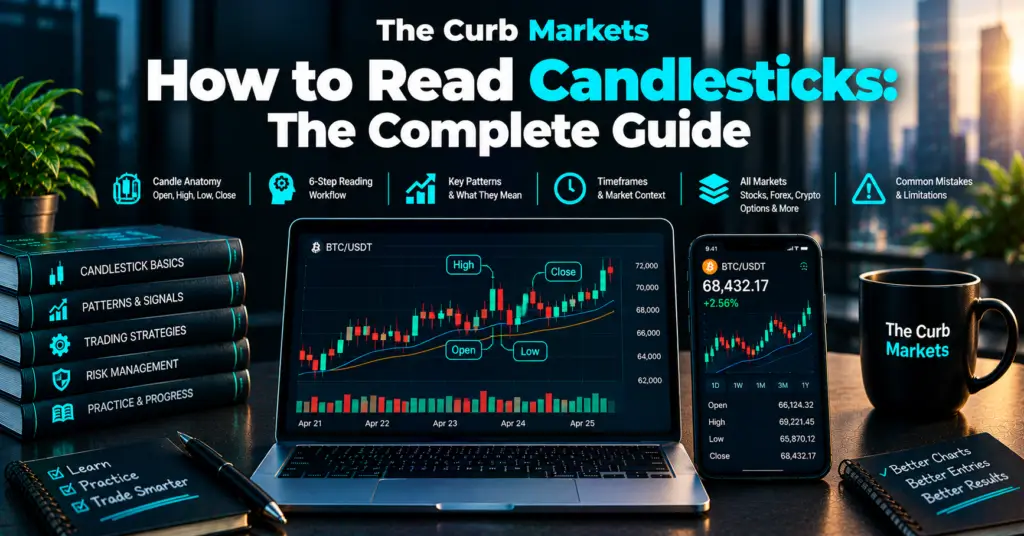
Most traders use candlestick charts. Each candle represents a chosen period of time, such as one minute, one hour, or one day. The thick part of the candle, called the body, shows where the price opened and closed during that period. The thin lines, called wicks, show the highest and lowest prices reached. Usually a green candle means the price closed higher than it opened, and a red candle means it closed lower, though some platforms let you switch the colors.
Timeframes
A short timeframe, like five minutes, shows a lot of noise. A longer timeframe, like a day or a week, shows the broader direction. A common habit is to look at a longer chart first to understand the overall trend, then zoom in to choose entry and exit points. Beginners who only stare at one minute charts tend to overtrade and get shaken out by random movement.
Support and resistance
Support is a price area where a falling coin has often stopped and bounced, because buyers stepped in. Resistance is an area where a rising coin has often stalled, because sellers appeared. These zones are not magic walls, and prices break through them all the time. Still, they help you think about where a trade might make sense and where your stop loss could sit.
Trends
An uptrend is a series of higher highs and higher lows. A downtrend is a series of lower highs and lower lows. A sideways market, sometimes called a range, moves between support and resistance without a clear direction. Identifying which condition you are in before you trade is one of the most useful habits a beginner can build.
Volume
Volume shows how much of a coin was traded during a period. A price move backed by high volume is generally more meaningful than one on low volume. When a price rises with shrinking volume, it may signal weak interest and a possible reversal.
Common indicators
| Indicator | What it shows | How beginners use it |
|---|---|---|
| Moving average | The average price over a set number of periods, smoothing out noise | To see the general trend direction |
| Relative strength index (RSI) | Whether recent buying or selling has been unusually strong | To spot when a move may be stretched |
| MACD | The relationship between two moving averages | To notice changes in momentum |
| Bollinger Bands | How far price has moved from its average relative to normal swings | To judge volatility |
Do not pile ten indicators on one chart. Beginners who do this end up with confusing, conflicting signals. Learn one or two well, and remember they are tools for probability, not crystal balls.
Using live data wisely
When people search for cryptocurrency trading live, they usually want real time prices, live charts, or live streams of experienced traders. Real time price data is available for free on exchanges and on market tracking sites. Live streams and social media commentary can be educational, but they can also create pressure and false confidence. If a streamer shows only wins, you are seeing a highlight reel. Treat live commentary as one opinion, never as instructions, and never place a trade purely because a stranger on video did.
Pay attention to the news too. Major announcements, regulatory decisions, and exchange problems often move markets. A simple habit is to check a trusted news source and an economic calendar before trading, so that an unexpected event does not catch you off guard.
10. Popular Crypto Trading Strategies
A strategy is simply a set of rules you follow so your decisions do not depend on your mood. There is no single best strategy. The right one depends on how much time you have, how much risk you can stomach, and how much you have learned.
Buy and hold
Often called HODLing, this means buying a coin and keeping it through the ups and downs, based on a belief in its long term future. It needs little screen time, which protects you from emotional trading. The downside is that you must endure very large drops, and some coins never recover. Holding only makes sense with assets you have researched and money you can leave alone for years.
Dollar cost averaging
With dollar cost averaging, you invest a fixed amount at regular intervals, such as every week or month, regardless of price. Sometimes you buy high and sometimes low, and over time your average purchase price smooths out. This approach reduces the temptation to guess the perfect moment, which even professionals cannot do reliably. It does not guarantee profit, but it is one of the calmer ways for a beginner to build a position.
Swing trading
Swing traders try to capture price moves that last days or weeks. They study charts to spot a trend, enter when it looks promising, and exit when the move seems to fade. It requires less constant attention than day trading, but it still needs planning, patience, and strict risk rules.
Day trading
Day traders open and close positions within the same day, trying to profit from small price changes. It demands constant focus, fast decisions, and a strong stomach for stress. Fees add up quickly because of the number of trades. Research on retail day traders in many markets has repeatedly found that most lose money over time. If you try it, do so with tiny amounts after months of preparation.
Scalping
Scalping goes even faster than day trading, aiming for very small gains on many trades within minutes. It is usually unsuitable for beginners because fees, spreads, and mistakes can erase the small profits.
Arbitrage
Arbitrage means profiting from a price difference for the same coin on two markets, buying where it is cheaper and selling where it is higher. In theory it is low risk, but in practice competition from automated systems, transfer delays, and fees make it hard for individuals to profit consistently.
Staking and lending
Some coins let you earn rewards for locking them up to help run a network. This is not trading, but it is often mentioned alongside it. The rewards are not guaranteed, your coins may be locked for a period, and platforms offering high returns have collapsed in the past, taking user funds with them. Treat any unusually high yield as a warning.
Choosing your starting point
| Strategy | Time needed | Stress level | Suitable for beginners? |
|---|---|---|---|
| Buy and hold | Very low | Low to medium | Yes, with research |
| Dollar cost averaging | Very low | Low | Yes |
| Swing trading | Medium | Medium | After learning the basics |
| Day trading | High | High | Not recommended at first |
| Scalping | Very high | Very high | No |
11. Risk Management for Crypto Traders
Ask experienced traders what separates the ones who survive from the ones who quit, and most will say the same thing: risk management. You can be wrong about the market again and again and still stay in the game, provided each mistake costs you only a small part of your money.
Only use money you can afford to lose
This rule appears in every serious guide because it matters more than any chart pattern. Do not borrow money to trade. Do not use savings meant for family needs. Do not sell useful assets to fund a trade because someone said the price will rise.
Risk a small percentage per trade
Many traders limit the loss on any single trade to one or two percent of their trading balance. If your account holds 1,000 units of currency, a two percent risk means you are willing to lose 20 on that trade. To follow this rule, you decide your stop loss first, then calculate the position size that keeps your loss inside your limit.
Use stop loss orders
A stop loss closes a trade automatically when the price drops to a level you have chosen. It removes the temptation to hope and wait while a loss grows. Keep in mind that in fast markets, a stop can fill at a worse price than you set, which is called slippage.
Avoid leverage as a beginner
Leverage lets you trade with borrowed money. A leveraged position multiplies gains, but it multiplies losses in exactly the same way, and it can be liquidated, meaning force closed, after a modest price move against you. Some CFD providers report that a majority of their retail customers lose money. As a beginner, stay with spot trading and skip leverage entirely.
Diversify sensibly
Putting everything in one small coin is a gamble. Spreading money across several assets reduces the damage if one fails. Keep in mind that most crypto assets tend to rise and fall together during big market moves, so diversification inside crypto does not provide full protection. Diversifying across different kinds of investments outside crypto is even more important.
Protect your keys and accounts
Security is part of risk. Use two factor authentication, keep software updated, avoid public wireless networks for financial actions, and never click links in messages claiming to be from your exchange. Bookmark the official website rather than searching for it each time, because fake sites often pay for search advertisements.
Have a plan before you enter
Before each trade, know your entry price, your stop loss, your target, and the amount you are risking. Write it down. If you cannot explain why you are taking the trade in one or two sentences, do not take it.
12. Can You Make $100 a Day Trading Crypto?
This is one of the most searched questions about crypto, and it deserves a plain answer. It is possible for a trade to earn $100 in a day. It is not realistic to count on earning $100 every day, especially as a beginner.
Here is why. To make $100 a day consistently, you need either a large amount of capital or a very high return on a small amount. Suppose you have $500 to trade. Earning $100 daily would mean a twenty percent gain every single day, which no reliable method delivers. Even a large professional fund would be delighted with a return that is a tiny fraction of that. On the other hand, someone with $50,000 might aim for a small percentage return each day and reach $100, but that person also carries the risk of losing thousands in a bad day.
Beyond the arithmetic, remember these points:
- Most retail traders lose money, especially in short term trading.
- Screenshots of huge profits online are cherry picked. They rarely show the losing days, the losing accounts, or the fake ones.
- Selling courses, signals, and "copy trading" services is often more profitable than trading itself for the people promoting them.
- Chasing a daily income target pushes people toward bigger positions and leverage, which is exactly how accounts get wiped out.
A healthier approach is to focus on learning and protecting your capital for the first year. Track your results over months, not days. If you eventually develop a strategy that works, income will come as a byproduct of consistent process. If someone promises you $100 a day, treat that promise as a red flag, not an opportunity.
13. How Much Will 1 Bitcoin Be Worth in 2030?
You will find dramatic predictions online, from Bitcoin reaching several times its present value to collapsing to almost nothing. The honest truth is that nobody knows, and anyone claiming certainty is guessing or selling something.
There are good reasons why forecasting is so hard:
- Crypto has no earnings to analyze. Stocks can be judged partly on company profits. Bitcoin's price rests on demand, belief, adoption, and market mood, which are difficult to measure.
- Outside events matter. Government decisions, interest rates, wars, banking crises, and technology changes can all shift prices in ways nobody can time.
- Past performance does not guarantee the future. Bitcoin has seen huge rises and painful crashes in its history. Repeating an old pattern is possible, but not promised.
- Predictions are often marketing. Big price targets attract attention, clicks, and new buyers, which benefits those who already own the coin or run the platform.
So how should you think about it? Treat forecasts as scenarios rather than facts. Ask what would need to be true for a price target to happen, who is making the claim, and what they gain from it. Many thoughtful people use ranges and probabilities instead of a single number, and they accept a wide set of possible outcomes, including very bad ones.
A practical rule is to make decisions you could live with in any scenario. If you invested only a modest amount you can afford to lose, then a much higher price would be a pleasant surprise and a much lower price would be disappointing but survivable. That is a much better position than betting everything on a prediction.
14. Taxes, Laws, and Staying Safe
Taxes
In many countries, profits from selling or swapping crypto are taxable. Some places also tax crypto received as payment, mining or staking rewards, and even swaps from one coin to another. Rules differ widely, and they change. Keep records of every transaction, including the date, the amount, the price, and the fees. Good records make your life much easier at tax time, and many exchanges let you export a history of your trades. Speak to a qualified local tax professional if you are unsure.
Regulation
Some governments have set clear licensing rules for exchanges and traders. Others have restricted banking access to crypto, limited certain activities, or banned trading altogether. A few remain uncertain or are still writing their laws. Before you use a platform, check whether it is permitted where you live, and whether your bank allows transfers to it. Using an unlicensed platform may leave you without any legal protection if something goes wrong.
Common scams to know
- Fake investment platforms: Websites that show fake profits on screen and then refuse withdrawals unless you pay more fees.
- Romance and friendship scams: A stranger builds trust over weeks, then suggests a "great platform" for you both to invest in.
- Rug pulls: Creators launch a new token, attract buyers, then vanish with the money.
- Pump and dump groups: Organizers push a small coin to attract buyers while they sell into the excitement.
- Phishing: Fake emails, messages, or websites that steal your login details or wallet phrase.
- Impersonation: Accounts pretending to be support staff, celebrities, or well known traders.
- Recovery scams: People who claim they can get back lost crypto for an upfront fee.
The best protection is skepticism. If an offer sounds too good to be true, promises guaranteed returns, or creates urgency, step back. Talk to someone you trust before sending money.
15. How to Learn Crypto Trading: Courses and Resources
Many people search for a cryptocurrency trading course, and it is a sensible thing to want. Structured learning can save you from expensive trial and error. The trouble is that the crypto education market is full of overpriced courses run by people whose main income comes from selling the course.
Where to learn for free
- Exchange learning centers: Many large platforms publish free explanations of terms, order types, and security. Keep in mind they also want you to trade, so read with that in mind.
- University and online learning platforms: Well known education sites offer beginner courses on blockchain and digital assets, some free to audit.
- Official documentation: The Bitcoin and Ethereum project websites explain how their networks work in detail.
- Regulator and consumer protection websites: Financial authorities in many countries publish warnings and guides about crypto risks.
- Reputable news and research outlets: Following a few careful sources keeps you informed without the noise of social media.
- Books: Well reviewed books on investing psychology and technical analysis teach lessons that outlast any single market cycle.
How to judge a paid course
| Good signs | Warning signs |
|---|---|
| Clear syllabus and honest description of risks | Promises of income or a "secret system" |
| Instructor with a verifiable background and public track record | Anonymous teacher or luxury lifestyle marketing |
| Focus on risk management, psychology, and process | Focus only on entries and quick profit |
| Refund policy and realistic pricing | Countdown timers, pressure to buy today, huge fees |
| Independent reviews from real students | Only testimonials selected by the seller |
Before paying for anything, spend a few weeks with free material. You will quickly discover whether a paid course is teaching something new or just repeating what is already available.
Using demo accounts and small real trades
Reading is only half of learning. Combine it with a demo account or small real trades, and keep your journal. Try to understand your mistakes, not just your wins. After three to six months of careful practice, you will know far more than someone who jumped in after watching one video.
Charts, PDFs, and cheat sheets
Beginners sometimes hunt for downloadable guides and quick reference sheets. These can help as revision notes, but check the publication date, since crypto changes fast, and be careful with files from unknown sources, which can contain malware. Making your own one page summary of the terms and rules you have learned is often more useful than any file you download.
16. Common Beginner Mistakes
Almost every experienced trader has made most of these errors. Knowing them in advance can save you real money.
- Trading with money they cannot afford to lose. Fear of losing rent money leads to terrible decisions.
- Chasing hype. Buying a coin after it has already risen sharply because everyone online is excited is a classic way to buy near the top.
- Ignoring fees. Frequent small trades can produce a loss even when the price direction was right.
- Using leverage too early. It magnifies mistakes, and it can wipe out an account in minutes.
- No exit plan. Some traders know why they bought but have no idea when they will sell, either for a profit or a loss.
- Moving stop losses further away. This turns a small loss into a large one because the trader cannot accept being wrong.
- Revenge trading. After a loss, some traders take bigger, worse trades to win it back immediately.
- Overtrading. More trades do not mean more profit. Boredom is expensive.
- Falling for influencers and signal groups. Paid signals and promoted coins often benefit the promoter more than the follower.
- Putting everything in one coin. A single failure can then destroy everything.
- Weak security. Reused passwords, no two factor authentication, or a recovery phrase saved in a phone photo are common ways people lose funds.
- Forgetting taxes and records. A messy history creates stress and sometimes legal trouble later.
- Believing losses are unusual. Losses are a normal part of trading. The goal is to keep them small.
17. Trading Psychology and Realistic Expectations
Knowledge of charts and tools matters, but your own mind is often the biggest challenge in trading. Prices move quickly, money is on the line, and emotions rise. Two feelings do most of the damage.
Fear of missing out pushes you to buy something because it is rising fast and you cannot bear to watch others profit. Panic pushes you to sell everything at the bottom because a drop feels unbearable. Both lead to buying high and selling low, which is the opposite of what you intended.
Habits that help
- Write your plan before you trade and follow it.
- Limit how often you check prices. Constant watching increases stress and impulsive actions.
- Accept that some trades will lose, and judge yourself on your process, not on a single result.
- Take breaks after big wins and big losses, since both can cloud judgment.
- Keep trading small until you can follow your rules calmly for months.
- Keep other parts of life healthy. Sleep, exercise, and time with friends protect your decision making.
What realistic progress looks like
In the first months, expect to learn more than you earn. You may break even, you may lose a little, and you will probably make mistakes you did not anticipate. That is normal. Over the first year, a reasonable aim is to protect your capital, understand your own habits, and build a repeatable process. Profit, if it comes, arrives slowly and inconsistently. Anyone offering a faster route is either lucky, dishonest, or selling something.
If trading begins to affect your sleep, relationships, work, or mental health, or you find yourself chasing losses or hiding activity from family, take it seriously. Stop trading for a while and talk to someone you trust or a qualified professional. No profit is worth that cost.
18. Frequently Asked Questions
What is cryptocurrency trading in simple words?
It is buying and selling digital coins such as Bitcoin or Ethereum on an online exchange, hoping to gain from price changes. Prices can rise or fall, so you can make money or lose money.
How do I start crypto trading as a complete beginner?
Check that crypto is legal where you live, learn the basics, choose a reputable exchange, verify your account, secure it with two factor authentication, deposit a small amount you can afford to lose, and make a simple first trade. Keep a journal and learn from every trade.
Is cryptocurrency trading safe?
It is not risk free. Prices are volatile, scams are common, and exchanges can fail. You can reduce risk by using reputable platforms, protecting your accounts, avoiding leverage, and only using money you can afford to lose.
Can I start crypto trading with a very small amount?
Often yes, because you can buy fractions of a coin. Watch out for minimum order sizes and fees, which can take a large share of a tiny purchase. Use small amounts to learn, not to expect income.
Is crypto trading the same as gambling?
Not exactly, but careless trading can behave like gambling. Trading with a plan, limited risk, and research is different from placing random bets on hype. Even so, outcomes remain uncertain, so caution is essential.
Which is the best cryptocurrency trading platform?
There is no single best option for everyone. The right one is legal in your country, secure, clear about fees, supports the coins you want, and has a design you understand. Test with a small amount first.
What is the best crypto trading app for beginners?
Look for an app from a well established exchange with a simple mode, clear fee display, strong security options, and helpful learning material. Read recent reviews and test withdrawals early.
Do I need a cryptocurrency trading course?
No, but structured learning can help. Start with free material, and only pay for a course if the teacher is credible, the content is honest about risk, and the price is reasonable.
Where can I watch cryptocurrency trading live?
Exchanges and market tracking sites provide live prices and charts. Some educators host live streams. Treat these as learning tools, not as instructions to copy.
Do I have to pay tax on crypto profits?
In many countries, yes. The rules depend on where you live and can change. Keep records of every transaction and consult a local tax professional.
Can I lose more than I invest?
With simple spot buying, you can lose your full amount but not more. With leveraged products, losses can be larger or lead to debt on some platforms, which is another reason to avoid them at first.
19. Conclusion
Cryptocurrency trading attracts people because it feels open, fast, and full of possibility. It is also volatile, poorly understood by many newcomers, and full of scams and false promises. The people who do best over time are rarely the ones chasing the biggest gains. They are the ones who learn patiently, protect their money, follow a plan, and treat losses as part of the cost of doing business.
To recap the main lessons of this guide: understand what you are buying and how the market works, choose a legal and secure platform, start small with money you can afford to lose, learn to read a chart without expecting it to predict everything, use risk management on every trade, be honest about taxes and laws, and ignore anyone who promises easy daily income or certain price targets. If you follow these habits, you give yourself the best chance of learning cryptocurrency trading in a way that is sustainable and safe.
Take your time. There is no prize for rushing, and the market will still be there next month. Start with education, practice with small steps, and let experience, not excitement, guide your decisions.
- What Is Bitcoin and How Does It Work?
- How to Read Candlestick Charts for Beginners
- Crypto Wallets Explained: Hot Wallets and Cold Wallets
- How to Spot Crypto Scams and Protect Your Money
- Crypto Tax Basics: Records You Should Keep