Educational content. Nothing here is financial advice, and no vetting process can guarantee a server, bot, or signal provider is safe. Crypto Discord communities carry real risks alongside real value, so treat every recommendation in this guide as a starting point for your own judgment, not a substitute for it.
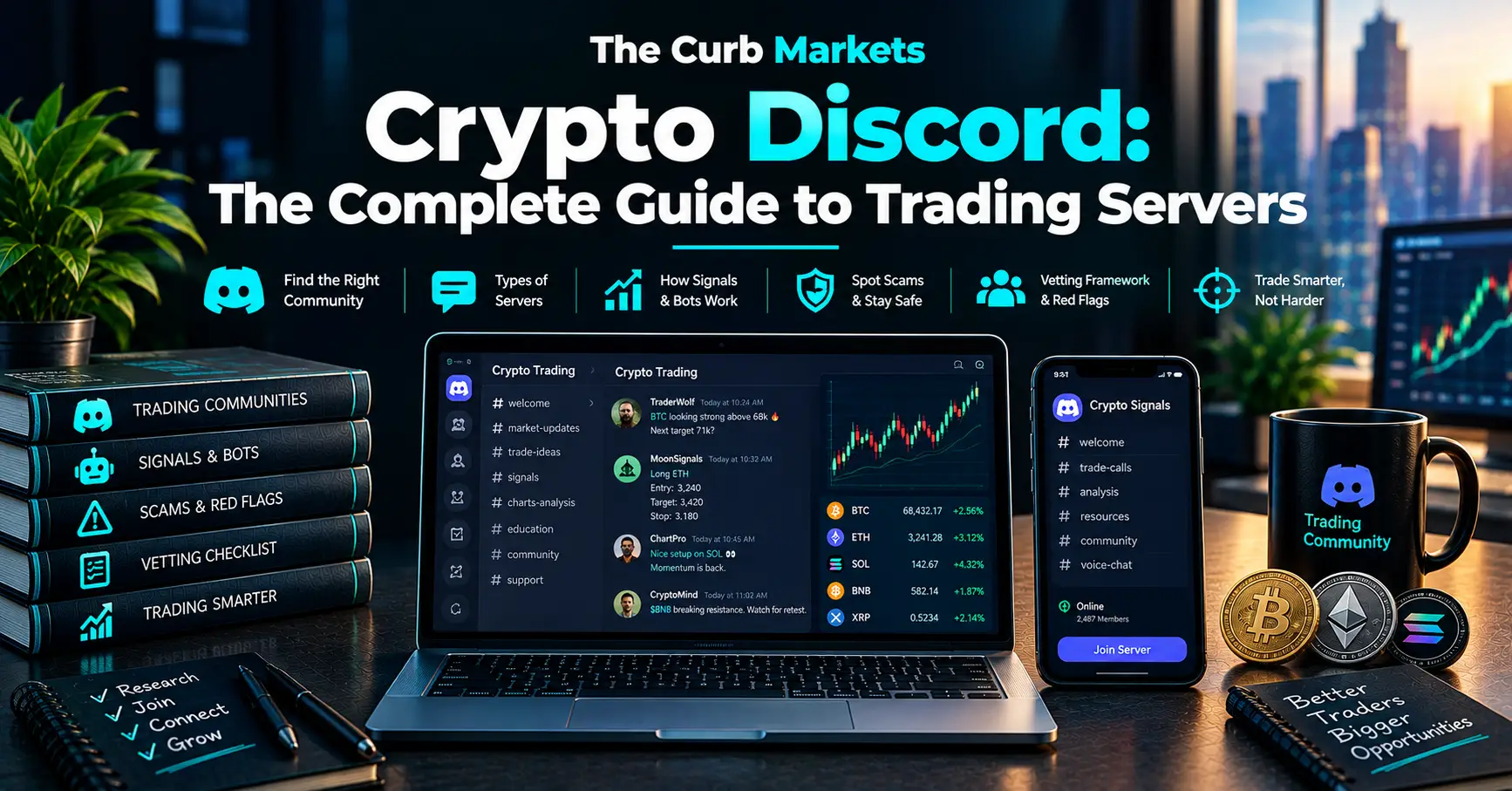
Crypto Discord communities can be genuinely useful: a place to catch project news early, discuss market structure with people who actually trade, or get a second opinion before entering a position. They can also be active hunting grounds for wallet-draining bots, fake support DMs, and pump-and-dump signal groups, often inside the very same server that does the useful stuff. The two sides aren’t easy to tell apart from the outside, which is exactly why so many people get burned.
This guide covers what crypto Discord communities actually are, the different types you’ll run into, how signals and bots work, and, most importantly, the scam patterns specific to this space that don’t really exist anywhere else in trading communities. By the end, you’ll have a concrete framework for finding legitimate servers and keeping your wallet safe inside them.
Top 9 Crypto Trading Discord Servers to Join
| # | Server Name | Short Description | Join |
|---|---|---|---|
| 01 | The Curb Markets | Crypto & forex community for market insights and trade ideas. | Join → |
| 02 | Axion Trading | Crypto community offering signals, analysis, and trading education. | Join → |
| 03 | Jacob’s Crypto Clan | Crypto community covering signals, DeFi, and trading education. | Join → |
| 04 | Bitcoin Heroes | Bitcoin and altcoin community focused on analysis and trading. | Join → |
| 05 | Cryptic | Crypto community covering technical analysis, futures, and DeFi. | Join → |
| 06 | Birdeye | On-chain crypto community focused on data and market analysis. | Join → |
| 07 | CryptoCurrency | Broad community covering crypto markets, news, and trading. | Join → |
| 08 | Crypto Awaz | Crypto community featuring trading calls, analysis, and airdrops. | Join → |
| 09 | Top Tier Signals | Trading community offering crypto signals and market alerts. | Join → |
What Is a Crypto Discord
A crypto trading Discord, sometimes just called a discord crypto community, is a Discord server organized around cryptocurrency: price discussion, trade ideas, project updates, or all three at once. The label covers a wide range of things, from an exchange’s official support channel to a scrappy, unofficial server run by a handful of traders who happen to like the same coin.
Broadly, these communities fall into a few overlapping categories:
- Official project and exchange servers, run or moderated by the team behind a token or platform
- Independent trading and signal communities, built by traders rather than projects, often centered on calls and market discussion
- Asset-specific groups, organized around a single coin or ecosystem
- NFT and DeFi-adjacent servers, which frequently overlap with the trading and signal categories above
Quality varies enormously across all of these. A server’s polish, member count, or “verified” badge tells you very little on its own. Some of the most dangerous servers are the most professional-looking ones, because that’s the point.
Types of Crypto Discord Servers
Crypto Trading Discord Communities
These are independent servers built around trading itself rather than a specific project. A typical crypto trading discord community includes channels for technical analysis, market commentary, and, frequently, paid or free trade calls from a designated signal provider or a rotating cast of active traders.
The appeal is obvious: real-time discussion with people who are actually in the market, faster than any newsletter or article. The risk is just as real, and it’s concentrated almost entirely in the signals section, which we’ll get to below.
Discord Crypto Exchange Servers
Most major exchanges run their own official servers for support, announcements, and general community discussion. These tend to be lower-risk than independent trading communities simply because there’s a real company with a reputation on the line, but they’re not risk-free. Exchange servers are a favorite target for impersonation scams, since a fake “support” DM claiming to come from an exchange carries built-in credibility.
Asset-Specific Servers (Ethereum, XRP, and Others)
Communities built around a single coin or ecosystem, such as an ethereum trading discord or xrp trading discord, typically blend two things: project-related updates (development news, ecosystem announcements) and trading discussion about that asset specifically. Quality here varies more than almost any other category, because the gap between an official, developer-linked server and an unofficial fan-run one can be enormous, and the two often look identical to a newcomer.
NFT and DeFi-Focused Servers
Worth a brief mention for completeness: NFT project servers and DeFi protocol communities operate under very similar dynamics to crypto trading servers, including official channels, community discussion, and a real risk of impersonation and phishing, particularly around mint dates and airdrop announcements. Most of the guidance in this article applies to them equally.
Discord Crypto Signals: The Honest Risks
A “signal” in this context means the same thing it does in trading Discords generally: someone posting a specific trade idea, often with an entry, target, and stop-loss, for others to follow. This section focuses on what’s different about crypto specifically, building on the general signal skepticism that applies to any Discord trade call.
Here’s the crypto-specific twist: the market includes thousands of low-liquidity tokens where a relatively small amount of buying pressure can move the price meaningfully. That creates a direct incentive problem. A signal caller who already holds a position, and many do, benefits personally from getting followers to buy the same token, regardless of whether the trade actually makes sense. In practice, this is functionally closer to a pump-and-dump than to genuine, disinterested analysis, even when it isn’t labeled that way.
That doesn’t mean every signal in every crypto Discord is dishonest. It means the incentive structure is different from, say, a stock-focused server, and it deserves a correspondingly higher bar of skepticism. A useful test: can you verify this call against something outside the server itself, such as on-chain data, exchange volume, or an independent chart, before acting on it? If the only evidence a signal is legitimate is the confidence with which it’s posted, that’s not evidence.
Crypto Discord Bots: What They Actually Do
Bots are a bigger part of the crypto Discord ecosystem than in almost any other trading-community niche, and they range from genuinely useful to actively dangerous.
Price and Alert Bots
The most common and lowest-risk category: bots that post price movements, volume spikes, or breaking news into a channel automatically. These are read-only in the sense that they don’t ask anything of you, they just push information.
Verification and Role Bots
Legitimate crypto Discord bot setups often use a verification bot to assign server roles based on token or NFT holdings, for example granting access to a members-only channel if you hold a certain amount of a project’s token. Done correctly, this is a read-only wallet check: the bot confirms what you hold without requiring you to sign anything or grant any permissions. This distinction, read-only checking versus requesting a signature, is the single most important concept in this entire guide, and it comes up again in the next section.
Trading Execution Bots
Some servers offer bots that place trades automatically based on signals, removing the human decision-making step entirely. This carries the same elevated risk that applies to any automated trading bot: no human review sits between a call, good or bad, and real capital moving. Combine an execution bot with a self-interested signal caller, and you’ve automated the exact problem described in the section above.
Discord Crypto Wallet Bot Scams: What to Watch For
This is the section worth reading most carefully, because it’s the risk that’s genuinely unique to crypto Discord communities and doesn’t have a real equivalent in stock or forex trading spaces.
The pattern: a bot, or a DM claiming to be from one, tells you that you need to “verify” your wallet or your holdings to access a channel, claim a role, or receive an airdrop. It directs you to a site, or to a wallet pop-up, and asks you to connect and approve something.
The critical distinction: a legitimate holdings check is read-only. It looks at what’s in your wallet without needing your permission to do anything with it. It never requires you to sign a transaction or approve token spending. The moment a “verification” step asks for a signature or an approval, that is very likely a wallet-draining attempt, not a check, regardless of how official the site or the bot looks.
Here’s what actually happens if you approve one of these: you’re not necessarily watching funds leave your wallet in that moment, which is part of what makes the scam effective. Instead, the approval grants a smart contract, controlled by the scammer, ongoing permission to move a specific token (or in some cases, broad permission) out of your wallet whenever they choose. The theft can happen minutes, hours, or days later, long after you’ve forgotten about the “verification” you did.
How to protect yourself:
- Treat any request to sign or approve something as part of a “verification” process as an automatic red flag. Legitimate checks don’t need it
- Never connect a wallet holding meaningful funds to an unfamiliar site, no matter how official-looking the branding
- Use a separate, low-balance wallet for any interaction you’re not completely certain about. This limits the damage if something does go wrong
- Periodically review and revoke token approvals you no longer recognize or need, using a reputable revocation tool
Discord Crypto Scam Messages and Spam: How to Recognize Them
Beyond wallet-draining bots specifically, crypto Discord communities see a high volume of scam messaging that follows a few recognizable patterns.
Fake Support Impersonation
Scammers pose as server staff, moderators, or official exchange support, often initiating contact via DM. This is a strong tell on its own: in a well-run server, real support and moderation staff generally don’t DM users first out of nowhere. If someone claiming to be staff messages you unprompted, that alone is worth treating with suspicion.
Fake Giveaway and Airdrop Messages
Urgency-driven messages claiming you’ve been selected for a free token airdrop or giveaway, but requiring you to take some action first, such as connecting a wallet, clicking a link, or “verifying” eligibility, before you can claim it. The urgency and the required action beforehand are both designed to short-circuit careful thinking.
Mass DM Spam and Invite Bots
Compromised accounts, or bots controlling them, mass-sending server invites, links, or “opportunities” to as many users as possible. Even a message from someone whose account you recognize isn’t necessarily safe. Compromised accounts are a common vector precisely because they carry borrowed trust.
The common thread across all three: an unsolicited DM, a sense of urgency, and a request to click a link or connect a wallet. When those three elements show up together, treat it as a near-certain red flag, no matter how official the message looks, how convincing the branding is, or how well-timed it seems.
How to Find and Join Legitimate Crypto Discord Servers
The safest way to find a project’s real Discord server is to get the link directly from the project’s official website or a verified social media account, not from a random search result, a DM, and not from a link posted in an unrelated server.
This matters because fake “official” server links are one of the most common scam vectors in this space. A cloned server, with the same name, same icon, and same channel structure, can look identical to the real one at a glance, and by the time you notice something’s off, you may have already interacted with a malicious bot inside it.
Rather than pointing you to a list of specific servers, which changes constantly and would go stale quickly, the more durable skill is the verification habit itself:
- Go to the project’s own website directly (typed in, not clicked from a search ad)
- Find the Discord link listed there, or on a verified official social account
- Cross-check that the server name and icon match what’s listed
- Be wary of any server link shared in DMs, comment sections, or unrelated servers, even if it looks correct
This habit stays useful indefinitely, regardless of which specific servers exist at any given moment.
What Communities Actually Say About Crypto Trading Discords
Across trading and crypto discussion spaces generally, sentiment toward paid signal servers specifically tends to run skeptical, and for good reason. Recurring, credible warnings about coordinated pump schemes, where a group of signal followers buy in together to create the price movement the “signal” then claims to have predicted, come up often enough to be a genuine pattern rather than isolated complaints.
That skepticism is worth taking seriously rather than dismissing as background noise. When a category of server has a consistent reputation problem among the very communities that use it, that reputation is itself useful information, arguably more useful than anything the server says about itself.
Crypto Discord Servers in 2026: What’s Changed
A few general trends are worth flagging, understanding this is a fast-moving space and specifics shift often:
- More established communities have moved toward wallet-based verification and KYC gating for access to certain channels, partly in response to the scam patterns described above
- Scam bots and phishing techniques have gotten more sophisticated in parallel, often mimicking legitimate verification flows closely enough that the distinction between a read-only check and a signature request is the main thing separating safe from unsafe
- The core safety principles in this guide, including verifying sources, never signing to “verify,” and using a low-balance wallet for unfamiliar interactions, remain the most reliable defense regardless of how the specific scams evolve
(This section addresses a fast-moving landscape and is worth revisiting periodically.)
Crypto Discord Emoji and Community Culture
On a lighter note: many crypto Discord servers develop their own custom emoji, tied to a project’s mascot, ongoing memes, or in-jokes that build up within the community over time. It’s a small thing, but it’s part of what makes these servers feel like communities rather than just information feeds, and it’s often one of the more visible signs of an active, engaged server versus a quiet or abandoned one.
How to Vet a Crypto Discord Server Before Joining
Beyond checking moderation activity, member engagement, and how the server handles disagreement, a few things are specific to crypto.
Crypto-Specific Red Flags
- Anonymous or unverifiable project teams, especially combined with aggressive marketing or promises of guaranteed returns
- Pressure to connect a wallet immediately upon joining, before you’ve had any chance to evaluate the server
- Signal callers who never disclose their own positions, making it impossible to judge whether they’re sharing analysis or promoting a bag they already hold
- Servers that discourage members from discussing losses, which tends to indicate a community more interested in maintaining a positive narrative than in honest trading discussion
Staying Safe: A Crypto Discord Security Checklist
- Never sign a wallet transaction or approval as part of a “verification” step. A genuine holdings check is always read-only
- Never share a seed phrase or private key with anyone, under any circumstance, including someone claiming to be support
- Use a separate, low-balance wallet for any interaction with an unfamiliar server or bot
- Enable two-factor authentication on your Discord account itself
- Adjust your Discord privacy settings to limit DMs from non-friends, since most scam contact arrives this way
- Verify official server links only through a project’s own verified website or social account, never through a DM, comment, or unrelated server
Frequently Asked Questions
Are crypto Discord servers safe? Some are, some aren’t, and the two can look nearly identical from the outside. Official servers tied to a real project or exchange tend to carry less risk, but no server is risk-free. The safety comes from your own habits (never signing to “verify,” using a low-balance wallet for unfamiliar interactions) more than from any property of the server itself.
How do I know if a crypto Discord server is legit? Get the server link directly from the project’s official website or a verified social account, cross-check the server name and icon against those sources, and be wary of any link shared through a DM or an unrelated server, even if it appears correct.
What is a wallet-draining bot? A bot or DM that requests a wallet “verification” involving a signature or token approval, rather than a genuine read-only check. Approving it grants a scammer’s contract ongoing permission to move tokens out of your wallet, sometimes long after the initial interaction.
Can joining a Discord server compromise my wallet? Joining a server by itself doesn’t put your wallet at risk. The risk comes from connecting a wallet and signing or approving something inside that server, so the server membership itself is safe, but what you do with a bot or link inside it may not be.
Are crypto trading signals on Discord reliable? Treat them with real skepticism, especially in low-liquidity tokens where a signal caller who already holds a position has a direct incentive to promote it. A signal you can independently verify against on-chain or exchange data is worth more than one you can’t.
What should I do if I think I’ve connected my wallet to a malicious site? Use a reputable token approval revocation tool to check and revoke any permissions you don’t recognize, and move remaining funds to a new wallet if you’re unsure what was approved.
Is it safe to use a role verification bot in a crypto Discord? Legitimate role bots use read-only checks and don’t require a signature or approval, so those are generally safe. If a “verification” bot asks you to sign or approve something, treat it as a wallet-draining attempt rather than a real check.
Do official exchange Discord servers ever DM users first? Generally, no. Legitimate support and moderation staff in well-run servers rarely initiate DMs out of nowhere. An unsolicited DM claiming to be exchange support is one of the more reliable red flags in this space.
Conclusion
The value of a crypto Discord community is real: faster information, real discussion, a genuine sense of community around a project or an approach to trading. So is the risk, and both live in the same servers, sometimes the same channels. Managing that risk comes down to one habit applied consistently: verify before you connect, click, or trust, whether that’s the source of a server link, the nature of a “verification” request, or the incentives behind a signal.