Leverage gets sold as more buying power for less money, and that framing is technically true. What it usually leaves out is the other half of the equation: leverage magnifies losses by exactly the same amount it magnifies gains. It is not a tool that tilts the odds in your favor. It is a tool that scales whatever outcome was already coming, in either direction.
This guide answers what is leverage in trading directly and thoroughly: how leverage ratios actually work, the crucial difference between leverage and margin, how leverage behaves differently across stocks, forex, crypto, and futures, and what actually happens when a leveraged position goes wrong, from a margin call to a full stop out. We will use worked numeric examples throughout, since leverage is a concept that genuinely clicks once you see real numbers move through it rather than reading about it in the abstract.
By the end, the goal is not for you to walk away chasing the highest leverage ratio a broker will offer. It is for you to understand the actual mechanics well enough to size leverage deliberately, based on the instrument you are trading and your own risk tolerance, rather than defaulting to whatever maximum is available.
What Is Leverage in Trading?
Leverage in trading means using borrowed capital to control a position larger than your own funds alone would allow. A trader depositing a relatively small amount of their own capital, known as margin, can open a position worth significantly more than that deposit, with a broker or exchange effectively extending the difference.
What is leveraging in trading refers to the same underlying practice: the act of applying leverage to increase position size beyond what your own capital would support unassisted.
It is worth being precise about what leverage actually changes and what it does not. Leverage does not change the dollar size of a price move in the underlying market. A stock moving from one hundred dollars to one hundred and five dollars is a five percent move regardless of leverage. What leverage changes is how much of that move applies to your actual capital, since the position size being moved is larger relative to the money you put up.
What Is Leverage Ratio?
A leverage ratio expresses the relationship between the total value of a position and the margin required to open it. The formula is straightforward: leverage ratio equals total position value divided by margin required.
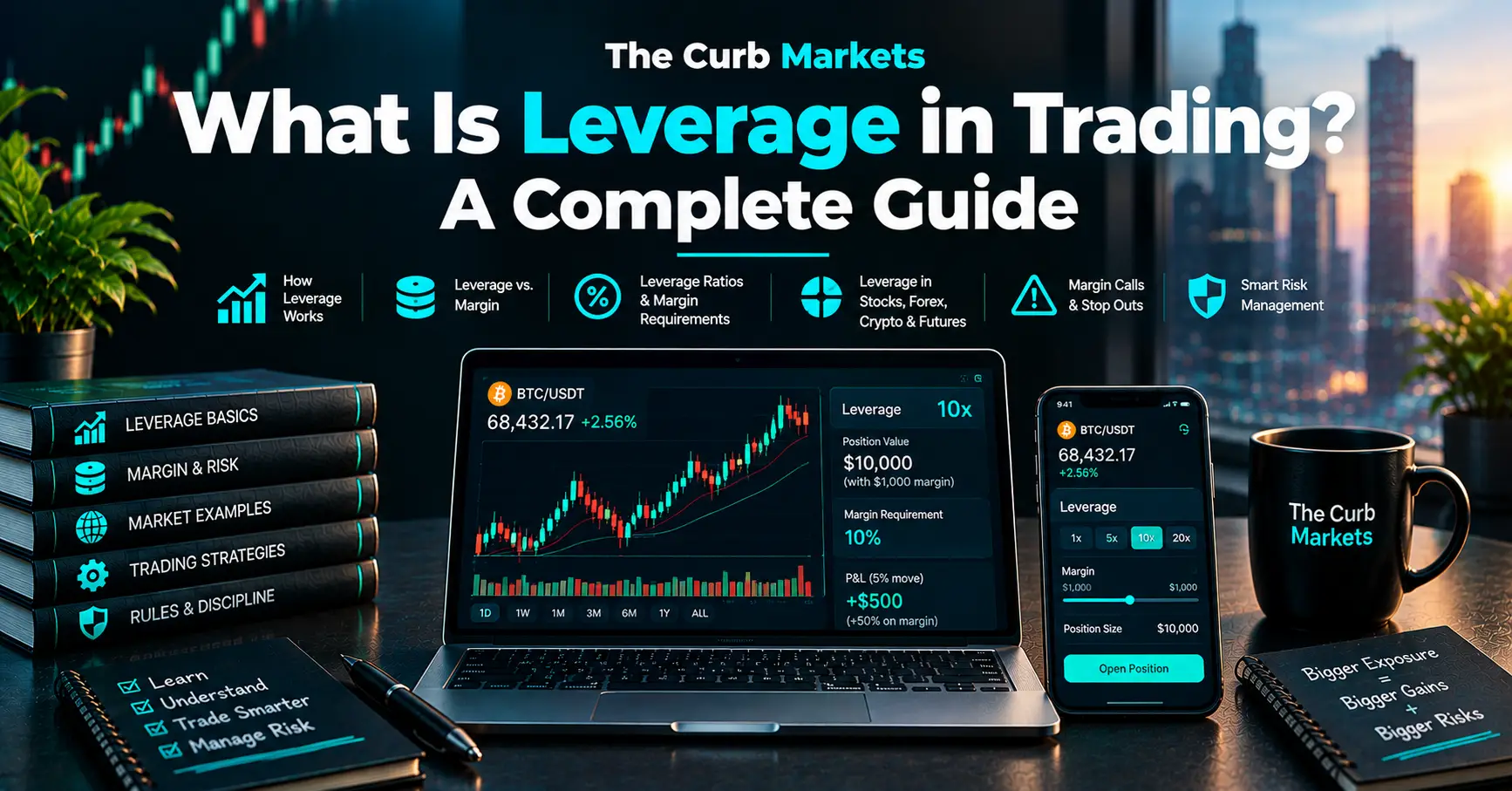
Consider a worked example. A trader deposits one thousand dollars as margin and uses ten to one leverage. That ratio means the trader can control a position worth ten thousand dollars, since ten thousand divided by one thousand equals ten.
It is worth noting that leverage ratio and margin percentage describe the exact same relationship, just from opposite directions. Ten to one leverage corresponds to a ten percent margin requirement, since one thousand dollars is ten percent of the ten thousand dollar position it controls. A broker or platform might quote either figure, a leverage ratio or a margin percentage, and converting between them is simply a matter of dividing one into one hundred, or one hundred into the ratio.
What Is Leverage and Margin in Trading? Understanding the Difference
This is genuinely the most important distinction in this entire guide, so it is worth slowing down and covering it thoroughly.
Margin is the actual capital you deposit as collateral to open and maintain a leveraged position. It is real money sitting in your account, set aside specifically to support the position you have open. Leverage, by contrast, is the resulting ratio of exposure that margin provides. Margin is the input. Leverage is the multiplier effect that input produces.
Required, or Initial, Margin
Required margin, sometimes called initial margin, is the specific amount of capital a broker requires you to deposit in order to open a given position. This figure is typically calculated as a percentage of the total position’s notional value, based on the leverage ratio being applied.
Free Margin
Free margin is the portion of your account equity that is not currently tied up as required margin on open positions. It represents the capital available to open new positions, or to absorb further adverse price movement on existing ones, without immediately triggering a margin call.
Margin Level
Margin level is calculated as account equity divided by used margin, expressed as a percentage. This is the key real time risk indicator most trading platforms display prominently, since it tells you, at any given moment, how much cushion exists between your current account state and a margin call or stop out.
Here is a worked numeric example connecting all three terms. A trader has five thousand dollars in account equity. They open a position requiring one thousand dollars in required margin. Their free margin is four thousand dollars, the equity remaining after subtracting used margin. Their margin level is five hundred percent, calculated by dividing the five thousand dollars in equity by the one thousand dollars in used margin, then multiplying by one hundred. As the position moves against the trader and equity declines, that margin level percentage falls in real time, and it is the number worth watching closely rather than waiting for a broker notification.
How Leverage Works: A Side by Side Example
Numbers make this concept click far more clearly than description alone, so here is a direct comparison.
Unleveraged trade. A trader buys ten shares of a one hundred dollar stock, paying one thousand dollars upfront for the full position, with no leverage involved.
Same exposure using ten to one leverage. A trader deposits one hundred dollars in margin and uses ten to one leverage to control the same one thousand dollar position, ten shares at one hundred dollars each.
Now consider both the upside and downside case for each.
Upside case. The stock rises five percent, from one hundred dollars to one hundred and five dollars. The unleveraged trader’s position is now worth one thousand and fifty dollars, a fifty dollar gain, representing a five percent return on their one thousand dollar outlay. The leveraged trader’s position is also now worth one thousand and fifty dollars, the same fifty dollar gain in dollar terms, but that fifty dollar gain represents a fifty percent return on their one hundred dollar margin deposit.
Downside case. The stock falls five percent instead, from one hundred dollars to ninety five dollars. The unleveraged trader’s position is now worth nine hundred and fifty dollars, a fifty dollar loss, representing a five percent loss on their original one thousand dollars. The leveraged trader’s position is also worth nine hundred and fifty dollars, the same fifty dollar loss in dollar terms, but that fifty dollar loss represents a fifty percent loss on their one hundred dollar margin deposit.
The symmetry here is the entire point. Leverage turned a five percent market move into a fifty percent return in the gain scenario, and it turned that same five percent market move into a fifty percent loss in the loss scenario, applying the identical multiplier in both directions without favoring either outcome.
What Is Leverage in the Stock Market?
Leverage in the stock market typically works through a margin account offered by a broker, distinct from a standard cash account where trades must be fully funded with your own capital. A margin account allows a trader to borrow a portion of a position’s value from the broker, using existing account equity as collateral.
Stock market leverage generally comes with meaningfully lower ratios than forex or crypto trading, largely due to regulatory limits placed on brokers offering margin accounts to retail traders. It is worth flagging clearly that specific margin percentage requirements are set by regulators and individual brokers, and these figures can and do change over time, so any specific number should be verified against current broker and regulatory disclosures rather than treated as a fixed fact from this guide.
What Is Leverage in Forex Trading?
Forex trading commonly offers meaningfully higher leverage ratios than stock trading, and the main reason comes down to liquidity. Major currency pairs are among the most heavily traded financial instruments in the world, with extremely high liquidity, which historically has allowed brokers to offer higher leverage ratios than markets with comparatively lower liquidity and higher typical volatility.
It is worth being clear that there is a wide regulatory range globally when it comes to forex leverage caps. Some regulatory regions cap retail forex leverage considerably lower than what offshore or less regulated brokers may offer. Both the specific capped figures in regulated regions and the higher figures sometimes advertised by offshore brokers should be treated as needing verification, since they vary by regulator, by broker, and change over time.
It is also worth reinforcing a point that gets lost in a lot of marketing: a broker allowing a very high leverage ratio does not mean using that full ratio is appropriate for your actual trade. Available leverage and appropriate leverage are two different questions, and conflating them is one of the more common mistakes newer forex traders make.
What Is Leverage in Crypto Trading?
Crypto exchanges commonly offer a wide range of leverage on derivatives products, such as perpetual futures and other leveraged crypto instruments, and these ratios are often considerably higher than what is typically available in traditional stock or even forex markets.
Because cryptocurrency markets tend to carry meaningfully higher volatility than traditional asset classes, leveraged crypto positions can move toward liquidation unusually quickly compared to a similarly leveraged position in a less volatile market. A price swing that would take hours or days to meaningfully threaten a leveraged stock position can sometimes threaten a leveraged crypto position within a much shorter window.
It is also worth briefly mentioning funding rates, an additional cost specific to perpetual futures contracts commonly used for leveraged crypto trading. Funding rates are periodic payments exchanged between long and short position holders, functioning as an added holding cost that does not exist in the same form on a standard stock margin position.
What Is Leverage in Futures Trading?
Futures trading involves an important distinction that trips up a lot of newer traders: futures margin is not a down payment on the contract, and it is not a loan from the broker. It is a performance bond held by the broker and clearing firm, calculated and set by the exchange itself, intended to ensure both sides of a futures contract can meet their obligations.
The leverage ratio formula in futures follows the same underlying logic as other markets: leverage ratio equals notional contract value divided by initial margin. If a futures contract has a notional value of fifty thousand dollars and requires an initial margin of five thousand dollars, that reflects ten to one leverage, following the identical division used throughout this guide.
It is worth flagging clearly that exchange set margin requirements for futures contracts change regularly based on current market volatility, sometimes adjusted with very little notice during periods of elevated uncertainty. Any specific dollar figure for a given contract’s margin requirement needs to be verified against the exchange’s current published requirements rather than treated as fixed.
| Market | Typical Leverage Range | Key Note |
|---|---|---|
| Stocks | Generally lower, regulated margin account limits | Varies by broker and regulatory jurisdiction |
| Forex | Generally higher on major pairs | Wide global regulatory range, varies significantly |
| Crypto | Often the widest range, sometimes very high | Higher volatility, faster liquidation risk |
| Futures | Set by exchange as a performance bond requirement | Adjusts with market volatility, changes without much notice |
Figures above are illustrative only. Actual leverage limits vary by broker, exchange, product, and regulatory jurisdiction, and change over time. Verify current figures directly with your broker or exchange before trading.
Margin Calls and Stop Outs: What Happens When Leverage Goes Wrong
Understanding what actually happens when a leveraged position moves against you is arguably more important than understanding how leverage works when things go well.
What Is a Margin Call?
A margin call is a broker’s demand for additional funds when account equity falls too close to the required margin level on open positions. It functions as a warning and a request: deposit more capital, or reduce position size, to restore a healthier margin level before the account moves closer to a forced closure.
What Is a Stop Out?
A stop out is the automatic closure of one or more open positions, triggered by a trading platform when margin level falls to a predetermined threshold, intended to prevent an account from going further negative than the platform allows. Unlike a margin call, which is a request, a stop out happens automatically and without requiring trader action or consent once the threshold is reached.
Negative Balance Protection
Negative balance protection is a feature some brokers offer that caps a trader’s total losses at their account balance, preventing the account from going into negative territory even during extreme, fast moving market conditions. It is important to note this feature varies considerably by broker and by jurisdiction, and it should not be assumed to be universal. Whether a specific broker offers this protection, and under what conditions, needs to be confirmed directly with that broker rather than assumed.
Benefits and Risks of Trading With Leverage
Leverage offers a genuine, legitimate benefit: capital efficiency. It allows a trader to gain meaningful market exposure without committing the full value of a position upfront, freeing up remaining capital for other purposes, whether that is diversification, reserve funds, or simply not having all available capital tied up in a single position.
The risk sits directly alongside that benefit, not as a separate, smaller consideration. Losses are magnified by exactly the same factor as gains, as demonstrated in the worked example earlier in this guide, and depending on the specific product and broker, losses can in some cases exceed the original deposit, particularly in markets or products without negative balance protection.
It is worth citing, in general terms, a pattern that shows up consistently across regulatory disclosures: a majority of retail accounts trading leveraged CFD style products lose money over time, based on a wide hedged range across multiple regulatory disclosure studies. The specific percentage varies by regulator, by broker, and by the specific time period measured, so treat any exact figure as needing verification against current regulatory disclosures rather than a fixed statistic.
This article is educational content, not financial advice. Leverage is a legitimate tool with real capital efficiency benefits, but it carries genuine risk of loss, potentially exceeding your original deposit depending on the product and broker involved. Anyone considering leveraged trading should evaluate their own risk tolerance carefully and consider independent professional advice before using leverage.
How to Manage Leverage Risk
A handful of practical habits meaningfully reduce leverage related risk, without requiring you to avoid leverage entirely.
Never default to a broker’s maximum available leverage simply because it is offered. Available leverage and appropriate leverage for your specific trade and risk tolerance are two different numbers, and treating them as the same thing is one of the most common ways traders overextend themselves.
Size leverage to the specific instrument’s volatility rather than to your account’s maximum allowance. A highly volatile instrument generally warrants meaningfully lower leverage than a comparatively stable one, even if your account technically allows the same ratio on both.
Use stop loss orders consistently on leveraged positions, since the magnified nature of leveraged losses makes an undefined exit point considerably more dangerous than it would be on an unleveraged position of the same size.
Actively monitor your margin level rather than waiting passively for a margin call notification. Since margin level is a real time figure, checking it regularly gives you the opportunity to act on your own terms, rather than reacting only once a broker intervenes or a stop out has already been triggered.
Common Mistakes with Leverage
Several mistakes show up repeatedly among traders using leverage, and most of them are avoidable with a bit of deliberate planning.
Overleveraging with no buffer for adverse price movement is probably the most common mistake, using a leverage ratio that leaves essentially no room for a position to move against you before triggering a margin call, even on ordinary, expected volatility.
Ignoring volatility differences between instruments when choosing a leverage ratio, applying the same ratio to a highly volatile instrument that would be reasonable on a comparatively stable one, tends to produce far more frequent and more severe margin issues than traders anticipate.
Skipping stop loss orders on leveraged positions removes a critical safety mechanism precisely where it matters most, given how quickly a leveraged position’s equity can move.
Misunderstanding overnight and swap financing costs, the fees associated with holding a leveraged position open past a given point, such as overnight in forex or funding rates in crypto, can quietly erode returns or add to losses over time in ways that are easy to overlook when focused primarily on price movement.
Frequently Asked Questions
Is leverage good or bad for beginners?
Leverage itself is neutral, a tool rather than inherently good or bad. For beginners specifically, using lower leverage ratios while still learning how margin, margin level, and liquidation mechanics actually work in practice is generally a far more prudent approach than starting with a broker’s maximum available ratio.
Can you lose more than you deposit with leverage?
In some cases, yes, depending on the specific product, broker, and whether negative balance protection applies. Some brokers and jurisdictions offer negative balance protection that caps losses at your account balance, while others do not, so this needs to be confirmed directly with your specific broker rather than assumed either way.
What leverage ratio is considered safe?
There is no single universally safe ratio, since appropriate leverage depends heavily on the specific instrument’s volatility, your own risk tolerance, and whether you are using consistent risk management tools like stop loss orders. A ratio that is reasonable on a comparatively stable instrument may be considerably less appropriate on a highly volatile one.
Does leverage cost money to use?
Often, yes, depending on the market and product. Forex and crypto positions frequently involve overnight or swap financing costs, and crypto perpetual futures involve periodic funding rate payments, both of which function as an ongoing cost of holding a leveraged position open, separate from the underlying price movement itself.
What is the difference between leverage and margin again?
Margin is the actual capital you deposit as collateral. Leverage is the resulting ratio of exposure that margin provides. Margin is the input, leverage is the multiplier effect that input produces, and the two terms describe the same underlying relationship from different angles.
Why do margin requirements change over time?
Margin requirements, particularly in futures markets, are set by the exchange and adjusted based on current market volatility. During periods of elevated uncertainty, exchanges commonly raise margin requirements to account for the increased risk of larger price swings, sometimes with relatively little notice.
Is higher leverage always riskier than lower leverage?
Generally, yes, in the sense that higher leverage magnifies both gains and losses more significantly relative to your deposited capital. That said, risk also depends heavily on position sizing and the underlying instrument’s volatility, so a lower leverage ratio applied carelessly on a highly volatile instrument can still carry meaningful risk.
Do all brokers offer the same leverage on the same instrument?
No. Leverage limits vary meaningfully by broker, by regulatory jurisdiction, and by the specific instrument being traded, which is part of why this guide consistently flags specific figures as needing verification rather than presenting them as fixed across the industry.
Conclusion
Leverage changes the math of a trade in both directions equally, magnifying gains and magnifying losses by the exact same factor, never favoring one outcome over the other. Understanding the actual mechanics covered throughout this guide, how margin and leverage ratio relate to each other, what margin level actually measures in real time, and what triggers a margin call or a stop out, matters considerably more than chasing whatever the highest available leverage ratio happens to be.
What is leverage in trading, at its core, comes down to using borrowed capital to control a larger position than your own funds alone would support, with the resulting exposure scaled proportionally in both the gain and loss scenario. That scaling is neither a shortcut nor a trap on its own. It is a multiplier, and how it plays out depends entirely on how deliberately it gets used.
If you take one thing from this guide, let it be this: size leverage to the instrument you are actually trading and your own genuine risk tolerance, not to the maximum number your broker happens to display on screen. That single habit will do more for your long term outcomes than any other adjustment covered here. Follow Curb Markets on X.