Search “trading discord servers” and most of what comes back is a “Top 10 Best” listicle, and a lot of those lists are really just advertisements for whichever server pays the highest affiliate commission. None of that content actually helps you figure out whether a specific server deserves your time, or your money.
That’s the problem this guide is built to solve. Trading discord servers cover an enormous range: some are genuinely useful, education-first communities run by people who want newer traders to actually get better. Others are signal-selling operations built almost entirely around a sales funnel, a free channel to hook you, a paid tier to monetize you, and a carefully curated highlight reel of wins to keep you subscribed. Most existing advice doesn’t help you separate one from the other.
You won’t find a ranked list of “the best” servers here. This space moves fast, servers rebrand, shut down, change hands, or quietly turn into something different than what they started as, so any specific ranking would be outdated within months, and most of what’s already out there is unverifiable to begin with. Instead, this guide gives you something that stays useful regardless of which specific server you’re looking at: a real vetting framework, an honest breakdown of how discord trading signals actually work, and a clear rundown of the risks involved. If you only read one part of this guide, make it Section 6, that’s the framework that will actually protect you.
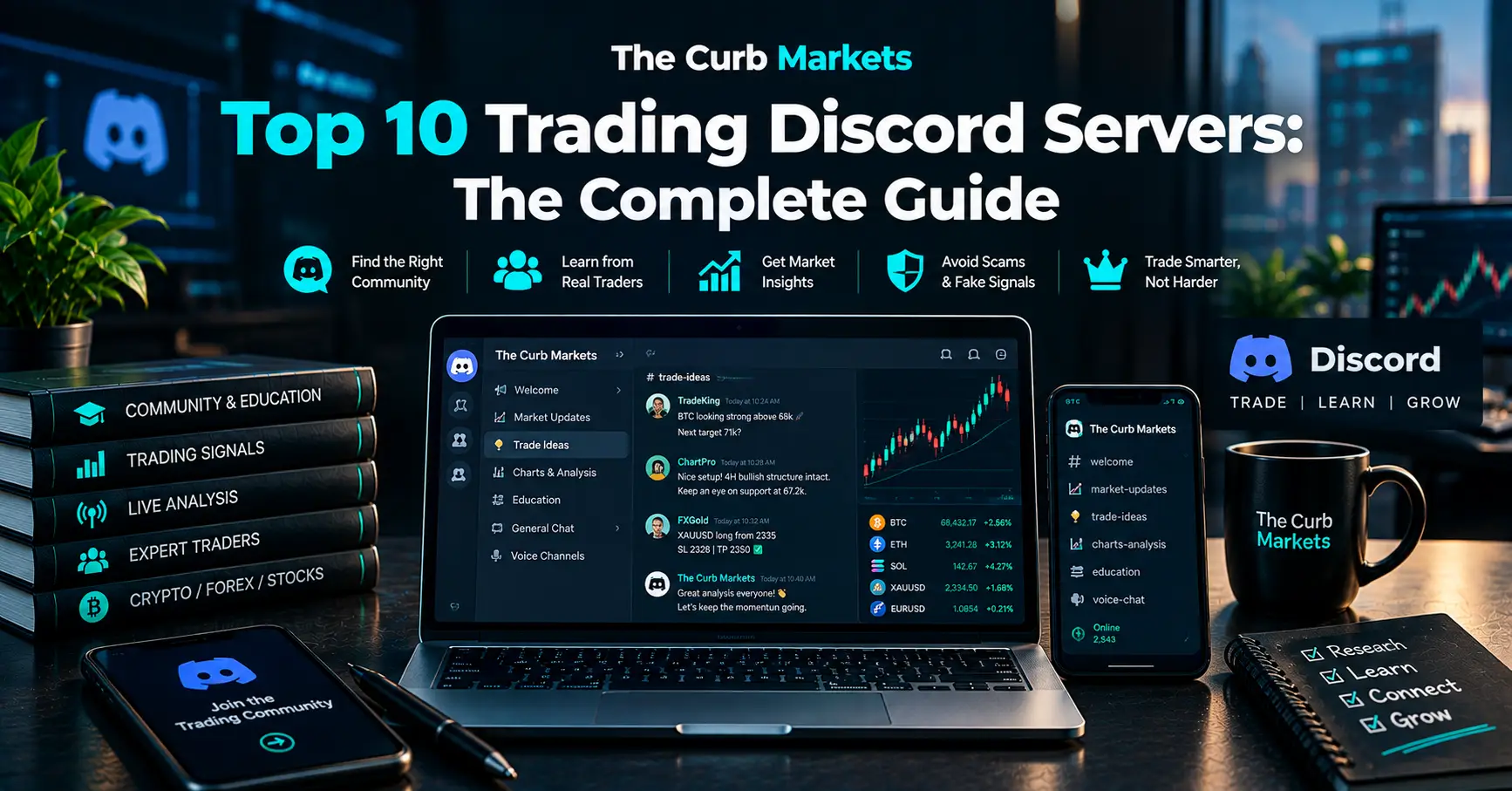
Top 10 Trading Discord Servers:
| Trading Discord | Market | Join Server |
|---|---|---|
| The Curb Markets | Crypto / Forex | Join → |
| Wealth Group | Crypto | Join → |
| The Traveling Trader | Stocks / Investing | Join → |
| Team Bull Trading | Trading / Stocks | Join → |
| Kaizen | Crypto | Join → |
| Options Insider | Stocks / Futures | Join → |
| Crystal Academy | Trading / Forex | Join → |
| Learn to Trade Community | Forex / Futures / Stocks | Join → |
| American Dream Trading | Stocks / Options | Join → |
What Is a Trading Discord Server?
A trading discord server is a Discord community organized around trading financial markets, stocks, options, forex, futures, or cryptocurrency. Unlike a general finance forum or subreddit, a trading server discord setup typically has a specific set of features that make it feel closer to a live trading floor than a discussion board:
- Real-time text and voice channels where members talk through setups, post charts, and react to markets as they move
- Live-stream or screen-share channels, sometimes with a moderator trading live during market hours
- Role-based access tiers, where free members can see a limited set of channels and paying members unlock “premium” signal or analysis channels
- Bot-delivered alerts, where a bot automatically posts price alerts, trade signals, or notifications into a channel
The format spans a wide range. At one end are free, volunteer-run community hubs where people just discuss the market together. At the other end are paid signal services run almost like a subscription product, and prop-firm-linked servers built around a specific funded-trading program. In between is basically everything else, free entry with a paid upsell, “education” branding on what’s really a signal shop, and every hybrid you can imagine.
Knowing which type of server you’re actually looking at is the first step toward evaluating it honestly, which is the focus of the next section.
Types of Trading Discord Servers
Not every trading discord server is built the same way or serves the same purpose. Before you can vet one, it helps to know which category it falls into, because the risks, and what’s reasonable to expect — differ by type.
Educational/Community Servers
These servers are organized primarily around teaching and discussion rather than delivering trade calls. A genuine discord trading community in this category focuses on explaining why a trade idea makes sense — the technical setup, the fundamental catalyst, the risk management, instead of just telling members what to buy and when. The strongest ones tend to have structured content: beginner channels, pinned glossaries, recorded lessons, and moderators who actually answer questions rather than just dropping calls.
The best trading server discord communities in this category treat trading as a skill worth building, not a product worth selling. That distinction is arguably more important than anything else in this guide.
Signal and Alert Servers
These servers exist primarily to deliver discord trading signals, specific buy/sell alerts, often including an entry price, a profit target, and a stop-loss. Some are free (usually functioning as a funnel toward a paid tier). Others are paid membership tiers from the outset, with monthly fees ranging from a few dollars to several hundred.
Signal servers aren’t automatically bad, but they concentrate a lot of trust in a signal provider you frequently have no way to independently verify. We go into this in detail in Section 4.
Prop Firm–Linked Servers
A growing share of trading discord servers are tied to a prop firm Discord, a community built around a proprietary trading firm’s funded-account evaluation program. These typically blend community discussion with content aimed at helping members pass a firm’s specific challenge structure. Some are run directly by the firm; others are independent communities that have formed around a particular firm’s program.
Because these servers are connected to a business relationship — and sometimes to affiliate commissions tied to new evaluation sign-ups — it’s worth checking whether the server’s enthusiasm for a given firm reflects genuine experience or a financial incentive.
Discord Servers for Trading Stocks
Servers focused specifically on equities, day trading, swing trading, or options on individual names, make up some of the most common discord trading channels around. These range from large, loosely-moderated free communities to small, tightly-run paid groups. Because stock trading is heavily influenced by earnings, news flow, and broader market conditions, the better servers in this category put as much emphasis on risk management and position sizing as they do on picks.
Forex- and Crypto-Focused Servers
Forex and crypto discord trading groups warrant a specific warning. Forex servers often lean heavily on prop-firm evaluation marketing (see above), while crypto-focused servers carry meaningfully higher pump-and-dump risk. Low-liquidity tokens can be moved significantly by a coordinated group of buyers, which means a crypto trading discord server with a large, active membership has both the means, and, in the worst cases, the incentive, to hype a token that insiders already hold, then sell into the demand that hype creates. This dynamic is well documented across crypto markets generally, but Discord’s real-time, large-audience format makes it a particularly effective distribution channel for it.
| Server Type | Primary Purpose | Typical Cost | Notable Risk |
|---|---|---|---|
| Educational/Community | Teaching, discussion | Free to low-cost | Quality varies widely |
| Signal/Alert | Delivering trade calls | Free (funnel) to $$$/month | Cherry-picked track records |
| Prop Firm–Linked | Evaluation support + community | Free to paid, tied to firm fees | Affiliate incentive bias |
| Stock-Focused | Equity trade ideas, discussion | Free to paid | Overreliance on picks vs. skill |
| Forex/Crypto | Signals, evaluation prep, token calls | Free to paid | Pump-and-dump (crypto), unregulated brokers (forex) |
Discord Trading Signals: What They Are and How They Work
A discord trading signal is a specific, actionable trade idea posted into a channel, typically naming an asset, a direction (buy/sell, long/short), and usually an entry price, a target, and a stop-loss. Signals can be posted manually by a moderator or signal provider, or automatically by a bot tied to a strategy or algorithm.
On the surface, a signal is a shortcut: someone else does the analysis, and you get the output. In reality, how much that shortcut is worth depends entirely on the honesty and skill of whoever, or whatever, is generating it, and that’s exactly what most people skip checking.
Free vs. Paid Signals
Discord trading signals free of charge are everywhere, and it’s worth understanding why. Free signal channels frequently act as a funnel: they exist to demonstrate a track record (real or curated) and build trust, with the expectation that a meaningful portion of free members eventually upgrade to a paid tier for “better” or more frequent calls. That doesn’t automatically make the free signals worthless, but it does mean the free channel’s real purpose is often marketing rather than education.
At the same time, paying for signals is no guarantee of quality. A paid membership tier can just as easily wrap a mediocre or dishonest provider in more professional-looking packaging. Price alone is not a reliable indicator of legitimacy here.
The Problem With “Free” Signal Servers
This is the single most important honesty point in this guide, so we’ll be direct about it instead of vague.
Cherry-picked results are the norm, not the exception. Many free signal channels showcase only their winning calls, often via win-rate screenshots drawn from a much larger, unshown pool of results. A channel that posts ten “wins” a week but never mentions the trades that hit stop-loss isn’t giving you an honest picture of performance, it’s giving you a highlight reel.
Some signals are effectively delayed until the move is already visible. A subset of “free” providers post alerts only after a price move has already begun, sometimes labeling it as a fresh signal. This isn’t always intentional, reaction lag happens, but in servers where it’s a consistent pattern, the effect is similar to front-running: the provider (or an inner circle) captures the real edge, and the wider channel gets a signal that looks timely but isn’t.
Many free servers exist purely to build an audience for a paid upsell. A free tier’s engagement, hype, and apparent win rate function, in practice, as the marketing asset. If a server’s free content consistently nudges you toward urgency, “last few spots,” “results speak for themselves,” “join before the next call” — instead of toward genuine understanding, that’s a signal worth noticing, just not the kind you want to trade on.
None of this means every free signal server is a scam. It means unverified win-rate claims deserve real skepticism, and a server’s transparency about its losses should carry far more weight than its enthusiasm about its wins.
Discord Trading Bots
Discord trading bots automate parts of the signal or alert process, and they vary widely in both function and risk.
Alert and Price Bots
The simplest category: bots that post a notification when a price crosses a threshold, when volume spikes, or when a technical condition triggers. These are largely informational, they tell you something happened, not what to do about it. Risk here is low; functionally, the bot is an automated version of a price alert you could set yourself.
Signal Delivery Bots
A step up in complexity: bots that post fully-formed trade signals, generated either by a human moderator feeding input into the bot or by an underlying algorithm. These carry the same risks as manually posted signals, plus an added layer of opacity — you generally can’t inspect the logic behind the signal, so you’re trusting both the strategy and whoever built it.
Auto-Trading/Execution Bots
This is the highest-risk category, and it deserves a clear warning: auto-trading bots execute trades directly on your account without you reviewing each one. That means real capital is tied to unreviewed third-party code and unreviewed third-party signals, with no human judgment in between. If the underlying strategy is flawed, the bot has a bug, the API connection misbehaves, or the signal source is compromised or dishonest, losses can pile up before you notice. Auto-execution removes exactly the layer of judgment that would otherwise catch a bad trade — treat any server pushing this setup with extra scrutiny, and never connect live brokerage credentials to a bot you haven’t independently vetted.
How to Choose a Trading Discord Server
This is the section worth saving. Whatever type of server you’re evaluating, educational, signal-based, prop-firm-linked, stock-focused, or forex/crypto, the same signs of legitimacy and the same red flags apply.
Signs of a Legitimate, Trustworthy Server
- A transparent track record that includes losses, not just wins. A server willing to show a losing trade right next to its winners is telling you something true about itself.
- Identifiable moderators with some kind of verifiable background, rather than anonymous accounts with no history and no way to check their claims.
- Education that explains reasoning, not just outcomes. Look for content that walks through why a setup was taken, the thesis, the risk, the invalidation point, rather than just “buy here, sell here.”
- No pressure toward a specific unregulated broker. A legitimate server has no reason to insist you fund a specific offshore or unregulated broker in order to participate.
- Realistic risk language. Genuine traders talk openly about probabilities, drawdowns, and the fact that losses are a normal part of trading. If nobody ever mentions risk, take note.
Red Flags of Scam or Low-Quality Servers
- Guaranteed or unrealistic returns. No legitimate signal provider can guarantee a specific return. Markets simply don’t work that way, and anyone claiming otherwise is either lying or doesn’t understand risk.
- Cherry-picked wins with no visible losses. If a server’s public track record looks suspiciously clean, ask to see the losses. A refusal, deflection, or vague non-answer is a genuine red flag.
- Urgency and scarcity pressure tactics. “Only 5 spots left,” “price goes up at midnight,” “last chance before the next call”, these are sales tactics lifted straight from other high-pressure marketing, and they have nothing to do with trading skill.
- Anonymous, unverifiable moderators. Especially in a paid server, it’s fair to expect that whoever is taking your money and shaping your financial decisions has some kind of verifiable identity or track record.
- Requests for payment outside Discord’s normal flow. Be cautious of anyone asking for direct crypto transfer, peer-to-peer app payment, or gift cards instead of a standard, traceable payment method with some recourse if things go wrong.
- Requests to share credentials or screen-share a live brokerage session. No legitimate signal provider, moderator, or “mentor” needs your brokerage login, your two-factor codes, or a live screen-share of a funded account. This is one of the clearest scam indicators in the entire space, treat it as disqualifying, no exceptions.
Discord Trading Servers for Beginners: What to Prioritize
If you’re new to trading, the natural instinct is to search for the server with the best-sounding signals. Resist that instinct. Education over signals should be the priority, for a simple reason: a server that explains its reasoning teaches you a transferable skill you’ll use for the rest of your trading life. A signal-only server teaches you dependency, you’re handed a fish, never a fishing lesson, and you never build the judgment to recognize when a signal (from that server or anywhere else) doesn’t add up.
When evaluating discord trading servers for beginners specifically, look for:
- Dedicated beginner channels, separate from the fast-moving, jargon-heavy channels experienced traders use
- Patient moderation — moderators willing to answer basic questions without condescension
- A welcoming culture, rather than one that treats questions as an interruption
- No pressure to trade live early. A genuinely beginner-friendly server encourages paper trading or small position sizes while you learn, rather than pushing you toward real capital and live signals from day one
Whatever server you’re considering, and no matter how legitimate it looks, start with a free tier or trial period if one’s available. Apparent legitimacy, polished branding, a professional-looking website, a large member count, is not the same thing as verified legitimacy. A trial period costs you nothing but time, and it lets you judge actual content quality before any money changes hands.
Categories of Well-Known Trading Communities
We’re deliberately not naming specific servers here, for the same reasons outlined at the top of this guide: this space moves quickly, unverifiable claims about individual communities are exactly the kind of content already cluttering search results, and any specific list published today could be inaccurate within months as servers rebrand, shut down, or change hands.
Instead, here’s a general map of the recognizable categories you’re likely to run into:
- Large forex education communities built around structured courses, live trading rooms, and often a tie-in to prop firm evaluation programs
- Prop-firm evaluation communities, sometimes run directly by a funded-trading firm, focused on helping members pass a specific challenge structure
- Options and day-trading stock communities, often centered around a small number of high-profile moderators with an active live-trading or screen-share culture
- Crypto signal and alpha-call communities, typically organized around fast-moving token calls and higher membership turnover
- General finance/investing communities broader than pure trading, blending long-term investing discussion with more active trading content
If you come across a specific server in any of these categories — through a friend, a YouTube video, an ad, or anywhere else, treat any claims about it (membership size, win rate, results, pricing) as unverified until you’ve checked them yourself using the framework in Section 6. Screenshots and testimonials are trivially easy to fabricate or curate, and even genuine ones tell you very little about what’s likely to happen to your own capital going forward.
Are Discord Trading Signals Worth Following?
The honest answer sits in the middle, and anyone giving you a confident yes or no probably has something to sell you (in the “yes” case) or hasn’t looked closely at the space (in the “no” case).
Some traders genuinely do profit from following signals, particularly when they treat signals as one input among several rather than as an instruction to execute blindly. A signal that lines up with a trader’s own read of the market, and that gets sized and risk-managed like any other trade, can be a legitimately useful source of ideas.
Where it breaks down is when signals get followed mechanically, copy trading a call the moment it posts, with no independent analysis and no personal risk assessment. That approach hands your capital’s fate entirely to someone else’s judgment: someone you typically can’t verify, and have no real recourse against if they turn out to be wrong, careless, or dishonest.
Treat signals as ideas to validate, not instructions to execute. If a signal doesn’t hold up once you look at the chart or the news yourself, that mismatch is worth taking seriously, even if the person posting it has a large following.
And as covered above: self-reported win rates with no visible losses deserve real skepticism. Ask how the number was calculated, over what time period, on what sample size, and whether losing trades are included. A provider who’s unwilling or unable to answer clearly is telling you something.
Risks of Trading Discord Communities
Beyond the scam-specific red flags already covered, there are structural risks worth understanding even when a server is acting in good faith:
- Pump-and-dump risk, especially in crypto servers, where a large, coordinated audience can be used to move a low-liquidity token’s price before insiders sell into the resulting demand
- Fake or cherry-picked track records, which can make a mediocre or losing strategy look consistently profitable
- Pressure toward unregulated brokers, sometimes tied to affiliate arrangements that benefit the server rather than you
- Overtrading, driven by a constant stream of alerts that can push members to trade far more frequently than their strategy or risk tolerance actually supports
- Capital loss risk regardless of signal source. Even a well-run, honest, transparent server cannot guarantee a winning trade. Markets involve genuine uncertainty, and any signal — free or paid, from a stranger or a professional — can turn out wrong.
This article is educational content, not financial advice. No signal, moderator, bot, or community — however well-vetted — can guarantee results. Trading carries real risk of loss, and you should never risk money you can’t afford to lose based on a Discord signal or anyone else’s trade idea.
How to Stay Safe in Trading Discord Servers
A short, concrete safety checklist, worth revisiting periodically as you use any trading discord server:
- Never share brokerage credentials or screen-share a live trading session with a moderator, “mentor,” or fellow member, no matter how trustworthy they seem
- Never send money directly to an individual outside normal, traceable payment flows — that includes peer-to-peer apps, direct crypto wallet transfers, and gift cards
- Enable two-factor authentication everywhere — your Discord account, your email, and especially your brokerage or exchange accounts
- Independently verify any claimed credentials, licenses, or track records rather than taking a bio or a pinned message at face value
- Treat urgency and pressure tactics as a red flag regardless of context. Even in a server that otherwise seems legitimate, a sudden push toward “act now” behavior is worth pausing on
Frequently Asked Questions
Are trading Discord servers legit?
Some are, many aren’t, and most fall somewhere in between. Legitimacy varies enormously by individual server, not by the category as a whole. Use the vetting framework in this guide — transparent track records, identifiable moderators, realistic risk language, and no pressure tactics — rather than assuming legitimacy from member count or marketing polish alone.
Are free trading signals reliable?
Reliability varies widely, and free signals in particular warrant caution, since many exist primarily as a funnel toward a paid tier. Some free signal channels are genuinely useful; others lean on cherry-picked results. Check whether losses are shown alongside wins before trusting a free channel’s track record.
Should beginners join a paid trading Discord?
Not as a first step. Beginners are generally better served starting with free tiers or trial periods, and prioritizing education-focused servers over signal-only ones, before committing to a paid membership.
Can you make money from Discord trading signals?
Some traders do, typically by treating signals as one input to validate against their own analysis rather than instructions to follow blindly. Mechanically copy-trading signals without independent judgment is a much riskier approach and isn’t a reliable path to consistent profit.
How do I know if a trading Discord is a scam?
Watch for the red flags covered in Section 6: guaranteed returns, cherry-picked wins with no losses shown, urgency and scarcity pressure, anonymous unverifiable moderators, off-platform payment requests, and any request to share brokerage credentials or screen-share a live account. Any one of these deserves real caution; several together is a strong signal to leave.
Are trading bots on Discord safe to use?
It depends on the type. Alert and price bots are generally low-risk since they only provide information. Signal delivery bots carry the same risks as manually posted signals. Auto-trading/execution bots are the highest risk, since they tie real capital to unreviewed code and signals with no human review in between.
What’s the difference between a trading discord community and a signal server?
A community-focused server emphasizes discussion, education, and shared learning, with trade ideas as one part of a broader conversation. A signal server is built specifically around delivering actionable trade calls, often with a paid tier for more frequent or “premium” signals. Many servers blend both models to some degree.
Do I need a paid membership to learn trading on Discord?
No. Plenty of free, education-focused discord trading channels exist, and starting there, while treating any eventual paid upgrade with the same scrutiny as a first-time purchase, is a reasonable way to evaluate a community before spending money.
Conclusion
Trading discord servers aren’t inherently good or bad, the format itself is neutral. What matters is which specific server you’re looking at, and whether it earns your trust through transparency or tries to manufacture trust through marketing. The best trading discord servers are the ones that are honest about their losses, that teach reasoning instead of just handing out alerts, and that never lean on urgency or guaranteed-return language to get you to act.
If you take one thing from this guide, let it be the vetting framework in Section 6. Apply it to any server, free or paid, educational or signal-based, stock-focused or crypto-focused — before you commit any time or money. Ask to see the losses, not just the wins. Check whether the moderators are identifiable. Notice whether the culture pushes patience or pressure.
This guide is educational content, not financial advice, and no trading discord server, however well-vetted, can guarantee your results. But a little skepticism, applied consistently, will do more to protect your capital than any signal ever will.