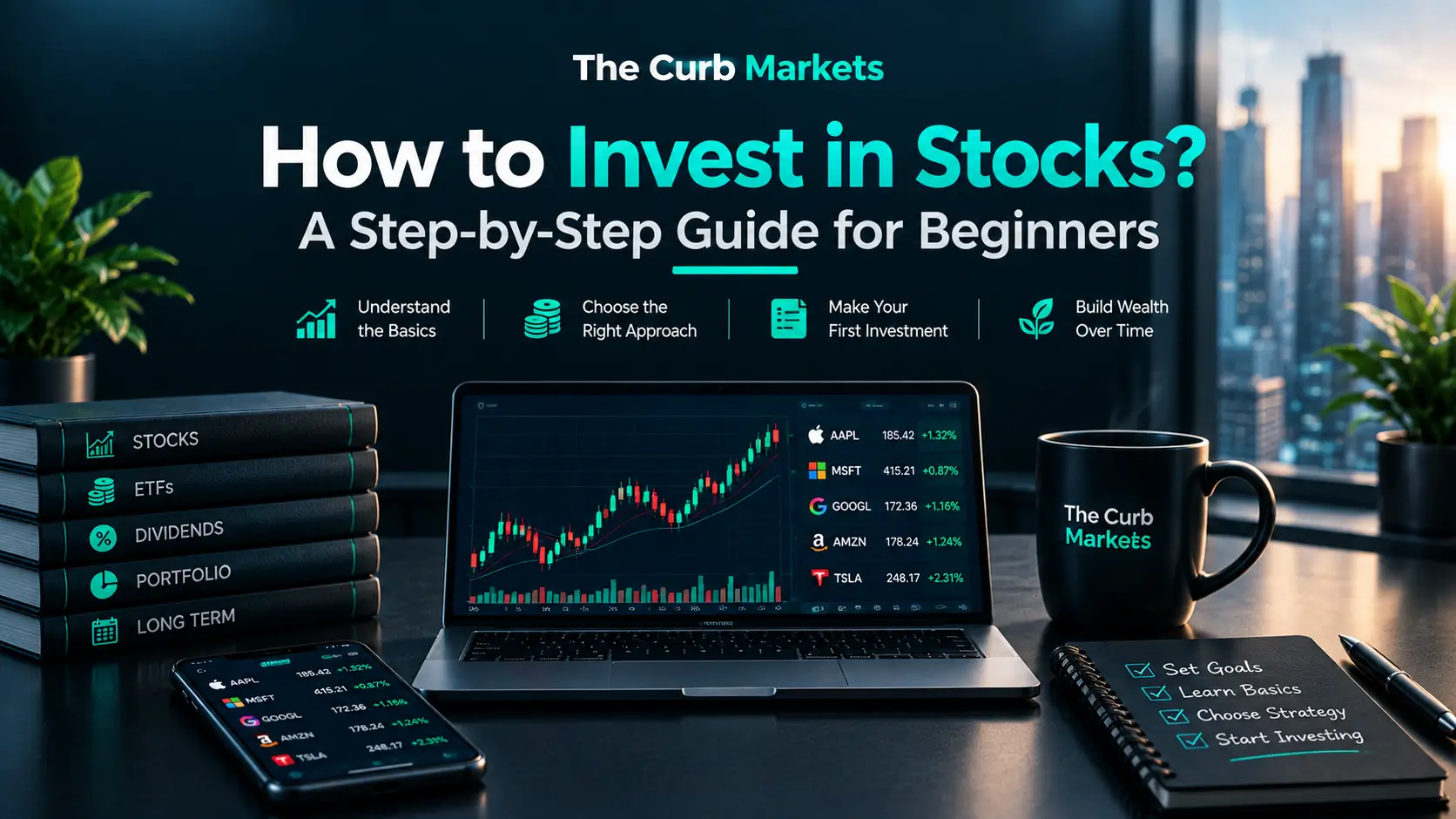
Investing in stocks sounds complicated before you actually do it. Between unfamiliar terms like “ETFs,” “dollar-cost averaging,” and “asset allocation,” it’s easy to assume you need a finance degree just to open an account. You don’t.
The truth is that learning how to invest in stocks is far less about mastering complex math and far more about understanding a handful of core concepts, picking an approach that fits your goals, and then staying consistent over time. The jargon is the hard part, not the actual process.
This guide breaks down how to invest in stocks into clear, sequential steps, starting from the very basics: what investing actually means, how much money you need to get started, and how to make your first purchase. It’s written specifically for people starting from zero, including those who want to begin with a small amount of money rather than a large lump sum. By the end, you’ll have a concrete framework you can act on this week, not just a list of abstract principles.
What Does It Mean to Invest in Stocks?
When you buy a share of stock, you’re purchasing a small piece of ownership in a company. If the company grows and becomes more valuable, the value of your shares generally rises along with it. If the company struggles, the value of your shares can fall. As a shareholder, you may also be entitled to a portion of the company’s profits, paid out as dividends, depending on whether that company chooses to distribute them.
This is different from trading, which is a shorter-term activity focused on buying and selling stocks quickly to profit from price movements. Trading requires constantly watching the market, reacting to news, and accepting higher risk in exchange for the possibility of faster gains, or faster losses.
Investing, by contrast, is generally a longer-term activity. Instead of trying to predict short-term price swings, investors buy shares of companies (or funds made up of many companies) with the intention of holding them for years, allowing the value to grow over time. This guide focuses on investing, not day trading or short-term speculation, because for the vast majority of beginners, a long-term approach is both simpler to execute and more forgiving of mistakes.
Why Invest in Stocks?
The main reason people invest in stocks is to build wealth over the long run. Historically, stocks have offered higher average returns than savings accounts or bonds over long time periods, though this is not guaranteed and past performance never predicts future results.
The engine behind long-term stock investing is compounding. When you earn returns on your investment, and then those returns start earning their own returns, growth can accelerate over time. This is often summarized as “compound interest,” although with stocks it’s more accurately compounding returns rather than interest, since returns include both price appreciation and any dividends reinvested.
Consider it conceptually: a modest amount invested consistently and left to grow for decades has the potential to become substantially larger than the same amount stuffed under a mattress or left in a low-interest savings account, purely because of how compounding works over long stretches of time. The specific numbers depend entirely on market performance, which varies and can’t be predicted, so this guide won’t project specific dollar outcomes, but the underlying mechanism, time in the market working in your favor, is the core reason long-term investors accept some short-term volatility.
It’s worth being direct here: investing in stocks is not a guaranteed path to wealth, and it is not a substitute for having an emergency fund, paying down high-interest debt, or covering your basic financial needs first. It’s a tool for growing money you won’t need for several years, used alongside, not instead of, sound overall financial planning.
Another reason people invest in stocks specifically, rather than only saving cash, is inflation. Over time, the cost of goods and services tends to rise, which means cash sitting idle in a low-yield account can lose purchasing power even while the balance stays the same on paper. Stocks don’t guarantee protection against inflation in any given year, but over long periods, growth-oriented investments have historically had a better chance of outpacing inflation than cash alone, again, with no guarantee attached to any specific outcome.
How Much Money Do You Need to Start?
One of the most persistent myths about investing is that you need thousands of dollars to begin. This hasn’t been true for a while.
Thanks to fractional shares, the ability to buy a portion of a single share rather than a whole one, many brokerages now let you invest with as little as a few dollars. If a single share of a company costs $500, you might be able to buy $20 worth of it rather than needing the full amount.
Many brokerages have also eliminated account minimums and, for many types of trades, commission fees, meaning you may not need any minimum balance just to open an account. Fee structures and minimums do vary by brokerage and can change, so it’s worth checking a provider’s current terms directly before assuming a specific number applies.
What matters more than your starting amount is consistency. Someone who invests $50 a month for twenty years, without interruption, will very likely end up better off than someone who waits until they have $5,000 to “start properly“, because the second person loses years of potential compounding while waiting. If you’re learning how to invest in stocks for beginners with little money, the honest starting advice is: start with what you have, automate contributions if you can, and increase the amount as your income allows.
How to Invest in Stocks: Step-by-Step
Here is the full process for how to invest in the stock market step by step, from defining your goals to actually owning your first shares.
Step 1: Set Your Investment Goals
Before opening any account, get clear on what you’re investing for and when you’ll need the money. Someone saving for retirement in thirty years has a very different timeline, and can tolerate very different levels of risk — than someone saving for a house down payment in two years.
Write down, even informally:
- What you’re investing for (retirement, a future purchase, general wealth-building)
- Your time horizon (when you expect to need the money)
- Roughly how much you can realistically contribute on a regular basis
Money you’ll need within the next few years generally shouldn’t be in stocks at all, since short-term market volatility could force you to sell at a loss. Stocks are best suited to goals that are at least five years away, and ideally longer.
Step 2: Determine Your Risk Tolerance
Risk tolerance is your ability and willingness to withstand your investments losing value, sometimes sharply, without panic-selling. It’s shaped by two things: your financial situation (how much you can afford to lose without derailing your life) and your psychology (how you actually react when your account balance drops).
Someone with a stable income, an emergency fund already in place, and a long time horizon can generally afford to take on more risk than someone with unpredictable income and no cash cushion. Someone who checks their portfolio daily and feels sick at a 15% drop may need a more conservative mix than their financial situation alone would suggest, simply because panic-selling during downturns is one of the most common ways investors lock in real losses.
Be honest with yourself here. A portfolio you can’t emotionally stick with during a downturn isn’t the right portfolio for you, even if it’s theoretically “optimal” on paper.
Step 3: Choose the Right Type of Account
Where you hold your investments matters as much as what you invest in, largely because of how each account type is taxed. Here’s a comparison of the most common options:
| Account Type | Tax Treatment | Best For |
|---|---|---|
| Taxable Brokerage Account | No special tax advantages; you owe taxes on dividends and on capital gains when you sell | Flexible investing for any goal, with no withdrawal restrictions |
| Roth IRA | Contributions are made with after-tax money; qualified withdrawals in retirement are typically tax-free | People who expect to be in a similar or higher tax bracket in retirement, and want tax-free growth |
| Traditional IRA | Contributions may be tax-deductible now; withdrawals in retirement are generally taxed as income | People who want a potential tax break today and expect a lower tax bracket in retirement |
| 401(k) | Typically pre-tax contributions through an employer, lowering taxable income now; withdrawals taxed later (some employers offer a Roth 401(k) option) | Employees with access to a workplace plan, especially one with an employer match |
A note on specifics: contribution limits, income eligibility thresholds for IRAs, and employer-match structures for 401(k)s change periodically and vary by employer and income level. Rather than quoting figures here that could be outdated by the time you read this, check the current limits directly on the IRS website or with your plan provider before making contribution decisions.
If your employer offers a 401(k) match, it’s generally worth contributing at least enough to capture the full match before investing elsewhere, it’s typically treated as an immediate, guaranteed return on that portion of your contribution that’s hard to replicate anywhere else.
Step 4: Open a Brokerage Account
Once you know which account type fits your goal, you’ll need to open it through a brokerage, a platform that lets you buy and sell investments. This guide won’t recommend specific brokers, since offerings and pricing change frequently, but here’s what to compare when choosing one:
- Fees: Look for account maintenance fees, trading commissions, and fees for transferring money in or out. Many brokerages now offer $0 commissions on stock and ETF trades, but this isn’t universal.
- Account minimums: Some brokerages require no minimum deposit to open an account; others do. Confirm this before you start.
- Fractional share availability: If you want to invest small amounts into expensive stocks, confirm the brokerage supports fractional shares.
- Investment options: Make sure the brokerage offers the account type and investment types (individual stocks, ETFs, mutual funds) you’re planning to use.
- Ease of use and tools: Especially as a beginner, a clean interface and accessible educational resources can matter more than advanced trading features you won’t use yet.
- Customer support and reputation: Look for a regulated, established platform with a track record and responsive support.
You’ll typically need to provide personal identification, your Social Security number (or equivalent), and some basic financial information to open an account, as required by financial regulations.
Step 5: Decide Your Investing Approach
Broadly, you have two paths, and they aren’t mutually exclusive.
Do-it-yourself investing means you choose your own individual stocks, ETFs, or mutual funds and manage your portfolio directly. This gives you full control but requires more time, research, and comfort with decision-making.
Robo-advisors are automated platforms that build and manage a diversified portfolio for you based on your goals and risk tolerance, usually for a low annual fee. This is a hands-off option well-suited to beginners who want exposure to the market without picking individual investments themselves.
Many beginners land somewhere in between: using a robo-advisor or a small number of diversified index funds as their “core” holdings, while optionally exploring individual stocks with a smaller portion of their money as they learn.
Step 6: Fund Your Account and Make Your First Purchase
Transfer money into your new account, usually via a linked bank account. Most brokerages allow you to set up either a one-time transfer or a recurring automatic deposit, the latter is worth setting up early, since automating contributions removes the temptation to skip months or try to “time” your deposits around market conditions.
Once funds are available, you can place your first order. At a basic level, this involves:
- Searching for the stock, ETF, or fund by its ticker symbol
- Deciding how much to invest (in dollars, if fractional shares are supported, or in whole shares)
- Choosing an order type, a “market order” buys immediately at the current price, while a “limit order” only executes at a price you specify
- Reviewing and confirming the purchase
For a first purchase, many beginners choose a broad, diversified index fund or ETF rather than a single individual stock, since it immediately spreads risk across many companies rather than concentrating it in one.
Step 7: Diversify Your Portfolio
Diversification means spreading your money across different investments so that poor performance in any single one doesn’t sink your entire portfolio. This is one of the most important risk-management tools available to investors, and it’s largely free, it doesn’t cost extra to be diversified, it just requires intentional allocation.
Diversification can happen across several dimensions:
- Across companies: owning many companies instead of just one or two
- Across sectors: technology, healthcare, energy, consumer goods, and so on, rather than concentrating in a single industry
- Across asset types: stocks, bonds, and sometimes other assets, balanced according to your risk tolerance and timeline
- Across geography: domestic and international holdings, rather than only companies from one country
For most beginners, a broad index fund or ETF already provides substantial diversification in a single purchase, since it holds dozens, hundreds, or even thousands of underlying companies. Asset allocation, the specific mix of stocks, bonds, and other assets in your portfolio, should generally shift to become more conservative as you get closer to needing the money.
Step 8: Monitor and Rebalance Over Time
Investing isn’t entirely “set it and forget it,” but it also shouldn’t mean checking your account daily. A periodic check-in, quarterly or annually for most long-term investors, is generally sufficient.
Over time, some investments in your portfolio will grow faster than others, which can shift your intended allocation. For example, if stocks perform particularly well, they might grow from 70% of your portfolio to 80%, increasing your risk beyond what you originally intended. Rebalancing means periodically buying or selling to bring your portfolio back to your target allocation.
Rebalancing isn’t about reacting to short-term news or trying to guess market direction, it’s a disciplined, periodic adjustment based on your original plan, not a reaction to headlines.
Individual Stocks vs. ETFs vs. Mutual Funds
Understanding the differences between these three main investment types will help you decide how to build your portfolio.
Individual stocks:
- Represent ownership in a single company
- Offer the highest potential for both gains and losses, since your outcome depends entirely on that one company
- Require the most research and ongoing attention to understand the business, its industry, and its risks
- Provide no built-in diversification, owning one or a handful of stocks concentrates your risk
ETFs (exchange-traded funds):
- Bundle many stocks, bonds, or other assets into a single investment that trades like a stock throughout the day
- Offer instant diversification, since a single ETF can hold dozens to thousands of underlying securities
- Typically have low fees, especially for funds that passively track an index rather than being actively managed
- Come in many varieties, from broad market index ETFs to sector-specific or thematic ETFs, which vary widely in risk and diversification
Mutual funds:
- Similar in concept to ETFs in that they pool money to invest in a diversified basket of securities
- Traditionally priced and traded only once per day, after markets close, unlike ETFs which trade throughout the day
- May carry higher fees than comparable ETFs, particularly if actively managed, though low-cost index mutual funds also exist
- Sometimes have minimum investment requirements that ETFs don’t
Index funds deserve a specific mention: whether structured as an ETF or a mutual fund, an index fund simply aims to match the performance of a market index (like a broad U.S. stock market index) rather than trying to beat it. Because they’re passively managed, they tend to have very low fees, and they’re a common starting point for beginner investors precisely because they offer broad diversification without requiring stock-picking skill.
The trade-off across all three, in short: individual stocks require the most research and carry the most concentrated risk but offer full control; ETFs and index funds trade some of that control for built-in diversification and generally lower ongoing effort; actively managed mutual funds add professional management on top of diversification, generally at a higher fee, with no guarantee that active management will outperform a comparable index fund over time.
A practical way to think about it: if you enjoy researching companies, reading earnings reports, and following specific industries closely, individual stocks can be a rewarding (if riskier) part of a portfolio. If you’d rather not spend your evenings analyzing balance sheets, ETFs and index funds let you participate in the market’s long-term growth without needing to become an amateur analyst. Many experienced investors use a blend, a diversified core of ETFs or index funds, supplemented by a smaller allocation to individual stocks they’ve researched and feel strongly about.
It’s also worth understanding expense ratios, the annual fee expressed as a percentage of your investment that funds charge to cover management costs. A fund with a 0.03% expense ratio costs $3 per year for every $10,000 invested; a fund with a 1% expense ratio costs $100 for the same amount. That difference seems small year to year, but compounded over decades, higher fees can meaningfully erode returns, which is a major reason low-cost index funds have become a popular default choice for long-term investors.
How to Invest in Stocks and Make Money: Strategies That Work
Before covering specific strategies, an important caveat: there is no guaranteed way to make money in the stock market. Every strategy described here manages risk and improves the odds of long-term success, none of them eliminates the possibility of loss. Anyone who promises guaranteed stock market returns is not being straight with you.
With that said, several strategies have a strong track record of supporting long-term investors:
Dollar-cost averaging means investing a fixed amount of money at regular intervals, say, monthly, regardless of whether the market is up or down. Because you’re buying consistently, you end up purchasing more shares when prices are low and fewer when prices are high, which averages out your purchase price over time and removes the pressure of trying to time the market.
Buy-and-hold investing is exactly what it sounds like: purchasing quality investments and holding them for years or decades rather than frequently trading in and out. This approach benefits from long-term compounding, avoids the higher costs and tax consequences of frequent trading, and sidesteps the well-documented tendency of frequent traders to underperform the market by trying to time it.
Dividend reinvestment means automatically using any dividends your investments pay out to purchase additional shares rather than taking the cash. Over long periods, reinvested dividends can meaningfully contribute to total returns, since each reinvestment buys more shares, which can then generate their own dividends, another expression of compounding at work.
None of these strategies require predicting short-term market movements, which is precisely why they’re accessible to beginners. The common thread across all of them is time and consistency, not timing or cleverness.
Common Beginner Mistakes to Avoid
Even a solid strategy can be undermined by avoidable errors. Here are the mistakes that trip up new investors most often:
- Trying to time the market. Attempting to predict short-term highs and lows to buy low and sell high sounds appealing, but consistently and accurately timing the market is exceptionally difficult, even for professionals. Missing just a handful of the market’s best days, which often cluster near its worst days, can significantly reduce long-term returns.
- Over-concentration in a single stock. Putting a large share of your portfolio into one company, even one you feel confident about, exposes you to risk that diversification could have easily reduced.
- Investing money you’ll need soon. Money for near-term expenses or emergencies shouldn’t be exposed to stock market volatility. Keep short-term funds in cash or cash-equivalent accounts instead.
- Letting emotions drive decisions. Panic-selling during downturns and chasing hot stocks during rallies are both ways investors buy high and sell low — the opposite of the goal. A written plan, decided on in advance, helps you stay the course when emotions run high.
- Ignoring fees. Small percentage fees on funds or accounts may look insignificant, but compounded over decades, they can meaningfully reduce your total returns. Comparing fee structures before choosing investments and accounts is worth the effort.
- Not diversifying. Whether through owning too few individual stocks or by skipping diversification across sectors and asset types altogether, concentrated risk is one of the most common and avoidable mistakes new investors make.
Risks of Investing in Stocks
Stocks offer growth potential, but that potential comes paired with real risk. Understanding these risks is part of investing responsibly, not a reason to avoid investing altogether.
Market risk refers to the fact that stock prices fluctuate, sometimes significantly, based on economic conditions, company performance, interest rates, and countless other factors — many of which are unpredictable.
Bear markets, generally defined as a sustained decline of 20% or more from recent highs, happen periodically and are a normal, if uncomfortable, part of investing over the long run. Bull markets, extended periods of rising prices, tend to follow, though the timing and duration of both are unpredictable.
Individual company risk is the added risk that comes from owning a small number of individual stocks rather than a diversified fund — a single company can underperform or fail entirely, regardless of how the broader market is doing.
Volatility in the short term is normal and expected, even in a portfolio that performs well over the long run. A portfolio can be down significantly in a given year and still deliver strong average annual returns over a decade or more.
Liquidity risk is generally low for publicly traded stocks and ETFs, since shares of major companies and funds can typically be bought and sold easily during market hours. This is worth noting mainly by contrast: less liquid investments, such as real estate or shares in a private company, can be harder to convert to cash quickly if you need the money unexpectedly.
Sequence-of-returns risk matters most for people nearing or in retirement: a market downturn that happens right before or during the years you begin withdrawing money can have an outsized impact compared to the same downturn happening earlier in your investing timeline, since you’re forced to sell shares at a lower value to cover expenses. This is one reason portfolios are often shifted toward a more conservative allocation as retirement approaches.
None of this means investing is reckless, it means investing carries genuine risk that should be sized appropriately to your goals, timeline, and ability to withstand losses.
A note on this guide: This article is intended for general educational purposes only and does not constitute personalized financial, investment, tax, or legal advice. Investing involves risk, including the potential loss of principal, and past performance does not guarantee future results. Consider speaking with a licensed financial advisor about your individual circumstances before making investment decisions.
Frequently Asked Questions
How do I start investing in stocks with little money?
Open a brokerage account with no minimum balance requirement, look for one that offers fractional shares, and start with whatever amount you can afford — even a small recurring monthly contribution. Consistency matters more than your starting amount.
What’s the safest way to invest in stocks for beginners?
There’s no investment that’s entirely without risk, but broadly diversified index funds or ETFs, held for the long term, are generally considered a lower-risk way to gain stock market exposure compared to concentrating your money in individual stocks.
How much should a beginner invest in stocks?
This depends on your income, expenses, existing debt, and emergency savings. A common approach is to first build an emergency fund and pay down high-interest debt, then invest an amount you can contribute consistently without affecting your ability to cover near-term expenses.
How much money do I need to start investing?
Many brokerages now allow you to open an account and begin investing with no minimum deposit, and fractional shares let you invest with just a few dollars. There’s no universal minimum, what matters more is starting and staying consistent.
What is the best way to invest in stocks as a complete beginner?
For most beginners, a diversified, low-cost index fund or ETF combined with a consistent contribution schedule (dollar-cost averaging) offers a simpler and generally more manageable starting point than picking individual stocks.
Can I lose all my money investing in stocks?
It’s possible to lose your entire investment in a single stock if that company fails, which is one reason diversification matters. Losing your entire investment in a broadly diversified fund tracking the overall market is far less likely, though it’s still possible to lose a significant portion of your investment’s value, especially over short time periods.
What’s the difference between a robo-advisor and a financial advisor?
A robo-advisor is an automated platform that builds and manages a diversified portfolio based on algorithms, typically at a low annual fee and with little or no human interaction. A traditional financial advisor is a person who can offer personalized guidance across your broader financial picture, taxes, estate planning, complex situations, usually at a higher cost. Many beginners start with a robo-advisor or self-directed index fund investing and consider a human advisor later as their finances become more complex.
Should I invest in stocks or pay off debt first?
This depends on the type of debt. High-interest debt, such as most credit card debt, often carries a cost that exceeds likely investment returns, so many financial professionals suggest prioritizing that debt before investing heavily. Lower-interest debt is more of a personal judgment call, and this decision should be weighed against your full financial picture.
How long should I hold my stock investments?
For goals tied to long-term investing, such as retirement, many investors hold their core investments for years or decades, in line with a buy-and-hold approach. Money needed within the next few years generally shouldn’t be invested in stocks at all.
Stay informed with real-time financial market updates by following Marcus on X (formerly Twitter).
Conclusion
Learning how to invest in stocks doesn’t require predicting the market, having a finance background, or starting with a large sum of money. It requires a clear goal, an honest read on your risk tolerance, the right account, a diversified starting point, and, more than anything else, consistency over time.
Start with what you can, automate your contributions where possible, resist the urge to react to short-term market swings, and revisit your plan periodically rather than constantly. The specific numbers in your account will fluctuate; the discipline behind your approach is what compounds.
If you’re ready to take the next step, consider researching a brokerage that fits the criteria covered in this guide, or speak with a licensed financial advisor to build a plan tailored to your specific situation.